Beer cooler sous-vide
My two favorite avocations are music and cooking; I have found that camping at music festivals in Bertha Bus, my mobile kitchen, gives me the perfect opportunity to enjoy both. Over the years, as my meal preparations have become more elaborate and time consuming, I have often missed my favorite performers because I can’t leave my fire unattended. If I wait until the day’s music is over, I’m cooking in darkness with unpredictable results. So this summer I have been focusing on cooking techniques that allow me to leave the campsite for a 90-minute music set while my food is cooking.
This past Labor Day weekend at Shoefest Music Festival in Manteno, I conducted a series of scientific experiments to see if I could prepare properly cooked, delicious main courses with minimal attention while drinking beer and wandering off to hear the bands on the stage. My tasting panel was composed of some of the hungry tie-dyed hippie music festival veterans who tend to congregate around Bertha Bus at meal times.
Sous-vide (French for “under vacuum”) is a cooking technique used in upscale restaurants in which food is sealed in an airtight plastic bag and cooked in a water bath at low temperatures for long periods of time. The resulting item is evenly cooked, tender and moist. Steaks can be held for several hours in the water bath and when the time is right, quickly seared in a cast iron pan or on a grill to create a nice crust.
Commercial sous-vide units are quite pricey and consist of an immersion circulator, which is placed into a tub of water to maintain an exact and constant temperature. The continuously circulating water cooks the food slowly and evenly. Also required is a vacuum-sealer to package the food in a watertight, air-free environment so that the food does not float to the top. A typical setup could cost over $500 and requires electricity. This is out of the price range of Bertha Bus’s R and D budget and music festival camping rarely has electric hookups.
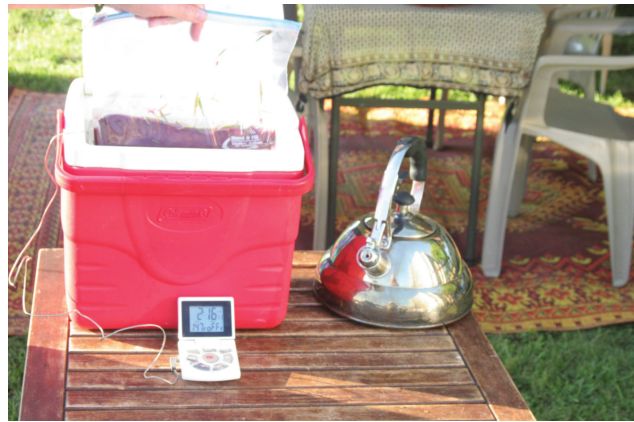
My low-budget experiment consisted of a beer cooler, Ziploc slider bags and a cooking thermometer. A beer cooler is an insulated box that is as effective in keeping things hot as it is in keeping things cold. Instead of using a vacuum-sealer, air can be removed from a slightly opened Ziploc slider bag by submerging it into water. Cooking thermometers can be purchased for under $20.
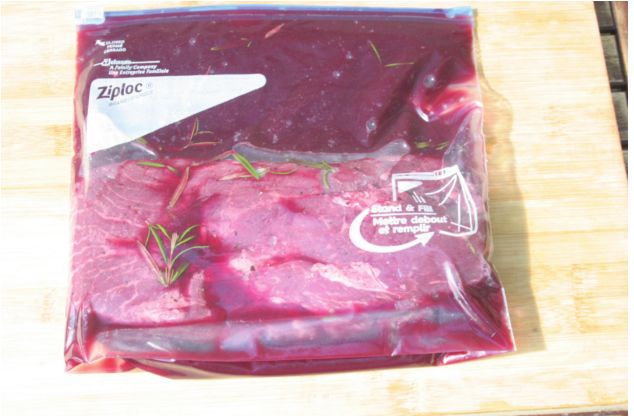
To conduct my beer cooler sous-vide experiment, I thawed a flatiron steak and placed it in a gallon Ziploc slider freezer bag. I added last night’s leftover Malbec wine, a couple spoonfuls of capers, a few sprigs of rosemary, some garlic salt, and pepper. I removed the air and allowed it to marinate while I went off to hear some music.
I returned to Bertha Bus to begin the cooking process. I put a stockpot full of water on to boil. My hippie tasting panel was a bit freaked out by the thought of eating steak cooked in a beer cooler, so to allay their concerns, I agreed to cook the steak to medium (water bath at 140-145 degrees) instead of my preferred mediumrare (water bath at 130-135 degrees).
When the water was slightly hotter than my target temperature I filled the cooler and dropped in the Ziploc. The addition of the steak lowered the temperature of the water bath so I adjusted it to 145 degrees by adding small amounts of hot water from my teakettle. The water temperature would drop a couple degrees per hour and I hoped it wouldn’t drop below 140 degrees over the next 2 hours.
I headed back to the main stage to hear another band. After their set I ran back to the bus to check on my experiment. Water temperature was holding steady in the 140- 145 degree range!
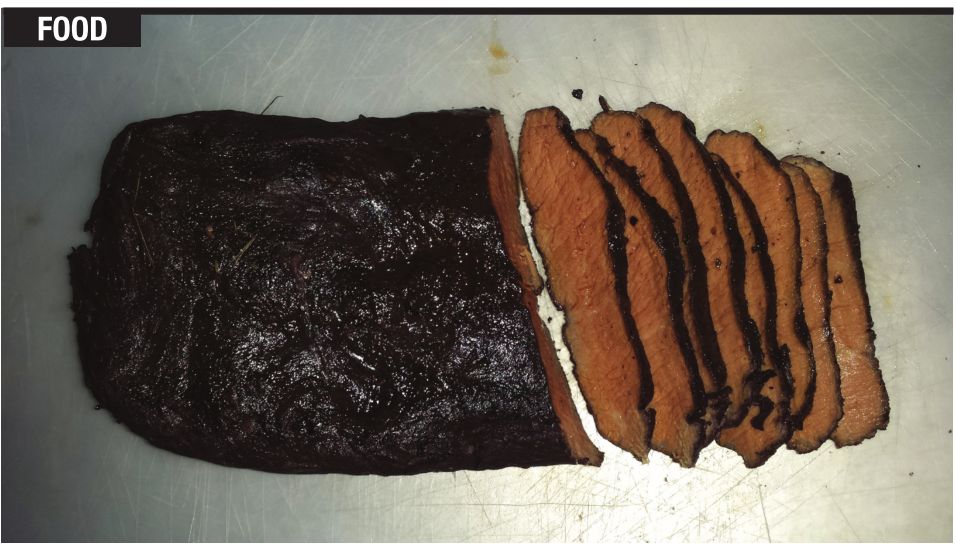
Sous-vide cooked beef is very tender but has a rather unappealing boiled meat appearance, so I started a roaring hot charcoal fire in my hibachi to give a quick char to the surface. The resulting steak was a perfect medium. I sliced it thinly and set out the platter on the dining table. I went into my bus to open a bottle of red wine. When I returned, all that remained was a few little morsels. My hungry tie-dye hippie tasting panel had devoured the steak. The experiment was a success!
Beer cooler sous-vide instructions
1. Put steak in a Ziploc bag along with desired seasonings. With the top of the bag still open, submerge the bag in water almost all the way to the top so that the mouth of the bag is still above the water level. Close the bag. This will remove the air in the bag. Let the steak marinate for about an hour.
2. Put a large pot on the stove filled with more than enough water to fill the ice chest.
3. Determine the final temperature at which you want your meat cooked and fill the cooler with water 5 to 10 degrees higher than the desired temperature to allow for the heat that gets absorbed by the ice chest.
4. Place the thermometer into the water and close the lid.
5. Wait about one minute. Adjust the temperature by adding hot or cold water. Once the proper temperature is reached put the food bag into the ice chest and close the lid with the thermometer still in it. Let it sit for an hour or two depending on the thickness of the meat. It is impossible to overcook the meat this way if the temperature is kept consistent even if it is in there for two hours or more.
6. Check the temperature occasionally. If it drops too low, add more boiling water.
7. When it is done, sear the steak on a very hot pan or grill for just a few seconds to brown it.
Peter Glatz will be a guest cook in the kitchen of Zingerman’s Road House in Ann Arbor, Michigan, on Sept. 23 and 24. Zingerman’s Chef Alex Young is a great interpreter of Southern food traditions and also tends a farm that provides much of his provisions.