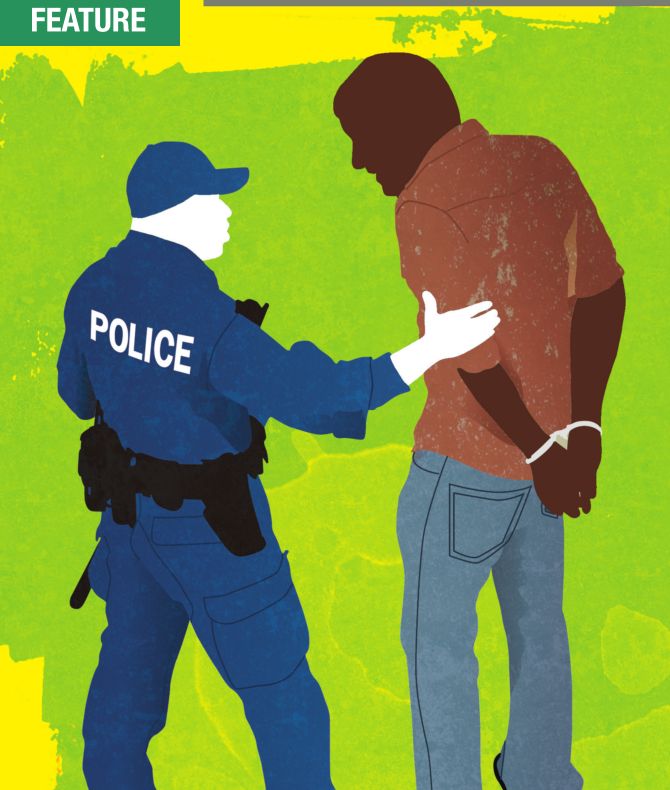
Springfield’s efforts to build bridges
Sunshine Clemons was in high school when she had one of those formative experiences nearly every black person has involving police.
Clemons, who lives in Springfield, says she and a couple of her fellow black friends were pulled over while driving in southern Illinois, ordered out of the car, restrained with zip ties and forced to kneel on the side of the highway in the rain while the police searched their car.
“They thought we were up to something,” Clemons said.
The teens were eventually let go, but the officers admonished that they were taking a beer bottle cap they found in the trunk as evidence.
“My experiences are the same as many other [black] people,” Clemons said. “It just kind of becomes what we deal with. We can’t let every instance bring us down, because we would never find happiness if we let the actions of others and stereotypes tear us down.”
Clemons is starting a Springfield chapter of the nationwide protest group Black Lives Matter, which formed as a response to police killing black people. The local chapter is the latest to join several Springfield organizations in a dialogue meant to counter institutional racism, build relationships and prevent a similar tragedy from happening here.
The problem
Michael Brown’s fatal shooting in 2014 by a police officer in Ferguson, Missouri, helped bring to the surface a long-festering tension between police and communities of color. Brown’s killing, though ultimately ruled justified by the U.S. Department of Justice, forced the country to contend with the fact that black people are proportionately more likely to be stopped by police and more likely to be killed in such encounters.
Since Brown’s death, several other cases have gained national attention involving black people either being killed by police or dying while in police custody. Many of those cases began as routine stops over minor issues and quickly escalated.
Following two such cases earlier this month – those of Alton Sterling and Philando Castile – retaliatory attacks on police in Dallas and Baton Rouge resulted in a combined eight officers killed.
The growing anger and distrust toward police is a symptom of a larger problem in America: racism didn’t die with the banning of slavery or the end of Jim Crow laws. Although outright racism is widely condemned, a more insidious form called institutional racism thrives.
Institutional racism is the abuse of power by some system based on racial prejudice. In a nutshell, it’s institutions like banks, the media or law enforcement treating white people one way and everyone else another way – usually not out of malice, but simply because those systems were created by and for white people. As a result, white people typically benefit from privileges that non-white people don’t enjoy.
Vanessa Knox of Springfield says one such privilege is how white people are represented in popular culture. Knox is
co-chairwoman of Communities United for Justice and Order, a
restorative task force within the Springfieldbased Faith Coalition for
the Common Good.
Racism:
“It just kind of becomes what we deal with.”
She says cultural representations of different groups matter because they form the basis of our beliefs about what is normal and good.
“If your parents only exposed you to people that look exactly like you, and that’s all you’ve ever been around, then you turn on the TV, you’re going to think that blacks are the most vicious, violent people you’ve ever seen in your life,” she said. “The images of what the media give you severely affect you.”
Knox says being black has consequences for her any time she drives a car or does any number of other routine activities in public. Although she works two jobs and dresses professionally, she says she is often followed around by store clerks.
Clemons say that black people are “an oddity” in America – overrepresented in sports and entertainment, but underrepresented in textbooks. Meanwhile, white people see themselves represented and reflected in most aspects of culture.
“When you are the face of what is considered right, your face is on TV all the time, your face is in books, your face is generally the police officer,” she said. “You don’t see our faces in textbooks unless they’re talking about slavery or something in Africa.”
When cultural representations are left unexamined or untempered by
personal relationships, they lead to stereotypes, which affect how
people view and treat one another. That can be seen in the interaction
between people of color and law enforcement.
The police perspective 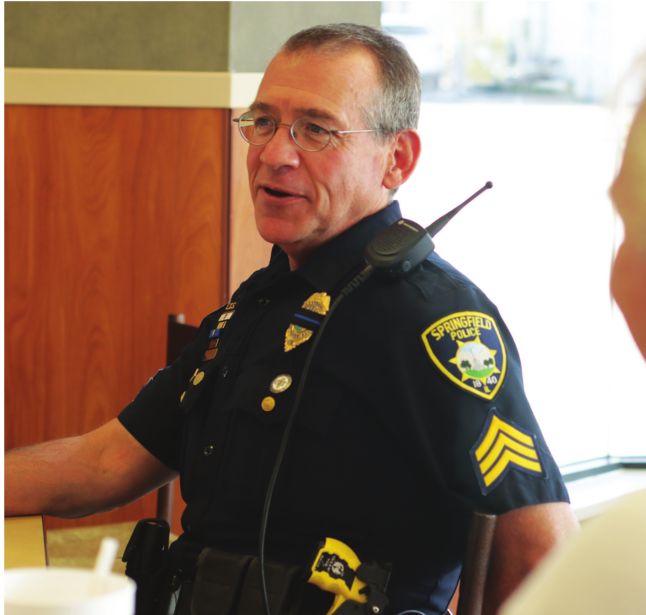
Sergeant
Gerry Castles is a white, 26-year law enforcement veteran, serving with
the Springfield Police Department for the last 22 years. He sees his
role as that of a parent – sometimes enforcing rules, but just as often
providing guidance and a helping hand. He tells the story of a young man
in Springfield whom he met on the job. The young man sells dope,
Castles says, but he lies awake at night worrying that each day will be
his last.
“He doesn’t want to do it, but he has no other way to pay the rent,” Castles said.
He adds that it’s easy to say the young man should just get a real job, but no one has modeled that behavior for him.
“Even
something as simple as filling out an application – we have to open our
minds and realize that maybe they don’t know how to do this,” Castles
said. “It has nothing to do with intellect or intelligence; it has to do
with what their environment was. If it’s easy to take $100 worth of
powder cocaine and turn it into X amount of dollars, that’s what you
do.”
Thoughtful and
funny at the same time, Castles has no problem defending law enforcement
in one breath and pointing out its shortcomings in the next.
“What
frustrates me is this mantra that when an officer goes through his
police training, then his moral code, whatever his parents taught him,
his filtering system all go out the window, and he becomes this monster
who’s out to kill people,” Castles said. “It’s ridiculous to think
that.”
The job of
policing requires officers to go into ambiguous situations with little
or no information about what to expect, Castles says. Often, what little
information an officer has is one-sided or completely wrong.
“You
prepare for this every time you go through a door,” Castles said,
putting his hands in a boxing pose, “but you can’t look like this.
“You
have to look like this,” he said, lowering his hands and plastering a
smile on his face to seem nonthreatening. Castles says he prefers to use
words to resolve conflict, and even when he has to use force, he tries
to explain why to the person afterward.
Still,
he says having to always be ready to defend against an attack can leave
officers on edge, and no officer wants to be the one who failed to
catch a criminal because the officer didn’t investigate a suspicion.
Castles recalls an incident that happened more than 20 years ago, in
which four men robbed a hotel in Springfield. Just after the robbery,
Castles saw a car drive by with four men inside staring directly at him. He didn’t stop the car because there was no information available on potential suspects at the time.
“To this day, I know that was them,” he said, a hint of regret in his voice.
Although
Castles is discouraged that police are sometimes seen as “the bad
guys,” he says he understands why. For one thing, he says, law
enforcement is an evolving science that sometimes changes only when an
incident or string of incidents reveal a problem. Castles says police
training and standards differ from state to state, so not all
departments operate the same way.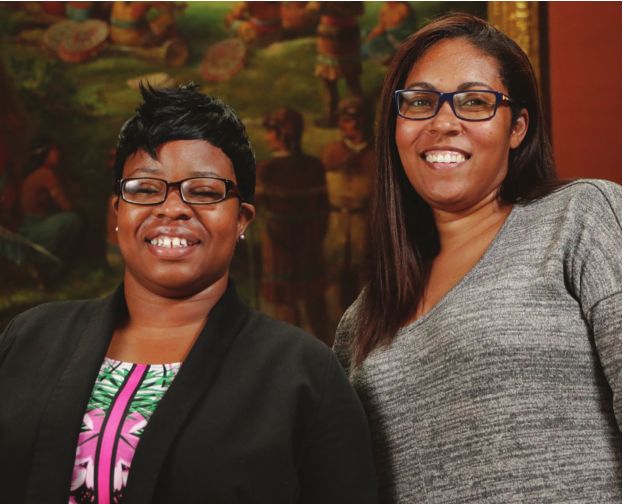
He also notes that the history of racism has, at times, been intertwined with law enforcement.
“We’re
not that far removed from race riots in the ’60s,” he said. “When we
think of the racism in the South during the ’50s and ’60s, some of the
perpetrators and Klan members were cops. So, I understand how that
thought process gets in there. Don’t think that’s not discussed from
generation to generation. I see where that seed of distrust [toward
police] comes from.”
Sometimes,
Castles says, wearing his uniform gets tiresome. He can often feel the
stares of bystanders at a crime scene, some of them likely seeing him
only as a police officer and an enemy instead of as a person.
“When
it rises to the level of you see my uniform and you pass a judgment on
me, how is that any different from what you accuse me of?” he said. “You
can’t measure my heart behind this uniform, my moral code.”
Springfield
police chief Kenny Winslow knows that feeling, too. He was off duty in a
restaurant with his young son when he heard about the July 7 attack in
Dallas that killed five police officers and wounded seven more. Nearby,
Winslow heard someone remark that there should be many more dead
officers.
“I was taken
aback,” he said. “It was not only the tragedy I saw on TV, but the
tragedy I saw in that restaurant. That kind of hate is taught. … I hope
that what comes out of Dallas is that we in law enforcement realize that
we’re all human; we’ve got to work together. We don’t want to see this
put us back into the throes of 1964. There’s got to be mutual respect.”
The data
Spurred
by serious shortcomings in how the FBI collects data on fatal shootings
by police (FBI director James Comey called the system “embarrassing and
ridiculous”), the Washington Post began collecting its own data on every fatal shooting by police in 2015 and 2016. The Post’s data
shows 990 people fatally shot by police in 2015. At publication time,
the database showed 533 people fatally shot so far in 2016.
Of the 990 deaths recorded by the Post for
2015, 494 (51.4 percent) were white, and 258 (26.8 percent) were
African-American. White people make up 73.4 percent of the U.S.
population, according to census data for 2014, while black people make
up 12.7 percent of the population. (Most of the remaining 21.8 percent
are classified as Hispanic in the Post’s database, but it’s
difficult to compare that with the general population because the U.S.
Census treats Hispanic ethnicity as separate from race.)
An independent study of the Post’s data by a team of criminal
justice researchers found that, after adjusting for factors like age,
mental illness and whether the person killed was armed and attacking
someone, black people who were unarmed were more likely to be killed
than unarmed white people.
Justin Nix, a criminal justice researcher at the University of Louisville, worked on the study.
“The
only thing that was significant in predicting whether someone shot and
killed by police was unarmed was whether or not they were black,” Nix is
quoted telling the Washington Post.

Critics
say tallying fatal shootings by police isn’t a good measure of whether
police treat people of color differently because the vast majority of
interactions with police don’t result in fatal shootings. While there is
no database of all police-public interactions nationwide, Illinois has
been collecting data on traffic stops since 2004. The data is limited to
Illinois, but it provides a somewhat broader scope than fatal shootings
alone can offer.
Collected
by most police agencies around the state and reported to the Illinois
Department of Transportation, Illinois’ traffic stop data covers more
than 25.7 million stops from 2004 to 2014. According to the data, white
people accounted for 67.3 percent of all stops on average during that
11-year period, but they accounted for 71.5 percent of the state’s
driving population. By comparison, minority drivers – all
people not categorized as white – accounted for 32.7 percent of all
stops but only 28.5 percent of the driving population.
Over
the same period, minority drivers were also held longer than white
drivers during stops, were more likely to be given tickets and were more
likely to be searched, yet less likely to be found with contraband.
While
police say there are reasons for more stops of minority drivers, such
as more patrols in high-crime areas, the effect remains the same: more
chances for people of color to have negative experiences with law
enforcement, leading to higher chances of incarceration or death.
The Springfield solution 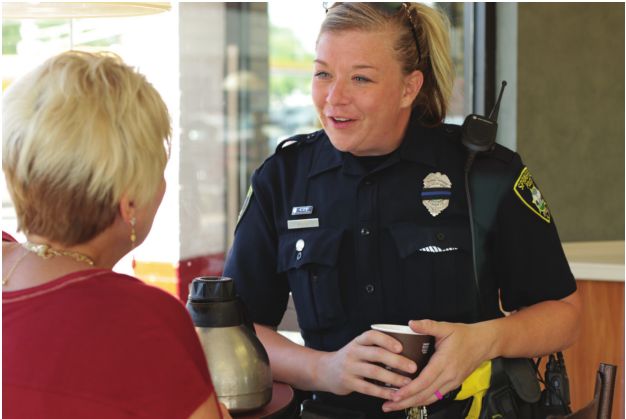
Springfield has a history of racial conflict.
Abraham
Lincoln’s neighbor in Springfield, a free black man named Jameson
Jenkins, sheltered people fleeing slavery at great peril to himself.
Springfield’s race riot of 1908, in which at least two black people were
killed and numerous black homes and businesses were destroyed, spurred
the creation of the NAACP. The city’s mayor-council form of government
is the result of a 1985 civil rights lawsuit that showed the former
commission form of government disenfranchised black citizens. In 2009,
former City Water, Light and Power employee Mike Williams found a noose
hanging at his work station.
Those
are just some of the more memorable examples. That history remains in
the forefront of many minds in Springfield, spurring several groups to
meet the problem head-on.
The
Springfield Police Department is lauded by several local groups for
taking an active approach to dealing with the racial divide. Winslow,
the police chief, says his agency’s efforts are not so much a program as
a philosophy called community policing. Essentially, community policing
is about building relationships.
“One
of our goals is to be able to build trust,” he said. “You’ve got to
have trust to have a relationship. That helps build partnerships, which
directly affects our ability to carry out our mission.”
The
SPD’s neighborhood police officers are the most visible example, in
which a beat cop is assigned to a certain neighborhood, getting to know
its residents, its geography and its issues. Winslow and his officers
also walk each neighborhood in the city, knocking on doors to meet
people and make their faces more familiar. They hold informal meet-ups
around the city so residents can bring up concerns or just chat. They go
to after-school programs to mentor young people. They talk to young
athletes about how to stay out of trouble. They even hold meetings about
what to expect and how to act during a traffic stop.
It
works, Winslow says, because it’s a consistent effort, and because it’s
not just done when there’s been an incident. He points to the July 11
shooting of a black man by a Decatur police officer. The police there
already had relationships with local black leaders, Winslow says, so
there was enough mutual trust to prevent additional violence.
Winslow
recalls walking a predominantly minority Springfield neighborhood,
which he said was “one of the roughest areas in town.”
“If
you’d have asked me going into that how much support we’d have, I would
have guessed 40 to 50 percent; I would have been happy with 50
percent,” he said. “Overall, I was shocked by how much support we had.”
The
police also partner with other groups in Springfield. One such
partnership is with the Springfield Race Unity Committee, which brought
the documentary Racial Taboo to be screened in Springfield. The film discusses the thread of racism
through American history and the difficulty the nation has with
addressing it. In April, the entire Springfield Police Department
attended a screening of the film and afterward participated in small
group discussions with members of the public.
Mike Lang, a member of SRUC, says the majority of police officers felt it was worthwhile.
“It’s really a simple concept, the whole idea of sitting down and talking with people of different backgrounds,” he said.
The
Springfield Race Unity Committee began about 20 years ago as a
collaboration between the mostly black Springfield Ministerial Alliance
and the mostly white Greater Springfield Interfaith Association. The
group holds regular “Constructive Conversation” discussions about race.
Lang says the recent violence has only made those discussions more
relevant.
“Everybody’s crying out that it’s time to learn how to get along, to learn how to love and respect each other,” he said.
The
Springfield Coalition on Dismantling Racism, called SCoDR for short,
has a similar aim. It began about four years ago out of discussions on
race between the Dominican Sisters of Springfield, the Greater
Springfield Chamber of Commerce and other groups. An outgrowth of
efforts the Dominican Sisters have made for the past decade to root out institutional racism within their organization, SCoDR holds weekend
“trainings” on recognizing institutional racism and countering it. The
sessions are led by Crossroads Antiracism Organizing and Training, based
in Matteson, Illinois, and SCoDR’s efforts have resulted in employees
with the city, Springfield Public Schools, and several other local
organizations going through the training.
“Everybody’s crying out that it’s time to learn how to get along, to learn how to love and respect each other”
Sunshine
Clemons, who is starting a Springfield chapter of Black Lives Matter,
says her group is still forming, but she anticipates taking part in
regular conversations with the Springfield Police Department to find
common ground.
Vanessa
Knox with Communities United for Justice and Order, says that, among
other things, the group wants to address mass incarceration. The state
and national prison populations are disproportionately black, stemming
partly from inequalities in arrests and sentencing. Currently in
Springfield, people released from prison receive little help
reintegrating into society, Knox says.
“These
guys, especially the nonviolent offenders, need more support so that
they don’t go back to the old life,” she said. “That’s the stereotypical
‘black guy goes to jail, dad went to jail, grandpa went to jail.’ ”
CUJO and its parent organization, the Faith Coalition for the Common
Good, focus on several issues in Springfield and central Illinois which
deal with racial inequality and social justice.
Despite
its devotion to building relationships, the Springfield Police
Department still has work to do. For example, the department consists
mostly of white men, which doesn’t reflect the population of the city.
According to an internal audit of the city’s workforce released on April
15, there were 242 sworn officers in the department at the time. Of
those, 20 were non-white and 27 were female.
Winslow
encourages more people of color and women to apply to the department.
He says that although the standards are quite strict, he prefers that
people be honest about their past when applying.
“There
are no perfect people out there; there are none,” Winslow said. “But
man up or woman up, and tell me the truth. We need good morals and
values, good work ethic, an open mind and the ability to learn. We’ll
teach you everything else you need to know.”
Both Knox and Clemons praise the efforts of the Springfield Police Department but say there is always room to build more trust.
“It’s
important to have these conversations because it leads to change,”
Clemons said. “You don’t just jump into change. It’s important to
include cops in this because they’re a vital part of what we’re trying
to do here. They can be part of the solution.”
Contact Patrick Yeagle at [email protected].


