But judge whacks Rauner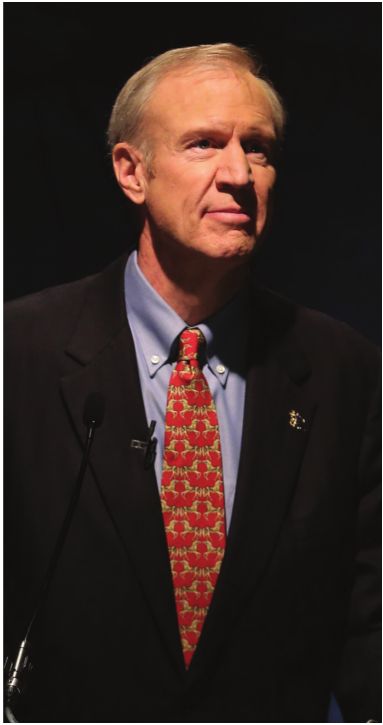
Sangamon County Circuit Court Judge John Madonia has sided with Gov. Bruce Rauner in a lawsuit over disclosure of the governor’s appointment calendar, refusing the newspaper’s request for legal fees.
The newspaper sued the governor last fall, one day after the attorney general’s office ruled that the governor’s appointment calendar is a public document. Illinois Times requested the calendar in the spring of 2015, after the governor’s office didn’t respond to questions about why Rauner departed early from a Holocaust remembrance ceremony at the Old State Capitol that included a speech by a death camp survivor. The governor provided a redacted copy of his calendar that didn’t include the names of people with whom he met.
In his March 23 ruling, Madonia wrote that the newspaper didn’t give Rauner sufficient opportunity to comply with the attorney general’s order. Under the law, public bodies have 35 days to decide whether to release records after the attorney general issues a binding opinion. Rauner ultimately released his unredacted calendar on Jan. 8, more than three months after the attorney general ruled the document is a public record and must be disclosed.
Don Craven, attorney for the newspaper, had argued that the only way a requester can enforce a ruling by the attorney general is to hire a lawyer to file a lawsuit separate from the Freedom of Information Act, which would put the requester on the hook for legal costs. But Madonia in his ruling wrote that the paper’s filing of a FOIA lawsuit immediately after the attorney general’s ruling “borders on the absurd.”
The governor’s office should have been given 35 days to decide whether to comply with the attorney general’s ruling, Madonia decided. If a public body refuses to disclose records, requesters must choose whether to sue or ask the attorney general for help, Madonia wrote, but they cannot do both under the state Freedom of Information Act.
While ruling against the newspaper, Madonia did not excuse Rauner for resisting the release of his calendar. And the judge said that his ruling, while proper under the law, makes it difficult for government officials who flout disclosure requirements to be held accountable.
The governor had claimed that releasing an appointment calendar documenting events that have already occurred and who attended meetings would reveal his thought processes. The governor also claimed that release of his appointment calendar documenting past events could pose a risk to his safety, on the theory that someone out to harm Rauner could discern patterns to his movements. The attorney general rejected those arguments, as did the judge.
“Clearly, the initial denial of the information, and the ‘rationales’ set forth therein, were flimsy at best, and disingenuous at worst,” Madonia wrote. “This court is very cognizant of the fact that the rulings contained in this opinion frustrate the overall purpose of ensuring transparency at the highest level for all government activity. Indeed, one drastic consequence of the court’s opinion…is that the ruling prevents the violator from being held accountable for their violations. The impact of this consequence is especially troubling in this case, where the governor’s office and its staff responded to the initial FOIA request by invoking a grossly insufficient argument that the governor’s calendar of events was not a public record, and also by unjustifiably citing…obviously inapplicable exemptions in a futile and ineffectual effort to prevent the release of public information.”
On the campaign trail in 2014, Rauner vowed that his administration would be an open book.
“I want to make Illinois government the most efficient, transparent (state government) in America,” Rauner said on the campaign stump.
Since the attorney general last fall ruled that the governor’s appointment calendar is a public record, Rauner’s staff has stopped writing down names of people who meet with the governor, according to a February story in the Chicago Sun-Times, which reported that the governor’s staff has started writing down initials such as “MH,” EB” and “JM” to document who is scheduled to meet with Rauner. Meanwhile, courtroom battles to obtain records from Rauner continue.
On March 23, the same day that Madonia filed his opinion, Craven, the same lawyer who represented Illinois Times, sued the governor on behalf of a Marion law firm that requested press releases from the governor’s office concerning Eric Gregg, a former member of the state Prisoner Review Board. The law office also requested any emails exchanged between the governor’s office and the media concerning Gregg, as well as written job descriptions for two members of the governor’s press office as well as the governor’s general counsel.
The law firm went to court after the governor’s office failed to produce any documents or state any reason under state law why the records should not be disclosed.
Contact Bruce Rushton at [email protected].


