Menus for Bertha the Bus
Four years ago I bought a school bus and named her Bertha. I removed all the seats and outfitted her with sleeping bunks, a restroom, a dining nook, and a small, but fully equipped kitchen. Bertha and I love hitting the open road and traveling to food and music festivals.
I love cooking for people and over the years I’ve developed menus that I can successfully prepare in a bus. My destinations are often without electric and water hookups so my meal planning favors dishes I can prepare with minimal effort and minimal cleanup. I have three go-to pasta dishes that meet these criteria and are totally delicious.
To simplify even further, I rely on a genius pasta cooking hack from Harold McGee, author of On Food and Cooking: The Science and Lore of the Kitchen. The traditional approach is to boil 4 to 6 quarts of salted water per pound of pasta and cook until al dente. Sometimes a small amount of the cooking water is reserved to finish the sauce, but most of the water is poured down the drain. When I’m cooking on the bus without water and electric hookups, I have to bring my own water, so six quarts of cooking water can be an extravagance. The process of boiling that much water consumes quite a bit of propane, as well as throwing out heat into the bus.
McGee’s life’s work is devoted to a scientific evaluation of cooking technique. Questioning the conventional wisdom, he derived the following technique for cooking pasta: Place dry pasta in a large (12-inch) skillet. Pour in about 1 ½ quarts of cold water and 1 teaspoon of salt. Because the water is cold, the pasta won’t stick together. Turn on the heat. When it’s done, you’ll have perfectly cooked pasta and a thickened liquid to use in the sauce.
This thickened liquid is the restaurant cook’s secret weapon. Pasta water consists of starch granules and water – the exact same ingredients that go into a cornstarch slurry used to thicken sauces. In addition to thickening a sauce, the thickened pasta water also acts as an emulsifier. The starchy cooking liquid prevents fat molecules from coalescing, which means that even oil-based sauces will emulsify into a creamy sauce that evenly coats the pasta.
Now, on to the recipes…
Cacio e Pepe
Cacio e Pepe is a Roman dish which means simply “cheese and pepper.” Those accustomed to elaborate, time-consuming preparations will appreciate the speed, simplicity and deliciousness of Cacio e Pepe. It’s one of the simplest, most delectable dishes you can whip up for not a lot of money and even less effort.
Ingredients
• 4 tablespoons extra-virgin olive oil, divided
• Coarsely ground black pepper
• Kosher salt
• ½ pound spaghetti
• 2 tablespoons unsalted butter
• 2 ounces Pecorino Romano cheese (about 1 cup), very finely grated on a Microplane grater, plus more for serving
Preparation
1. Heat 3 tablespoons olive oil and about a teaspoon of black pepper in a medium skillet over medium-low heat until ingredients are fragrant and pepper is barely starting to sizzle, about 1 minute. Set aside.
2. Place spaghetti in a large skillet and cover with cold water. Season with a pinch of salt, and turn on the heat, stirring occasionally to prevent it from
clumping. Cook until spaghetti is al dente (typically about 1 minute
less than the package recommends). Transfer 2 to 3 tablespoons of pasta
cooking water to the skillet with the olive oil/pepper mixture. Stir in
the butter. Using tongs, lift spaghetti and transfer to the oil/ butter
mixture.
3. Add cheese
and remaining tablespoon of olive oil to the skillet and stir with a
fork until cheese is completely melted. Add a few more tablespoons of
pasta water to the skillet to adjust consistency, reheating as necessary
until the sauce is creamy and coats each strand of spaghetti. Season to
taste with salt and more black pepper. Serve immediately, passing extra
grated cheese and black pepper at the table. Serves 2 Recipe adapted
from J. Kenji Lopez-Alt, seriouseats.com
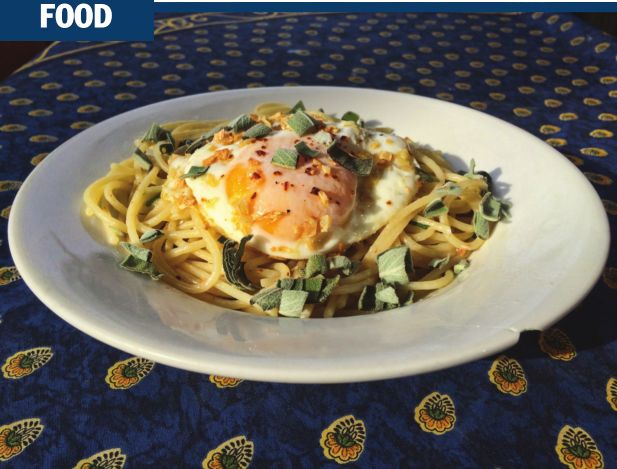
Fried Eggs, Red Pepper Flakes, Garlic and Herbs Pasta
This
pasta preparation was a favorite of my children while growing up, and
one of my late wife’s go-to staples for weeknight meals. It also makes a
satisfying midnight snack or brunch dish.
Ingredients
• 1 lb spaghetti
• 3 tablespoons Extra-Virgin Olive Oil
• 2 tablespoons unsalted butter
• 2 large garlic cloves, thinly sliced
• 4 large eggs (preferably from free-range chicken)
• Coarse or Maldon sea salt to taste
• Crushed hot red pepper flakes to taste
• ½ cup freshly grated Parmigiano-Reggiano plus additional as an accompaniment
• ¼ cup minced fresh parsley
• 1 tablespoon minced fresh oregano or sage
Preparation
1.
Place spaghetti in a large skillet and cover with cold water. Season
with a large pinch of salt, and turn on the heat, stirring occasionally
to prevent it from clumping.
Cook until spaghetti is al dente (typically about 1 minute less than the package recommends).
2.
While pasta is cooking, heat the olive oil and butter in a large
skillet over moderate heat. Add the garlic and cook, stirring, for 2
minutes.
3. Add the
eggs and cook, sunny-side up, basting with a spoon, for 2 to 3 minutes
without turning, or until the eggs are just done (the yolks should be
runny).
4. Remove the
pan from the heat and sprinkle eggs with salt and red pepper flakes. You
must time this dish so that the pasta is ready as soon as the eggs are
done.
5. Place the pasta on a serving platter and toss with Parmigiano-Reggiano, additional red pepper flakes and parsley.
6. Pour the contents of the egg pan, including the oil, butter and garlic, onto the pasta.
7. Garnish pasta and eggs with oregano or sage and serve immediately. Pass the additional Parmigiano-Reggiano at the table.
Serves 4 Recipe adapted from The Dean & Deluca Cookbook
Marcella
Hazan’s Tomato Sauce with Onion and Butter Stupidly simple, divinely
delicious, this pasta sauce requires 45 minutes on the stove top.
Ingredients
• 1 lb pasta
• 28-ounce can San Marzano whole peeled tomatoes
• 5 tablespoons butter
• 1 onion, peeled and cut in half
• Salt Preparation
1. Combine tomatoes, their juices, the butter and the onion halves in a saucepan. Add a pinch or two of salt
2.
Place over medium heat and bring to a simmer. Cook, uncovered, for
about 45 minutes. Stir occasionally, mashing any large pieces of tomato
with a spoon. Add salt as needed.
3.
Place spaghetti in a large skillet and cover with cold water. Season
with a large pinch of salt, and turn on the heat, stirring occasionally
to prevent it from clumping. Cook until spaghetti is al dente (typically
about 1 minute less than the package recommends).
4.
Discard the onion before tossing the sauce with the pasta. This recipe
makes enough sauce for a pound of pasta. Serves 4 -From Marcella Hazan’s
Essentials of Classic Italian Cooking
When
he’s not at music festivals cooking in Bertha Bus, Peter Glatz travels
in his bus to be a volunteer chef in the kitchens of famous restaurants
around the country. He and his daughter, Ashley Meyer, are carrying on
the food column written for the past 10 years by the late Julianne
Glatz, his wife and her mother.


