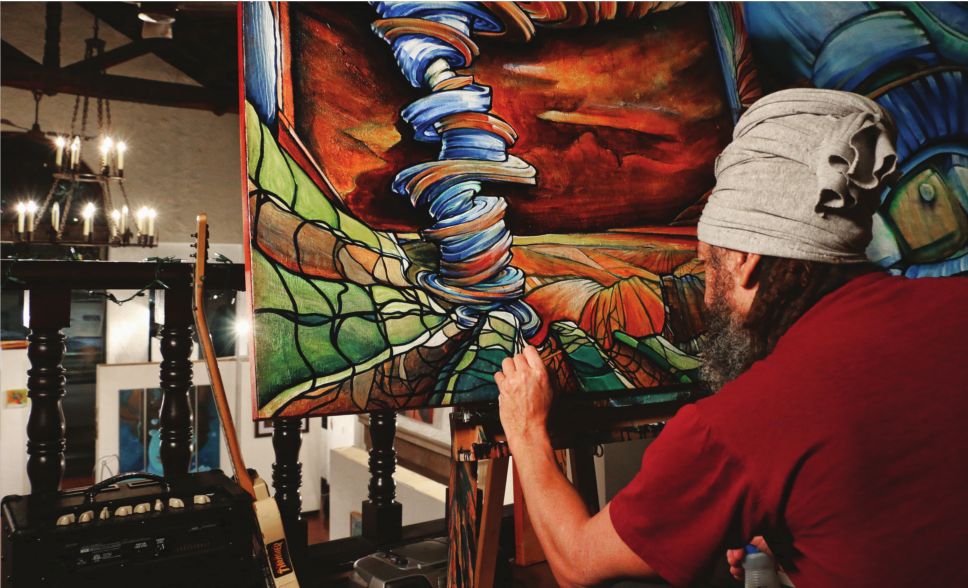
Visual artists paint a more lively Springfield arts scene
On Monday, Feb. 8, Illinois Times invited a small group of leaders in the Springfield visual art community to a luncheon at the Inn at 835 for the purpose of discussing the current state of presenting, creating and promoting visual art in the area. Springfield has long boasted a varied and vibrant selection of creative artists and arts organizations, with venues ranging from century-old institutions to energetic upstart collectives to free-for-all “pop up” showcases. Add in educational gallery spaces along with the efforts of various specialized clubs and societies and hardly a week goes by without some sort of art exhibition on display. And yet there is a clear sense of frustration among those involved in Springfield art, particularly regarding missed opportunities to engage meaningfully with a larger segment of the public.
Our panelists included Betsy Dollar, executive director of the Springfield Art Association; Clare Frachey, art director at Café Brio and Black Sheep Café; Allison Lacher, gallery manager at UIS Visual Arts Gallery and co-director of DEMO Project; Ruthann Mazrim, former co-president of Prairie Art Alliance, now board member of SAA; Mike Miller, chair of art, music and theater at University of Illinois Springfield; Sue Scaife, president of the Illinois Prairie Pastel Society; Janet Sgro, president of The Pharmacy Gallery and Art Space; and Jeff Williams, independent curator and Pharmacy member. Scott Faingold (IT staff writer and co-host of weekly arts roundup “The Scene” on NPR Illinois) moderated the discussion.
The participating panelists represent only a fraction of those involved with the visual arts in Springfield but all are passionate creators and promoters, working tirelessly to present exhibitions of local, regional and national art ranging from highly traditional to more innovative and challenging work. They are also united in an idealistic desire to see the Springfield art community grow and to find new and creative ways of interacting with the city they call home.
IT: What does it mean to create and present art in Springfield, Illinois?
Janet Sgro (The Pharmacy): I think it’s important to bring beauty to this community. By bringing great exhibits and art here and being creative it brings people happiness.
Mike Miller (UIS): I would add that it’s important to bring critical thinking and a notion of contemporary art to this community. That is what we try to do at UIS in both our gallery and in our curriculum. We are interested in bringing regional and national artists to UIS for our students and for the community. Cultural critique is a big part of what we are about.
Allison Lacher (UIS Visual Arts Gallery, DEMO Project): A recent visitor to the UIS gallery told us Springfield
is beginning to gradually cultivate a good reputation in Chicago and
elsewhere for what’s happening in our visual arts community. I see that
as something that is starting to take shape.
Miller: There
are some people in Chicago, relevant artists, who are aware that it
might be cool to have a show in Springfield – they realize that we’re
going to take care of them down here and honor their ideas and that
there’s a community here that will pay attention and show up and be
interested in what they do.
Betsy Dollar (Springfield Art Association): At
the Art Association we recognize the established organizations that are
producing very traditional work like the Watercolor Society and the
Pastel Society. We also work with DEMO Project [a small house located on
the grounds of the SAA which, while awaiting eventual demolition, has
been temporarily converted into an alternative gallery space] to bring
in contemporary artists, and some of those have even funneled into our
larger gallery. I think the key to growing the arts here is education of
the public – we need to continually present as wide a variety of work
as we can and then help the public to engage with it and accept it. When
we show local artists, people will turn up – same with something based
on local history like the “Shifting Sands” architecture show that we
just had, which had higher attendance than any other exhibition at the
SAA in the past five years. The frustrating thing is that we will show
other really great regional or national artists and – other than
people whose arms we twist – a lot of people don’t show up just because
they don’t know that person. I think we still have a lot of work to do
in the community to educate everyone to the value of exploring the
visual arts. Nobody said you have to like it all but if you keep an open
mind and just show up, you’re going to discover all kinds of
interesting things.
Miller: A
person doesn’t have to love every exhibition we have – some can be
quite strident in their messages and you might totally disagree. But you
can still come and connect with members of the art community who are
processing that same exhibition alongside you. The most important thing
is to build this group of people who are going to think about art
together in this town and be colleagues in the assessment of it. Maybe
we all don’t like this piece, maybe we all love that one – it’s more
about intellectually and emotionally engaging in art together as a
community. The point is not to woo people with beauty or to shock them,
the point is to show work that is relevant to their lives, to say things
about being alive in 2016.
Ruthann Mazrim (formerly of Prairie Art Alliance, currently on the board of the Springfield Art Association): What
we’ve seen at the PAA gallery at the Hoogland is that a lot of people
are intimidated by art, and especially an art gallery. There are so many
performing arts shows held [at HCFTA] and people will have 10 minutes
before the show and then during intermission, so they’ll gradually come
in to the gallery. We have a wide variety of work and some of it is
very, very accessible, but trying to get these people just to come in for the first time is difficult.
Sue Scaife (Illinois Prairie Pastel Society): My
group doesn’t have a gallery but that hasn’t been a problem. We are
always looking for venues and we’ve found that the community has been
very welcoming. But we have to reach out to them. No one ever says,
‘Hey, we’ve got an opportunity here, we’re looking for artists to hang
work.’ But along with the Art Alliance we also do several shows a year
at the Chatham library, we have done shows at the [SIU] medical school
library, and that’s been wellreceived. We do small shows at the
Presbyterian home – we don’t get any sales but we certainly make the
residents there happy. We will hang probably anywhere somebody asks us
to.
IT: What kind of responses does The Pharmacy get to its presentations?
Sgro: We
do four big group shows a year and all the members are involved in
promoting them and I think that helps with our attendance. We get at
least several hundred visitors per night during our openings.
IT: [to Frachey] Explain what you do for First Fridays.
Clare Frachey: At
the First Friday art shows we transform Café Brio into a
half-restaurant, half-art exhibit and we have different artists each
month. Some of these people haven’t ever shown their work in public.
These shows are a good way for people to be involved. I’ve never turned
anyone away – which can be good and bad. But the point is not just the
aesthetics, it’s the act of seeing.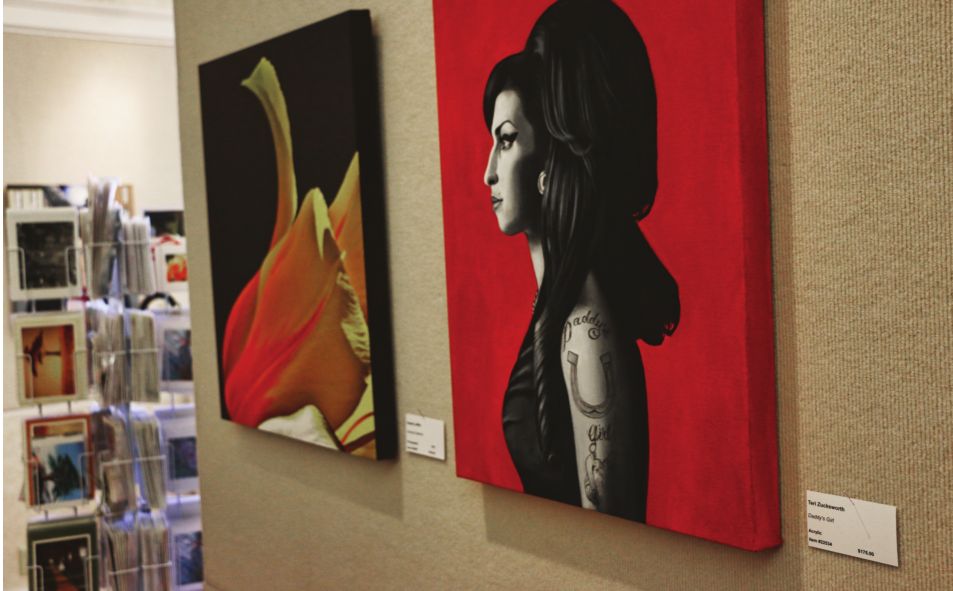
Dollar: It’s the opportunity. Scaife: And it’s the kind of opportunity emerging artists and local artists are always looking for.
Frachey: It’s
a lot more low-key than a formal gallery so that the intimidation
factor is not as prevalent – it’s just come in, come out, maybe get a
drink.
IT: What are
some things you’d all like to see happen? Any ambitions or plans or
dreams of what you’d like to see in a Springfield art scene?
Miller: I’m
saddened by the loss of the Illinois State Museum. They were such a
great partner. Maybe a year or so ago I would’ve said Springfield is as
strong as it’s ever been in terms of the presentation of art and the
levels of engagement with art. But when we lost the ISM we lost one of
our arms. They not only had full-time resources and curators who could
help us put on collaborative shows, they had connections throughout not
only the city but the state, who would help us promote things like that.
But we have to move forward without them at this point and that’s sad
because they were an important player.
Scaife: The
Illinois Artisans Program [previously administered by the ISM system to
promote and market crafts by local artisans through shops at the four
now-closed museum locations] was a casualty as well and that was a huge
loss to all the people who were members of that, who relied upon the
ability to show and be part of that, as well as the loss of the other
resources.
Dollar: The
Art Association’s gallery rarely makes any sales – there doesn’t seem
to be a real art-buying culture in Springfield. I’ve been told by
people, ‘If I’m really gonna buy art, I’ll go to Chicago or LA or New
York or someplace that has real artists.’ It is a point of
frustration because we work pretty hard to show artists both locally and
regionally and there really are high-quality things to buy here. I
think the people who are in the position to be buying art need to be
encouraged to buy local – just like in everything else.
Scaife: Or they go to Hobby Lobby and spend just as much there as they would at a gallery.
Dollar: They
buy a poster and then spend $200 having it framed instead of buying
something original. Again, education of the public could encourage
people just to look and determine what they like and then reassure them
that purchasing what they like is not a bad thing. The chance of
actually buying something that will be worth millions which you’ll leave
to your grandchildren is pretty minimal.
Miller: Even if they do go to Chicago or New York. [laughter] Scaife: Art is very reasonably priced here.
I had to take my art elsewhere to make a living at it.
Sgro: It
seems people go to galleries for an experience. At DEMO a lot of times
you’re creating these installations and they’re really not for sale,
it’s an experience.
Lacher: DEMO
Project is a very special venue. We really didn’t even understand the
wonderful gift the Art Association was giving us until it was really up
and running and we were starting to get submissions. It was very
surprising to see the kind of response we were getting to our calls.
People are willing to come here from all over the country to exhibit and
we want to give them an audience. I see DEMO as a space that serves our
community artists. As artists practicing in Springfield, we need to see
work from elsewhere to influence our work. And the community needs to
see this kind of work in order to grow and to exert critical thinking
when looking at art.
Another
thing I think could be helpful to our community of visual artists, and
would help build a true market here, is critical media coverage on art.
This arts community has been growing for a decade now. Consistent
writing about exhibitions that would contextualize the work, explain the
work, exert an opinion on it, good or bad – that would be the thing
that begins to educate the
community outside of the people who are already supporting us. I think
the visual arts community has earned that kind of coverage.
Miller: With
a more sophisticated, nuanced, diverse arts community, it’s not always
the best thing for writers and critics to just do the promotion piece
for the arts. Do a critical piece. Say, ‘This is good but it lacks in
this area.’ Or ‘this is better than this other thing that happened over
here.’ Just in order to help understand the difference between something
that is excellent and something that’s just pretty good.
Scaife: You’re gonna get letters to the editor… Miller: Excellent! Because that’s dialog and discussion!
Dollar: Drama is good! Lacher: There’s
a big difference between offering the context of a critical piece and
just saying ‘this is happening.’ I think to contextualize something can
spark interest. Maybe that seems lofty but if you look at the statistics
about what a viable arts community can do for an economy in a city the
size of Springfield, it’s pretty impactful. It’s worth paving the way.
Because here’s the thing about an art exhibition – it doesn’t live on
after being de-installed unless it is immortalized by an article,
by a catalog – there are a lot of different ways. An art exhibition is
at once an ephemeral thing; it’s not meant to last forever. But there
should be a record of it, some documentation, a life after that
conclusion.
Jeff Williams (The Pharmacy, NIL8): The
“Art of the Other Wheel” group show that I put together this past
September had the theme of wheels other than automobile wheels. I
reached out to people from the community and a few other states. It was
just a one-time thing but I still have people who think it’s an annual
event. They contact me about being in the next one even though there
isn’t going to be a next one. They’re excited about it.
It
made me start thinking about the little group critiques we do of each
other’s work at The Pharmacy. I thought we could do the same thing but
with “community critiques” where artists can bring work to The Pharmacy
and get feedback from the other artists in attendance. A lot of people
have been interested. At first they think there’s a catch. They’re like,
‘How much is of approach. That’s not
true. To me, we’re one of it?’ and I’m like, ‘It’s all free, just bring a
couple of pieces of art.’ It’s at The Pharmacy but it’s not strictly for The
Pharmacy, it’s for the open community. We’re not making any money off
of it, it’s not doing anything except letting people come and show their
stuff.
If you keep an open mind, you’re going to discover all kinds of interesting things.
– Betsy Dollar, Springfield Art Association
Mazrim: I
think with the merger of the Springfield Art Association and Prairie
Art Alliance [see “Springfield Art Association and Prairie Art Alliance
merge” in IT, Dec. 23, 2015] it’s a much tighter group in town, which is a great thing – two of the largest, oldest organizations are now one.
Miller: I
do think it’s important to accept that we’re not all doing the same
things. From my own experience, UIS is seen as only doing this kind of
conceptual stuff or something and people think that means we don’t honor
any other kind the few venues in town that
can get away with showing challenging work like that on a consistent
basis because we’re not trying to sell it and we’re not promoting just
from local artists and we need to give that input to our students and to
our community. That doesn’t make us better or worse than anybody else. I
think it’s important to accept that art is not monolithic – art can be
grass roots, national, regional or local. And if we want to be a rich
and diverse community serving this city, all of it is important.
Lacher: I’ve
spent a long time considering public art programming [exhibits and
projects intended for public spaces, generally presented outdoors, such
as murals, and often funded by public money]. Public art can be an
incredibly valuable tool for any community and on a lot of different
fronts, too –
it’s not just about the visual arts community. How can we capitalize on
sites that are available, funding that’s available?
Scaife: We need to
make sure that we continue to promote local artists as they reach out
and not let them get too far away, keep them as part of our base. My
organization [Illinois Prairie Pastel Society] is growing artists and
getting them involved and providing education and so forth, which is a
little bit different than having a gallery or an education facility or a
shop. I’m dealing with individuals each day and to help them promote
their own work and to improve their skills; I like the idea of the
collaboration amongst the people at the table and the groups here and
the different dynamics that each person brings. It will help local
artists.
Frachey: There’s a place for everyone in town who wants to have their work seen.
Williams: The
Pharmacy has talked about having pop-up shows [one-time exhibits in
nontraditional spaces like restaurants or retail spaces]. We also like
to give artists who are not already connected to some group a chance to
use part of our space to show their stuff.
IT:
Part of having art in town being selfsustaining and taken seriously and
critically looked at would all be part of keeping artists here as
opposed to leaving for so-called greener pastures. Are there things
beyond what we’ve talked about to try to keep individual artists here?
Dollar: The city is putting together a task force to look at initiatives to bring more artists here – and the Enos Park
Neighborhood Association is working with that, primarily because the SAA
is right there with the studios and available space to work. The plan
is to give these artists houses if they have some skills to do the
renovation work themselves, with the idea that Springfield is appealing
as a cheap place to live, plus you have easy access to St. Louis,
Indianapolis, Chicago. The hope is to create more of an arts district in
Enos Park and attract people who are graduating from the Art Institute
of Chicago or Washington University and bring them here and create some
more critical mass. The thing that concerns me about that is being able
to provide enough of an art market to make it worthwhile for them to
live here.
Lacher: I don’t think the role that visual artists can play in the community can be underestimated. It can be a very powerful boon.
Dollar: The
statistics are amazing when it comes to moving artists into floundering
neighborhoods and turning the neighborhoods around. That’s the premise
on which Artspace was built and they now have communities all over the
country. [Artspace is a national network of more than 35 affordable arts
facilities in 15 states – more info at artspace.org.] Lacher: We
don’t have to look far for great examples of centralized artist
studios. I only have to look to Peoria or Bloomington- Normal. Something
Springfield lacks is affordable studio space that is centralized. All
of us in one warehouse. To rent a studio in Peoria is only $150 a month
and you should see these studios, they’re fantastic. Enos Park is, I
think, the neighborhood that our artists should be looking at very
carefully. If we can curate and program exhibitions that are a mix of
our community artists with artists who live outside of the city,
creating a market where people are buying and supporting art – that
would be ideal.
Contact Scott Faingold at [email protected]
To see more photos related to this story please visit www.illinoistimes.com.


