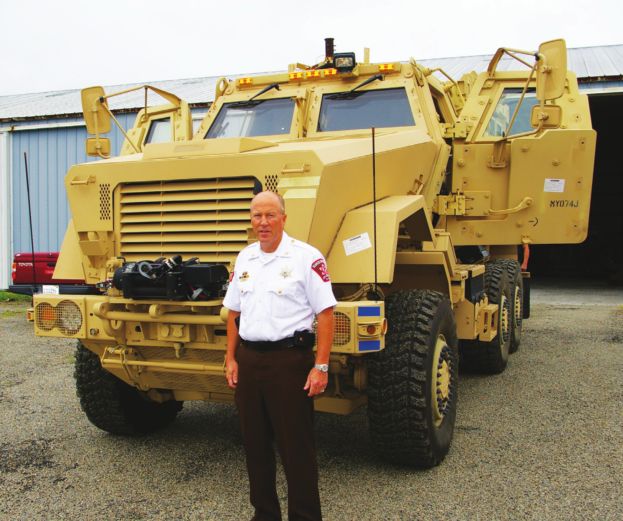
Sheriff dumps MRAP
The Sangamon County sheriff’s office has gotten rid of a massive armored vehicle designed to withstand blasts from mines and improvised explosive devices.
The department a few weeks ago returned the six-wheeled vehicle, officially dubbed a mine resistant ambush protected vehicle (MRAP, pronounced em wrap), to the federal government from whence it came less than two years ago, said chief deputy Joseph Roesch. He said he believes the MRAP, after being returned to the Law Enforcement Support Office, an arm of the Department of Defense that supplies surplus military gear to police departments, is now in the hands of the LaSalle County sheriff’s department.
The local sheriff’s office acquired the MRAP in 2014 under former sheriff Neil Williamson. The vehicle became a campaign issue that year, with Democratic candidate Jeff Regan saying that the MRAP was too heavy to negotiate some roads and was also hard to operate and maintain. He also said that the sheriff’s department should not be militarized. On the campaign trail, sheriff Wes Barr said that he was inclined to keep the MRAP, telling the State Journal-Register that the 27-ton vehicle that stands 11 feet high was an asset. Barr noted during the campaign that the MRAP had been used in the summer of 2014 to end a standoff in Riverton, where a man holed up in a mobile home surrendered as soon as the MRAP drove up.
But the MRAP came with issues, not the least of which was paperwork, Roesch says. The federal government wanted the sheriff’s department to write a policy stating the conditions under which the MRAP would be used as well as submit reports documenting each time the vehicle was deployed, even if it appeared in a parade, Roesch said. The department felt that the paperwork requirements were excessive, he said.
Echoing Regan’s criticism during the campaign, Roesch also said that maintenance was expensive and the vehicle’s weight exceeded weight limits on streets and roads. The department has a smaller armored personnel carrier that can be used to respond to calls that the MRAP would have been used for, he said.
“You can take it anywhere in the county,” Roesch said. “For what we were using it (the MRAP) for, it was just duplication.”
The MRAP, which came with a sticker on it that bore a $733,000 price tag, cost the sheriff’s office $6,400, the cost of transporting it from Texas to Springfield.
The money came from a drug forfeiture fund. The federal government offered to throw in a free set of spare tires tough enough to withstand bullets, but the sheriff’s office declined because the contractor who transported the MRAP couldn’t carry the spares without exceeding weight limits.
The federal government has distributed 625 surplus MRAPS to law enforcement agencies across the nation, according to a 2015 report in Mother Jones. The magazine obtained 465 requests for armored tactical vehicles submitted to the feds from police departments and found that the most common reason cited for needing armored vehicles was the war on drugs, with 25 percent of the departments saying they would use the vehicles to enforce drug laws. Just 8 percent of the departments said that they were concerned with barricaded shooters, and 7 percent mentioned hostage situations.
The Ohio State University police department in 2013 received an MRAP after asking for two armored vehicles. The department told the Department of Defense that it needed the vehicles for hostage rescue, responses to active shooters and “football missions and other critical incidents.” Police planned to park the MRAP outside the university’s stadium on game days, according to a report in the campus newspaper.
Police in Snoqualmie, a town of 12,000 in Washington state, received an MRAP to augment the surplus armored vehicle they already had after telling the Department of Defense that officers would use the second vehicle for “crowd management.” In their application, police in Lake Charles, Louisiana, a city of 74,000, justified their request for a MRAP by telling the Department of Defense, “We currently have no armored vehicle to respond with.”
In California, the San Diego Unified School District, which has its own police department, acquired an MRAP in 2014 without consulting the school board.
“There will be medical supplies in the vehicle,” Ruben Littlejohn, the district’s police chief, told the media at a press conference after word got out. “There will be teddy bears in the vehicle.”
The district returned the MRAP to the federal government within weeks of the media reporting the acquisition.
Contact Bruce Rushton at [email protected].


