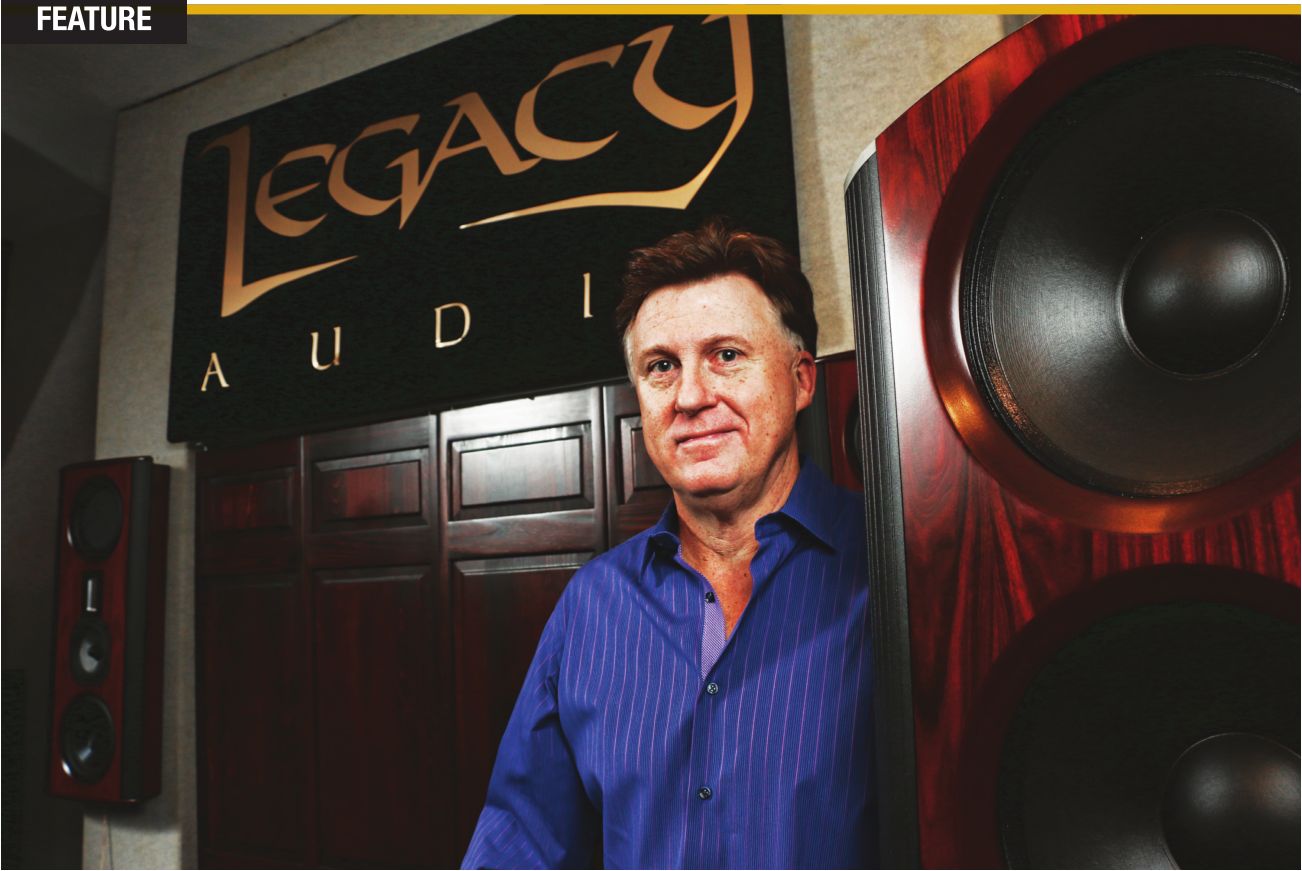
Legacy Audio makes noise outside Springfield
They come from everywhere to these metal warehouse-like buildings with a gravel parking lot, hidden behind a plain-looking fourplex on Sangamon Avenue.
Bill Dudleston, owner and founder of Springfield’s least-known famous place, recalls recently hosting two European customers, one from Poland, the other from Germany, on a single day. One of them got lost, which is understandable, considering that Dudleston’s shop isn’t visible from the street and the sign posted on Sangamon Avenue is the essence of understatement, more a piece of furniture than advertising. So the visitor stopped at nearby Hall’s Harley Davidson and asked for directions.
Where is Legacy Audio? Never heard of it, a Hall’s employee answered.
Dudleston gets that a lot in the capital city.
You won’t find Legacy Audio gear at Best Buy, H.H. Gregg or other big box stores. There are just 18 dealers in the U.S. who sell Dudleston’s creations and 20 in other countries.
But word gets around. Actor David Ogden Stiers, a classical music aficionado who has led more than 70 symphony orchestras as a guest conductor, once marched into Dudleston’s office in mock fury.
“Where are my speakers?” demanded the actor best known for playing Major Winchester in the television series M*A*S*H. “I have been waiting!”
Some clients are more studious than others.
With nary a test listen, Scottie Pippen, the former Chicago Bulls star, ordered a set of Legacy Audio speakers after reading about them in a magazine article, Dudleston says. Then there was the guy who showed up in a white Cadillac about 20 years ago, an eccentric sort who reminded Dudleston of Otho Fenlock, the interior decorator in the film Beetlejuice.
“He was very eclectic,” Dudleston recalls.
“He just says, ‘I’m told you build speakers.’ … He had no interest in the price – no interest in the price at all.”
The man spent hours asking questions and listening to loudspeakers. Dudleston, a hopeless music addict, was happy to oblige. The man didn’t state the purpose of his visit – Dudleston assumed that he was just another audiophile who wanted to know more before shelling out thousands for a pair of speakers. He left without buying anything, but shortly afterward, he called and placed an order: Send them to the Stradivari Society in Chicago.
 The visitor had been Geoffrey Fushi, an internationally famous violin dealer known for arranging loans of Stradivarius violins to promising young musicians who otherwise would never be able to touch an instrument worth as much as $16 million. Fushi, who died in 2012, was putting together a recording of 30 violins made by Antonio Stradivari, one of his sons and Giuseppe Guarneri, a legendary Italian luthier
who lived at the same time as Stradivari and crafted violins that are
considered some of the best ever made. The three-CD project titled The Miracle Makers featured
Elmar Oliveira, the only American violinist to win the prestigious gold
medal at the Tchaikovsky International Competition in Russia, playing
15 short pieces on a Strad, then a Guarneri and, finally, the opening of
the Sibelius Concerto on all 30 instruments.
The visitor had been Geoffrey Fushi, an internationally famous violin dealer known for arranging loans of Stradivarius violins to promising young musicians who otherwise would never be able to touch an instrument worth as much as $16 million. Fushi, who died in 2012, was putting together a recording of 30 violins made by Antonio Stradivari, one of his sons and Giuseppe Guarneri, a legendary Italian luthier
who lived at the same time as Stradivari and crafted violins that are
considered some of the best ever made. The three-CD project titled The Miracle Makers featured
Elmar Oliveira, the only American violinist to win the prestigious gold
medal at the Tchaikovsky International Competition in Russia, playing
15 short pieces on a Strad, then a Guarneri and, finally, the opening of
the Sibelius Concerto on all 30 instruments.
“With The Miracle Makers, I can prove that instruments like these are necessary to an artist,” Fushi in 2001 told The Strad, a
magazine that caters to musicians who play cellos, violins, violas and
stand-up basses played with bows. “My projects are big. Bigger is
better!” The project was accomplished with Legacy Audio speakers as the
final link of the recording studio’s playback system, Dudleston says. It
wasn’t the only time that Dudleston’s speakers have made the big time.
Legacy Audio’s listening room is decorated with framed albums mixed and
mastered by recording engineers who used Dudleston’s speakers to ensure
the highestquality recordings possible. Linda Rondstadt’s Greatest Hits Vol. 2. Hell Freezes Over by the Eagles. Frank Sinatra ’57 In Concert.
Steve
Hoffman, a California-based recording engineer acknowledged as one of
the best at remastering albums from original studio tapes and making
them sound fresh, says via electronic message that he was drawn to
Legacy Audio speakers by both the sound and the price, which is
considerably lower than other high-end speakers aimed at affluent
audiophiles who live in a world where loudspeakers can cost six figures.
“After
contacting the company, they helped us out by furnishing me with a pair
of speakers for my home studio and a pair for my listening room,”
writes Hoffman, who used Legacy Audio speakers when remastering
recordings by Sinatra, Nat King Cole and Elvis Presley. “Great sounding
and nice looking. I used them for many years.”
Dudleston also counts as customers L.A.
Reid,
chairman and CEO of Epic Records, and Rick Rubin, the record producer
who worked with the Beastie Boys, Public Enemy and other hip-hop artists
before reviving Johnny Cash’s career in the 1990s. In Peoria, the
five-stories-high by seven-stories-wide screen at the city’s Riverfront
Theater features a sound system built by Legacy Audio. But Dudleston
says that he especially likes folks who drive $5,000 cars and pay five
times that much for loudspeakers.
“I love those customers,” Dudleston says.
“They’re that passionate about music.”
From
Lanphier to Legacy Dudleston says he enjoys all kinds of music, from
blues to classical to country, preferably the Bakersfield variety. Is
there anything he doesn’t like?
“Muskrat
Suzie, Muskrat Sam, do the jitterbug…” he croons in response. The cover
version by Captain and Tennille, he says when asked for clarification,
not the original by America, a band that he proclaims had talent.
His
answer betrays a coming of age during the 1970s, a decade known for
both timeless classics and wretchedly awful tunes. Dudleston graduated
from Lanphier High School in 1976, the same year that “Muskrat Love” was
an AM radio constant. After graduating from Lanphier, Dudleston went to
Lincoln Land Community College, then the University of Illinois, where
he got a degree in chemical engineering. Along the way, he married
Deborah Albright, a Lanphier classmate who is now a pediatrician.
Dudleston
was in high school when he built his first speaker. Made from a cigar
box, he recalls that “it actually sounded pretty good.” Dudleston also
has a thing for microphones, and his love for recording music is
evidenced by a recording studio at Legacy Audio, although the studio is
now in temporary use as a storage area for speaker cabinets and other
audio components.
In
the fall of 1976, Dudleston snuck a tape recorder into the Assembly Hall
in Champaign to capture Elvis Presley in concert. He later acquired a
soundboard recording from the show – he won’t say just how – and mixed
it with his tape to create a recording that puts the listener in the
seats, with both Elvis’ performance and the audience’s reactions coming
through. He once managed to hide a microphone for a recording device
inside Ray Charles’ microphone during a performance in Chicago, and
Dudleston captured things the audience never heard.
“Goddammit,
I told you not to play that shit so loud!” Charles told his backing
band, unaware that he was being recorded for posterity.
Dudleston
took a job with U.S. Industrial Chemicals in Tuscola after graduating
from the University of Illinois in 1981, but his career as a chemist
didn’t last long. He realized that his career trajectory would
eventually have him sitting in an office reviewing reports from
subordinates, and it wasn’t the sort of working life he relished. And so
in 1983 he started his speaker company, then called Reel To Real, in
the garage of his father-in-law, Jacob Albright, an accomplished
woodworker who signed on as business partner.
By 1996, the company’s reputation was such that the Wall Street Journal published
an article extolling the company’s dedication to customer service. In
2001, Legacy Audio had 25 employees and $3 million in annual revenue,
according to a write-up in USA Today.
Dudleston now has 15 employees and says that bigger isn’t necessarily better.
“What happens is, it gets industrialized, and I just don’t like that,” he says.
There is no assembly line at Legacy Audio.
Employees
are cross-trained so that they can do a variety of tasks as the need
arises. Many had no experience in electronics or woodworking before
coming to work at Legacy Audio. Sam Wolf, for example, had never sprayed
a finishing coat on anything before Dudleston hired him about four
years ago. Wolf now lays down lacquer on speakers worth tens of
thousands of dollars as if he’d been doing it all his life.
“I didn’t know any of this before I started here,” he says.
Dudleston
says he knew that Wolf would succeed after watching him change the
taillight on a car. From the way Wolf went about the task, with
confidence and purpose, it was obvious that he could learn how to build
speakers.
“I just watched him work with his hands,” Dudleston says.
Tom
Kulavic, who’s worked at Legacy Audio for eight years, has been an
audiophile since he was 14. When he first started working for Dudleston,
he owned speakers made by Klipsch, a company several times the size of
Legacy Audio that has been in business since the 1940s. Kulavic figured
they were fine.
“It
only took a few months,” he recalls. The turning point came when
Dudleston played “Summer Wind” by Sinatra to test a pair of freshly
built Legacy Audio speakers – all speakers are played for two hours
before being shipped.
“That was it,” recalls Kulavic, who replaced his Klipsches with Legacy Audio speakers and has never looked back.
Doing
justice to music Legacy Audio offers more than three dozen models of
speakers, with small ones designed for compact rooms to behemoths built
for theaters and live music venues. Prices range from $1,000 for a
center speaker designed for home theaters to nearly $53,000 for a pair
that weigh 320 pounds apiece.
Special
requests can boost the cost as well as increasing the build time. It
took awhile for Dudleston to find just the right piece of rosewood to
finish speakers that have been two years in the making, and figuring out
how to put camouflage on speakers for a customer who wanted
one-of-a-kind wasn’t easy. Cabinets are made onsite, as are crossovers,
the part of the speaker that sends audio signals to tweeters, midranges
or woofers depending on the whether the frequency is high, low or
somewhere in the middle.
Tweeters,
woofers and other parts that aren’t made by Legacy Audio are custom
built in Europe to Dudleston’s specifications. While best known for
speakers, the company also makes amplifiers and preamplifiers that
process electronic signals from turntables, CD players and other sources
so that what comes out of speakers is as close to a live performance as
possible.
Each
speaker is “tuned” before shipment, a process that can take anywhere
from two hours to a day as electronics are tweaked until the sound is
just exactly perfect. Rob Price, who worked at Capitol Records’
now-closed CD manufacturing plant in Jacksonville before Dudleston hired
him 15 years ago, tinkers until he thinks he has it right, then calls
in Dudleston, who has the final listen and say. Price says that he gets
it right six or seven times out of ten.
“Bill’s particular,” Price says. “He wants it to sound the best that it possibly can.”
Dudleston’s
passion for science is obvious as he explains the challenge of filling
what he calls shadows inside the brain with sound, and when he really
gets going, much of what he says can be difficult to follow for a
layperson. Gradient acoustic pressure. Algorithms. The finer points of
electronic gizmos that detect the dimensions of the listening room and
tailor a speaker’s output so that sound doesn’t bounce willy-nilly off
walls but instead comes off as natural, as if the listener is sitting in
a concert hall. Sound and light, Dudleston notes, both come in waves.
“If
you can bend light with a prism, you can create colors,” he says.
“Sound’s no different. … I want to do justice to the music. I want to
hear the violinist when he takes a breath.”
To
hear Dudleston’s speakers in action is to have one’s breath snatched.
His products have won a slew of best-speaker awards from audiophile
publications, with reviewers prone to rave.
“One can hear the whole of the drum, its initial strike and the echo both inside the drum and inside the venue,” a Stereo Times reviewer
recently wrote after listening to an Igor Stravinsky recording on
Legacy Audio equipment. “(W)hen playing the soundtrack from the Broadway
play Cats and even on the movie soundtrack from Chicago, I
was hearing each instrument, voice and subtle nuance come through with
all their attendant nuances and inflections. In other words, the music
was rendered in a very emotive and natural way that enhanced my musical
pleasure and sucked me into the performances, causing me to extend my
listening sessions for longer than I had planned.”
 Terry Hetzel, a corporate recruiter who lives in Charlotte, North Carolina, is selling his Legacy Audio Classics, a model that retails for about $5,500,
so he can make room for the Focus model, which sells for twice as much.
Hetzel, who once worked in sales at shops in Chicago and Indiana that
cater to audiophiles, says that the Focus model gives $100,000 speakers
from other companies a run for their money.
Terry Hetzel, a corporate recruiter who lives in Charlotte, North Carolina, is selling his Legacy Audio Classics, a model that retails for about $5,500,
so he can make room for the Focus model, which sells for twice as much.
Hetzel, who once worked in sales at shops in Chicago and Indiana that
cater to audiophiles, says that the Focus model gives $100,000 speakers
from other companies a run for their money.
“I’m
heavily into high-end audio,” Hetzel says. “Legacy products are, pound
for pound, speaker for speaker, the very best value in all of high-end
audio. There’s just no way around that. The parts they use, the
furniture-grade finish – it’s really a miracle they charge what they
charge.”
At audio
shows where discriminating listeners gather, Dudleston says he tries to
get his speakers set up next to ones from other makers that push or
exceed the six-figure barrier. His speakers, he insists, can compete
with any on the planet, and a higher price doesn’t always mean better
quality.
“There’s only
so much you can spend on a speaker – I’m a practical guy,” he says. “I
only have one life. Why don’t we do what we do better than anyone else?”
Contact Bruce Rushton at [email protected].


