Environmental group feels ignored by city
Springfield’s municipal utility appears to be violating environmental rules, according to the Sierra Club.
The environmental group claims city leadership won’t discuss issues raised nearly four months ago. City Water, Light and Power responded last week to the Sierra Club’s concerns, but the group says it wants better communication with the city.
The Sierra Club and CWLP have a history together. When CWLP began planning the Dallman 4 power plant, the Sierra Club threatened to sue because the Sierra Club believed the permit for Dallman 4 would allow too much pollution. CWLP ultimately agreed to limit emissions of carbon dioxide and other pollutants in a 2006 ordinance approved by the Springfield City Council.
In a letter sent on July 31 to Springfield mayor Jim Langfelder, the Illinois and Sangamon Valley chapters of the Sierra Club outlined their concerns about emissions from the Dallman power plants and other aspects of CWLP’s operations.
“The City of Springfield faces multiple urgent and interconnected financial and environmental issues at CWLP that need near-term attention,” the letter states.
Andy Knott, senior campaign representative for the Sierra Club’s “Beyond Coal” project, says the Sierra Club isn’t considering a lawsuit over the alleged violations.
“The letter was not a legal threat,” he said.
“Our goal is to have a dialogue with the city.”
Scott Gauvin, vice chairman of the Sangamon Valley group of the Sierra Club, was one of the authors of the letter. Speaking to Illinois Times before CWLP sent a response letter on Nov. 25, Gauvin said the Sierra Club received no response for months after sending their July 31 letter. He and other
Sierra Club representatives feel their concerns are being ignored by the city.
“That’s one of the reasons we’re calling for a more formal process, because these technical things are not being discussed,” Gauvin said. “These things are not pushed, poked or prodded by the aldermen and women. They take what CWLP says as gospel. We want a process there, so that citizens have an open, honest venue to ask these questions.”
Among the Sierra Club’s concerns is a belief that CWLP has released the greenhouse gases carbon dioxide (CO2) and nitrogen oxides (NOx) in excess of the limits set in the 2006 ordinance. The ordinance limits CO2 emissions to 1,755,000 tons per year and NOx emissions to 0.07 pounds per thermal unit.
In the Nov. 25 response letter from CWLP, chief utility engineer Doug Brown said the utility’s CO2 emissions only appear over the limit in the EPA data because the data includes electricity that CWLP sold on the wholesale energy market. The CO2 associated with that electricity is exempt from the ordinance limit, which only applies to “native load” – the electricity generated for CWLP’s customers. Counting only the CO2 from the native load puts CWLP below the ordinance limit, Brown said. The utility’s NOx emissions also comply with the limit, he said.
The Sierra Club also believes that CWLP’s coal ash storage ponds – located north of Lake Springfield next to East Lakeshore Drive – may be leaching pollutants into the nearby Sugar Creek. Brown responds that the Illinois EPA monitors the ponds through groundwater sampling wells that CWLP voluntarily installed, and the utility has hired an environmental consulting firm to help CWLP comply with new regulations. Additionally, no drinking water wells are affected by the ponds, Brown said.
Andy Knott at the Sierra Club noted that CWLP didn’t deny there’s a problem with the ponds.
“The bigger question is how much is it going to cost to clean it up and prevent that from happening in the future,” Knott said.
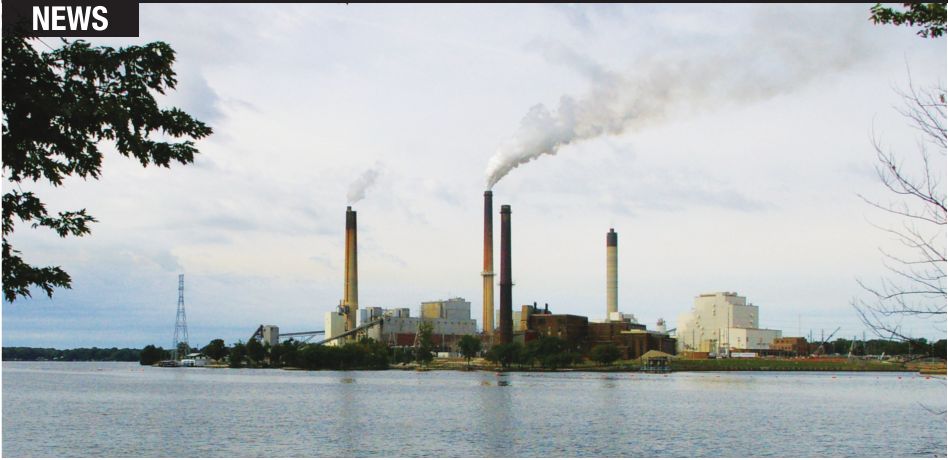
Another concern for the Sierra Club is that CWLP regularly exceeds the legal limit on smoke thickness, a measure known as “opacity.” CWLP notified the Illinois Environmental Protection Agency of opacity violations more than 7,000 times between 2012 and the middle of 2014, the Sierra Club said, and the utility claimed its emissions were excused under an exemption that the Sierra Club says the U.S. EPA and a federal appellate court have struck down.
Brown said that the thick smoke was due to the three oldest Dallman units having a slower start-up time. He said CWLP is already converting those units to start with natural gas instead of fuel oil, which allows pollution control devices to be engaged earlier in the process. Pollution controls are typically bypassed during start-up with fuel oil because the oil would otherwise contaminate the coal slurry.
The Sierra Club also believes CWLP’s “once-through” cooling system doesn’t meet a requirement for using “the best technology available.” Brown said the newest Dallman 4 unit has a closed-cycle cooling system that recycles its water. CWLP is preparing to address new regulations for the older units, he said.
Knott said he is pleased that CWLP responded to the Sierra Club’s concerns, but he hopes to meet with city officials for further discussions.
Contact Patrick Yeagle at [email protected].