‘Tactical urbanism’ seeks small efforts for big change
Just keep swimming.
That was the message of Sustainable Springfield last week as the progress-minded group shared its vision for building a more attractive city, one small piece at a time. Featuring panelists from other local groups, the nonprofit Sustainable Springfield called on residents to take up “tactical urbanism” during a Nov. 4 presentation at Lincoln Library.
Tactical urbanism is a new term for an old idea. It refers to improving a community through small steps that add up to big changes. One historical example is the Parisian merchants who began selling books along the River Seine during the Middle Ages after the invention of the printing press made books affordable to common people.
In more modern times, tactical urbanism can mean planting gardens on vacant lots, installing art in public places and slowing traffic through a neighborhood with makeshift barriers. Some such acts are sanctioned by local governments, but many are not, meaning tactical urbanism sometimes takes the form of low-key subversion in the public interest.
Jess Weitzel, a board member of Sustainable Springfield, says the City of Springfield’s last comprehensive plan was developed in 1999, which means it doesn’t account for the effects of the 2008 recession or thousands of state jobs moving to Chicago. At the same time, however, there has been a resurgence of do-ityourself culture, she says, which means people are more likely to initiate change on their own.
“A lot of people would rather do something themselves than wait for somebody else to do it,” she said.
George Sinclair of Springfield, owner of the Black Sheep music venue and Skank Skates International, is a veteran of the DIY movement, sometimes butting heads with city government and sometimes working with it. His block at the corner of South Grand Avenue and 11 th Street is a counterculture oasis of music and art, epitomizing the tactical urbanism ethos. He’s currently developing “Project Southtown,” a more formal continuation of his existing urban renewal efforts.
Sinclair credits Springfield chef Michael Higgins with inspiring some of his selfsufficient approach. Higgins, who owns Maldaner’s Restaurant, has several such projects to his credit, like keeping a bee colony on the restaurant’s roof, which required changing the city’s code of ordinances to allow beekeeping. It was Higgins who first convinced the City of Springfield to allow outside dining at downtown restaurants in 1998, and he’s also responsible for introducing the city’s first “parklette,” a seasonal outdoor dining patio that replaces two parking spaces in front of his restaurant. Earlier this year, Higgins added a hopscotch course on the sidewalk near his parklette – with the city’s permission, of course.
“You know what that cost?” Higgins said.
“A roll of gorilla tape. … This is an example when you talk about what you can do that costs nothing that puts a smile on peoples’ faces.”
Lindsay Record, program director for the Illinois Stewardship Alliance, says her group is working to make its Holiday Farmers Market at the Illinois State Fairgrounds a year-round program. To extend the farmers market, the group is raising money to rent a permanent space which will include an “incubator kitchen.” The kitchen will be used to teach low-cost cooking classes and provide food entrepreneurs access to a work space that meets safety standards, which the Stewardship Alliance hopes will allow more people to make and sell local food products.
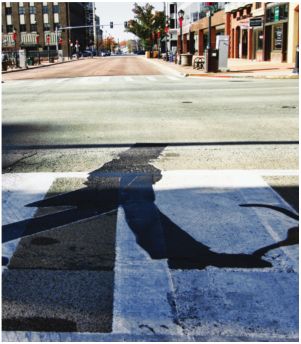
Erin Svendsen, education coordinator for the Springfield Art Association, says the group’s crosswalk painting program began in October with an installation at Sixth and Washington Streets. The crosswalk depicts Abraham Lincoln and family in the style of the Beatles’ famous Abbey Road album cover. Svendsen says the Art Association is looking for artists to paint additional crosswalks.
“Just keep swimming,” advised Katie Davison, who is responsible for the popular Bites on the Boulevard events that the MacArthur Boulevard Association debuted this summer. The two events, which featured food trucks and similar attractions, grew much faster than Davison anticipated, and she hopes to hold future events once per month next summer. Davison says at some points during the difficult planning process, she felt she was swimming upstream and felt like giving up. But she learned that changing a community takes persistence.
“If you keep running into a brick wall, turn,” she said. “Don’t keep running into the wall. Turn and you’ll find a different path.”
Contact Patrick Yeagle at [email protected].