Seasonal desserts have always been warm weather milestones. In spring, there’s rhubarb pie – so delicious that rhubarb itself was called “pie plant” in earlier times. And, of course, strawberry shortcake and various other rhubarb and strawberry concoctions, singly or in combination. Summer brings peaches, apricots, melons, Lodi apples and more berries: blackberries, red and black raspberries and gooseberries. Peach cobbler, anyone? Even a simple bowl of seasonal fruits, with or without a small scoop of ice cream or dollop of yogurt, is a simply delicious treat in a way that out-ofseason grocery fruits can’t match.
This time of year (when summer eases into fall) provides its own special dessert possibilities. Multiple varieties of apples and pears appear at farmers markets and stands. Yes, there will be apples and pears at grocery stores throughout the winter (and the rest of the year), but many varieties are strictly seasonal. Not least among these is seasonal Yellow Delicious, a world apart from their insipid grocery store counterparts.
Red raspberries produce a second local crop. Purple plums, aka Italian plums or prune plums and their smaller cousins, Damson plums, make their fleeting appearance.
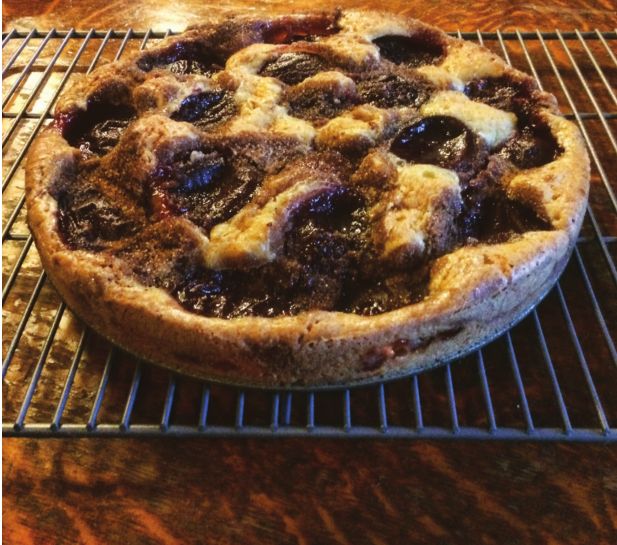
I think of the following recipe more as a homey kuchen than a torte. But I’ll defer to what has been the New York Times’ most requested recipe’s label. Longtime NYT food writer Marian Burros’ recipe for plum torte was first published in 1982. It was so popular that the paper reprinted it for the next seven years before editors decided it had its run.
Afterwards, Burris wrote, “To counter anticipated protests, the recipe was printed in larger type than usual with a broken-line border around it to encourage clipping.”
Readers didn’t buy it, and the NYT was deluged with “angry letters.” “The appearance of the recipe, like the torte itself, is bittersweet,” wrote one subscriber. “Summer is leaving, fall is coming. That’s what your annual recipe is all about. Don’t be grumpy about it.”
The NYT didn’t reprint the recipe each year, but made it easily available. It, along with a host of other recipes, cooking advice and helpful videos, can be found on the NYT’s Cooking website. It’s one of my favorites (maybe even my most favorite), and well worth checking out.
I’ve been making this simple – and simply sublime – recipe for many years, although I don’t remember exactly how many. It’s the definitive comfort dessert for this in-between season.
Plum torte
• 3/4 c. sugar
• 1/2 c. unsalted butter
• 1 c. unbleached flour
• 1 tsp. baking powder, preferably one without aluminum salts such as Rumford
• Pinch of salt
• 2 eggs
• Pitted and halved purple Italian or Damson plums
For topping:
•
2-4 T. sugar to taste, and depending on the sweetness of the plums,
preferably coarse sugar labeled variously as turbinado, demerara or
sugar in the raw
• 1 tsp. cinnamon, or more or less to taste
• Lemon juice to taste, depending on the sweetness of the plums. Preheat oven to 350 F.
The number of plums needed depends on their size. 24 halves of
purple/Italian plums is about right; figure on half again to twice as
many Damsons.
Cream the sugar and butter in a bowl.
Add the flour, baking powder, salt and eggs and beat well.
Spoon
the batter into a 9-or-10-inch buttered and floured springform pan or
cake pan. Place the plum halves skin side up on top of the batter. Mix
together the sugar and cinnamon and sprinkle evenly over the fruit and
batter. Drizzle with lemon juice.
Bake
approximately one hour, or until a tester inserted into a cake-only
section of the torte comes out clean. Remove and cool; refrigerate or
freeze if desired (see below). Or, cool until barely warm and serve
plain or with whipped cream.
To
serve the next day: Cover with plastic wrap or foil. Reheat briefly at
300 F. To freeze: Double wrap the torte in foil, place in a plastic bag
and seal. To serve a torte that was frozen: Defrost and reheat as above.
This
recipe is equally good for a single tart or as individual tartlets.
It’s spectacularly gorgeous but easily made. The easy-tohandle nut
shortbread crust is a boon to those who don’t want to fuss with regular
pie pastry.
Pear and raspberry tart(s)
• 1 recipe Nut crust, recipe follows. Use slivered and lightly toasted almonds and both the optional lemon peel and cinnamon.
• 1 beaten egg
• 6 T. seedless red raspberry jam
• 3 or more firm but ripe pears, preferably a more rounded variety
• Turbinado sugar, sometimes called demerara sugar, coarse sugar or sugar in the raw, for sprinkling
• 1 pint fresh red raspberries
• Creme fraiche or whipped cream for garnish, optional Preheat the oven to 350 F.
You can use tart pans to make the shells, but the nut crust is sturdy enough to just make them/it directly on a baking sheet.
If
making individual tarts, divide the nut crust into 6 equal portions.
Press each portion into a disk about 4 inches in diameter and pinch up
the sides to form a rim about ½-inch deep. If making one tart, press
into a disk about 9 inches in diameter, then pinch up the sides as for
individual tarts. Chill the tart shells for about 10 minutes to firm,
then transfer them to a baking sheet, preferably perforated.
Bake
the individual shells for 10 minutes or the single shell for 15
minutes, then remove from the oven, brush the bottoms and sides lightly
with the beaten egg and return to the oven for an additional 5 minutes.
Cool the shell(s) to room temperature.
Increase
the oven heat to 400 F. Halve and core the pears. They may be peeled or
not as you desire. Cut each half into 4–6 slices. Trim off any narrow
ends as necessary to make them fit the shell(s).
Spread
the bottom of each tart shell with 1 tablespoon of the jam. Arrange the
pear slices in a concentric pattern on top of the jam. Each individual
tart should take 4–6 slices, about 12 for a single tart, but the total
number of slices needed will depend on the size of the pears. You may
have leftover pieces for a delicious snack. Sprinkle each tart with
about a teaspoon of the turbinado sugar.
Bake the tart(s) for 35–40 minutes, or until the pears are lightly browned and cooked through.
Remove
the tarts from the oven and, while still hot, scatter a few raspberries
over them. Use only about 6 per tart; you do not want to cover the
entire surface.
Serve the tarts warm or at room temperature with a dollop of whipped cream if desired.
Makes 6 individual tarts or 1 9-inch tart.
Nut crust
• 1 c. lightly toasted nuts such as pecans, almonds, walnuts or hazelnuts, finely ground (measure before grinding)
• 1 1/2 c. unbleached all purpose flour
• 1/2 c. (1 stick) unsalted butter, softened
• 3 T. brown sugar
• 1 egg
• 1 tsp. vanilla extract
• 1 tsp. salt
• Optional
• 1 tsp. cinnamon
• 1 T. grated lemon peel
Mix
all ingredients together well, either by hand or using a mixer or food
processor. Press into pie or tart pan. Refrigerate or freeze until
thoroughly chilled.
Preheat
oven to 350 F. Bake for 25–30 minutes for a single pie shell, 15-20
minutes for individual shells or until golden brown. Cool completely
before filling.
Makes 1 9–12-inch pie or tart shell or 6 individual tart shells.
Contact Julianne Glatz at [email protected].