Will the high court leave Americans vulnerable to corporate panhandlers?
Nobody likes being bullied. Nobody likes being called names. Nobody likes being asked for money. As for being bullied and called names while being asked for money, well, there oughta be a law.
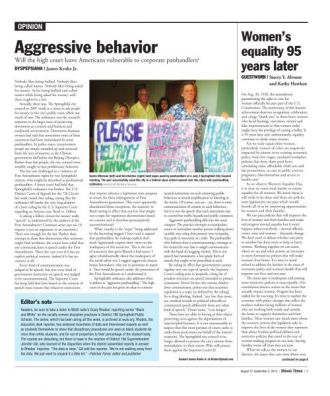
Actually, there was. The Springfield city council in 2007 made it a crime to ask people for money in the city’s public ways, albeit not much of one. The ordinance was the council’s response to the larger issue of preserving downtown as a tourist and business and residential environment. Downtown business owners had said that sometimes some of their customers had been intimidated by some panhandlers. In police states, inconvenient people are simply rounded up and removed from the eyes of tourists, as the Chinese government did before the Beijing Olympics. Rather than ban people, the city council more sensibly sought to ban problematic behavior.
The law was challenged as a violation of First Amendment rights by two Springfield citizens, who might be described as professional panhandlers. A lower court had held that Springfield’s ordinance was kosher. The U.S. District Court of Appeals for the 7th Circuit last week tossed that ruling, saying that the ordinance fell under the very long shadow of a June ruling by the U.S. Supreme Court regarding an Arizona case, Reed vs. Gilbert.
Is asking a fellow citizen for money really “speech” as understood by the authors of the First Amendment? Common sense says no. (A request is not an argument or an assertion.) That’s not enough for the law. Rather than attempt to draw fine distinctions that someone might find invidious, the courts have ruled that any communication is speech under the First Amendment. That’s the case even if it has no explicit political content, indeed if it has no content at all.
Every kind of communication was judged to be speech, but not every kind of government restriction on speech was judged to be unconstitutional. The Supreme Court has long held that laws based on the content of speech must ensure that whatever restrictions they impose advance a legitimate state purpose in return for their infringement of First Amendment guarantees. This court apparently abandoned those exceptions, the majority in Reed stating in effect that any law that singles out a topic for regulation discriminates based on content and is therefore presumptively unconstitutional.
What, exactly, is the “topic” being addressed by the hectoring beggar? I have read it argued that panhandlers, by making explicit their need, legitimately express their views on the inadequacy of the social net. This is the sort of statement that gives liberals a bad name. I agree wholeheartedly about the inadequacy of the social safety net; I suggest aggrieved citizens harass lawmakers, who are in positions to repair it. That would be speech under the protection of the First Amendment as I understand it.
Springfield’s ordinance also addresses what it defines as “aggressive panhandling.” The high court in the past has given its okay to content neutral restrictions on such annoying public behaviors as sound amplification or loitering in the streets. Of course, you say – yes, there is some communication of content in such behaviors, but it is not the speech that such restrictions aim to control but traffic hazards and public nuisances.
Aggressive panhandling falls into the same category. The practice attempts to manipulate, coerce or intimidate another person walking down a public way using that person’s own sympathy, fear, guilt or insecurity as a club. The panhandler who behaves thus is communicating a message to his victim the way that a cudgel communicates with the head of mugging victims. This is not speech but harassment, a low-grade form of assault that ought to be proscribed as such.
By ruling in effect that governments cannot regulate any one type of speech, the Supreme Court’s ruling puts in jeopardy a long list of prudent strictures on speech intended to protect consumers. Kevin Drum, the veteran Mother Jones commentator, points out that securities regulation is a topic [as defined by the ruling]. So is drug labeling. Indeed, “any law that treats, say, medical records or political robocalls or commercial speech differently from any other kind of speech,” Drum notes, “is in danger.”
Those laws are alike in having as their object protecting us’ns against the depredations of unprincipled business. It is not unreasonable to suspect that this most partisan of courts seeks to undo those protections on behalf of the nation’s corporati. The Springfield city council is no longer allowed to protect the city’s citizens from intimidation on their streets. Who will protect them against the Supreme Court?
Contact James Krohe Jr. at [email protected].
Editor’s note
Readers,
be sure to take a listen to WUIS radio’s Dusty Rhodes’ reporting series
“Black and White” on the racially uneven discipline practices in
District 186 Springfi eld Public Schools. The series, which has been
airing all this week, is archived at wuis.org. Rhodes, the education
desk reporter, has analyzed mountains of data and interviewed experts as
well as students themselves to show that disciplinary procedures are
used on black students far more than white students, and far out of
proportion to their percentage of the student body. The reports are
disturbing, but there is hope in the reaction of District 186
Superintendent Jennifer Gill, who learned of the disparities when the
district assembled reports in answer to Rhodes’ inquiries. “The data is
clear,” Gill told the reporter. “We’re not walking away from the data.
We just want to unpack it a little bit.” –Fletcher Farrar, editor and
publisher