Reforming what matters
Getting labor back into politics
DYSPEPSIANA | James Krohe Jr.
Tell me, brother, don’t you understand We’re all working for the Pharaoh “Pharaoh” Richard Thompson © BMG Rights Management US, LLC
Reform. Our problem is not that everybody talks about it but no one ever does anything about it. Our problem is that everybody talks about it but only a few people get listened to. Take the vexed issue of public employees unions. Our Mr. Rauner has a plan to reform the relationship between employer and employed in these regards. His ideas have not gotten enough informed attention – see “The razor blade in the apple,” June 18, 2015 – but even so he remains the only would-be reformer whose reforms get talked about by the press at all.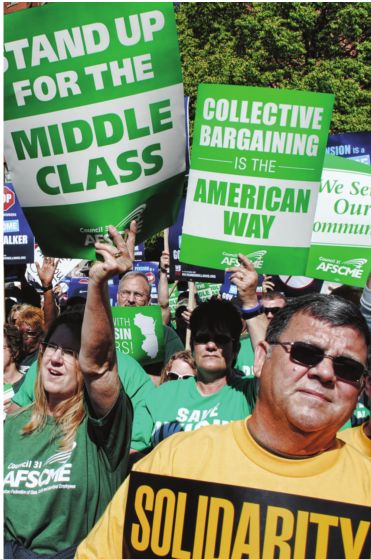
The tragedy for Illinois is not that one side or the other might win. The tragedy is that the argument about pensions and health care is, as always, taking place in the context of labor negotiations. The governor contends that public employee unions wield too much power over public policy in this state. I suggest that the problem is that unions have never wielded enough power over public policy, and not only in Illinois. In a better U.S.A. – not, mind, the one dreamed of by the nation’s Rauners – pensions and health care would not be on the bargaining table. That’s because pensions and health care would be guaranteed by the national government as a right of citizenship, not a condition of an employment contract.
In this country and in most of Europe, politics and economic life in the 19th and well into the 20th centuries was roiled by the social consequences of industrialization. In Europe, working people backed new political parties to cope with the conditions caused by the new economy. Those parties pressed for what amounts to a better contract between government and all citizens. National governments undertook by various means to maintain the social balance in the face of the destructive tendencies of unfettered capitalism, as is done under the so-called German model, for example. Daily life in the democratic, prosperous north of Europe to this day features health care as a matter of right, free or cheap college education, universal pensions, child care, real vacations. If that is hell on earth, as our Right ridiculously claims, then call me a sinner and sign me up.
In the U.S., labor unions began as cooperative associations providing pension and unemployment relief, not as bargaining agents. For a time they entertained wider ambitions to mobilize a national constituency for such policies as a matter of public policy. For reasons much too complicated to explain here, organized labor gave up on politics as the means of achieving fairness and security for working people. Instead of trying to unite to represent all working people in legislatures and Congress, they represented only their members. The rest of us were left to our own devices.
Our new part-time, on-demand we’lllet-you-know Uber economy promises a world of convenience for the consumer; for the people trying to make a living it means uncertainty, lower wages, overwork. This is a change, indubitably. It is not reform. It is absolutely not progress. New arrangements must accommodate these new realities, of course, but the principles that informed the European-style social economy still look to be the best basis for a renegotiated bargain between governed and government. Vermont’s Bernie Sanders is a man who blends good intentions and bad economics, but if Sanders has many of the wrong answers he’s at least asking the right questions. The only thing you will learn about them from the media, however, is that they render him unelectable.
In spite of a few attempts, Illinois never got a viable workers party, as I was reminded the other day reading the news from Chicago. The Chicago Teachers Union was in the news because of its foolish insistence that it was unacceptable to expect members’ share of their pension contribution be paid out of their own pockets. This intransigence is usually dismissed as rooted in mere entitlement but the union argues it is a matter of social justice. They note that mayors have diverted millions from the schools via TIFs, the board office hired hot-shot money men who gambled away another hundred mill, and corporate types are trying to get their hands on revenues via privatization. To then ask teachers to make good the resulting shortfall is wrong.
In a press release from Aug. 5 the CTU sketched out its agenda for alternative ways to fix the money problem. Run the schools by democratic governance rather than mayoral fiat. Adopt a progressive state income tax. Close corporate tax loopholes. Tax financial transactions. “Take a bold stance away from the status quo and do what is just and right, for once.”
“Just” and “right” have very little to do with Illinois politics. There are lots of Illinoisans who think that such steps would be good for everyone, not just schoolteachers. But they are proposed by a union, not from a broad-based political party that represents not only union members but everyone else who doesn’t need a tax lawyer. For that reason they are dismissed unconsidered, indeed barely acknowledged, as narrow and self-interested. No need for the governor to get unions out of politics. They have been for a long time.
Contact James Krohe Jr. at [email protected].
Editor’s note
Illinoisans
have been lulled into thinking that once the current budget stalemate
is resolved, social services will be funded. But, as detailed in this
week’s cover story by Patrick Yeagle, the social services cuts proposed
in Gov. Bruce Rauner’s budget threaten to do more longterm damage than
the current impasse. Defunding social services will affect everyone,
whether they use those services or not. For example, cutting back on
community mental health programs that keep the mentally ill stable and
functioning well increases the risk of hospitalizations, at more
expense. “When you look at any one program, you can say, ‘Well that’s
just one program,’” said Dr. Stephen Soltys of SIU School of Medicine.
“But when you start looking at all of the others, you start seeing a
social safety net – which everyone benefi ts from – falling apart.”
–Fletcher Farrar, editor and publisher


