Should Illinois honor the now-dishonored dead?
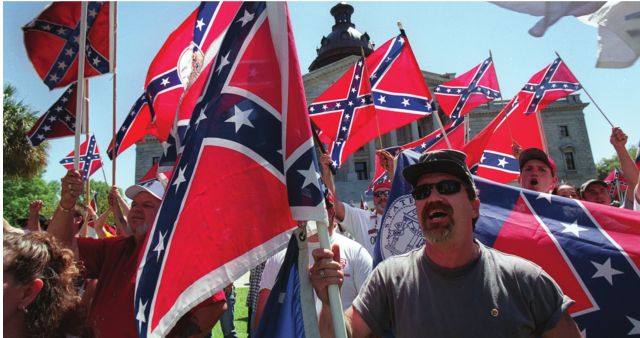
Across the South, Confederate battle flags, long regarded with pride as the symbol of a newly risen South, have been coming down from atop statehouses and courthouses. Hyperbolic commentators see the removal as the final act of the Civil War, but I see it as mere circumspection, not a change of conviction. Those flags still fly in the hearts of millions where the war for the South goes on. A substantial fraction of the public in that part of the country have concluded that slavery was a benign institution (apparently because being a slave in Alabama is still better than being free in Africa) and a former governor and a current U.S senator from Texas again preach secession to cheering audiences.
Not only the South has been slow to come to terms with its past, however, as Capitol Fax’s Rich Miller noted the other day. Miller wondered whether government facilities and entities in Illinois should be allowed to reflect historical incidents, doctrines or individuals that some members of the polity regard as odious. He pointed to Calhoun County, which was named to honor South Carolinian senator John C. Calhoun, who in his later years was an apologist for slavery and a preacher of secession. Miller argued that the state of Illinois does itself and history a dishonor by allowing one of its counties to honor him: “Frankly, I think any official memorialization of that man in the Land of Lincoln should offend us all.”
This, of course, is the objection raised by Southerners to, say, statues of Lincoln being erected in their parks, but I here am interested in how people are offended, not which people are offended. Can the name of a man who held repugnant views offend people who don’t know that the man held such views? I suspect fewer Illinoisans, including those living in Calhoun County, know who John C. Calhoun was than know the name of Oprah’s personal trainer.
Another question: Was Calhoun the slavery apologist and secessionist the man honored by the naming? The Great River Road’s visitor guide to Calhoun County describes him as “a lawyer, politician, and statesman, from South Carolina.” This is laughably inadequate – a little like summarizing Lincoln as “a proponent of internal improvements” – but not inaccurate. At the time Calhoun County was organized and the name chosen in 1825, Calhoun was indeed a respected statesman for his views on westward expansion, a national bank and internal improvements (views then not much different from the young Lincoln). His reputation would change but the name on the maps did not.
The fact that times change, and people change, and views of the times change is a very good reason to never name anything after anyone until that anyone is very, very cold in the ground. (Springfield was for a time known as Calhoun, an episode I explore over at Second Thoughts, at illinoistimes.com.) It also is a good reason to not un-name anything, since what changes can change again. A Springfield public school was named after Black Hawk, author of an Indian uprising in 1832. In his day Black Hawk was regarded as a terrorist. Later he was considered variously a noble red man of the romantic sort, a victim of racial injustice and a people’s liberator.
In this country, the usual way to settle such disputes is not to determine who is correct or incorrect, but to determine the people’s opinion via an open vote and declare the majority’s opinion to be wise, whatever the facts. The public is rarely consulted about the names put on public things and places. It is not usually the people who live in a place who do the initial naming, for example, but the people who own it. There also the awkward question of which public gets to reconsider a naming. Is Calhoun County’s name a matter for Calhounians to decide? They live there, but counties are creatures of the state, so it is or ought to be the state of Illinois’ business.
Rather than how to do re-naming we should ask again whether it ought to be done. Purging Illinois places of references to its many Calhouns uncomfortably resembles the Soviets’ practice of erasing official memory of references of dishonored apparatchiks. Worse, it resembles the way they do things in today’s South. A year ago, the Texas Board of Education approved revisions to its social studies curriculum to require future textbooks and teaching standards to explore the positive aspects of American slavery, to treat Jefferson Davis as another Abraham Lincoln and to inform Texas pupae about the violence of the Black Panther Party while maintaining a polite silence about the terrorism of the Ku Klux Klan. In Tennessee recently, Tea Party activists pressed school officials to remove references to slavery and to the slave-owning pasts of the country’s founders.
Illinois ought to be able to do better. The way to come to terms with the state’s past is to understand it, not change it. The study of John C. Calhoun won’t teach us much about secession or slavery we need to know, but understanding why the people of 1825 Calhoun County chose to name their home after him can teach us about Illinois’ past that we do need to know.
Contact James Krohe Jr. at [email protected].
Editor’s note
Don’t
close the museum, continued. The one and only public hearing on Gov.
Bruce Rauner’s crazy proposal to close the Illinois State Museum is 4
p.m. Monday in Room 212 of the Capitol. Those who wish to speak must
contact in advance the Commission on Government Financing and
Accountability at facilityclosure@
ilga.gov. The written comments posted on COGFA’s website grew to 170
pages by July 5, up from 100 pages July 1. Among the latest to write
their opposition is the American Institute of Biological Sciences: “The
closure of the state museum will prevent researchers, educators,
students and the public from accessing more than 12.5 million items.
These are irreplaceable resources documenting the natural and cultural
history of Illinois.” The president of The Field Museum writes: “There
are measures of economy that are repairable and some that are not. The
collections of the [Illinois State] Museum require sophisticated
maintenance. Not providing that maintenance will cause lasting and
irreparable harm.” Curiously, so far we haven’t heard much on this
subject from Springfi eld’s mayor or city council members, who may be
too busy celebrating the Rauner administration’s support for a second
Springfi eld lake to give attention to saving one of the city’s most
important cultural resources. –Fletcher Farrar, editor and publisher


