Earl a showcase for young performers
FILM | Chuck Koplinski
Having taken the Audience Award as well as the Grand Jury Prize at this year’s Sundance Film Festival, Alfonso Gomez-Rejon’s Me and Earl and the Dying Girl comes to theaters with the burden of high expectations. While I wasn’t completely swept away by this tragic comedy, I couldn’t help but admire its ambition and wasn’t oblivious to its charms; not a statement you’d think could be said when referring to a film that revolves around the death of a young woman.
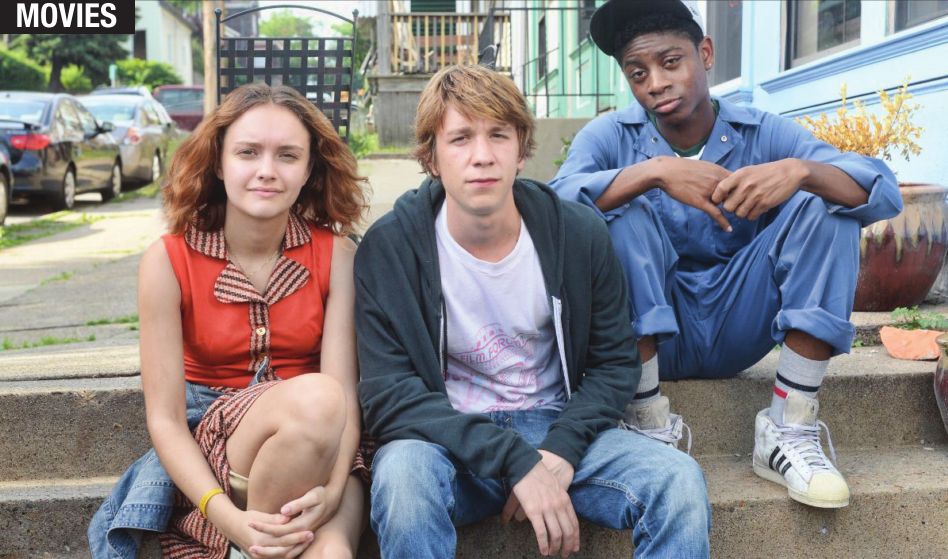
Greg (Thomas Mann) is a high school senior who’s managed to skate through life without making any true friends, only acquaintances. Actually, that’s not true; while he refers to Earl (RJ Cyler) as his “co-worker,” this quietly intense young man is the best friend Greg has, though he’s loathe to admit it. Bonding over their love of film, they’ve spent years making parodies of classic movies. Yet, despite his obvious affinity for the art form, Greg hasn’t taken any steps towards pursuing his passion in college. No, he’s quite content to skate through his final year in high school, oblivious to the future, but even that approach is scuttled when his mother (Connie Britton) insists that he do her a favor. Seems that Rachel (Olivia Cooke), the daughter of a casual friend of theirs, has been diagnosed with leukemia and she insists that Greg spend some time with her. It’s uncertain who hates this idea more – Greg or the young woman who doesn’t want to be pitied – but to placate their parents they get together and ultimately form an odd relationship that profoundly affects them both.
Obviously, Gomez-Rejon is setting the audience up to be manipulated but to his credit he’s able to avoid the usual tropes that would regulate Earl to Movie-of-the-Week status, not focusing so much on Rachel’s debilitating condition as much as the developing friendship between the three principals. Equally refreshing is the fact that the three central figures in the film are written in such a full, well-rounded manner that they don’t come off as the sort of one-note creations that populate John Hughes’ films but rather as multifaceted, troubled teens who exhibit and are defined by more than one character trait.
Cooke never plays Rachel as doomed but rather a young woman with hopes and dreams, given to good days and bad, dictated by typical teenage mood swings, who just happens to have leukemia. The disease is only a small part of her, it does not define her. Of the three principals, Cyler is given the most difficult task, having to work with the least as far as character development is concerned, but it’s to the actor’s credit that he’s able to convey much by being still, making the few moments he’s allowed in the spotlight that much more effective. As for Mann, he has the most difficult role, taking a character that’s hard to like at times yet is able to convince us that the change Greg undergoes is honest and not dictated by the screenwriter’s wishes. All three of these young performers are very, very good and deserve watching in years to come.
If the film has a fault – and it’s a major one – it’s in the way Gomez-Rejon and screenwriter Jesse Andrews, adapting his own novel, portray the adults in the film. Greg’s parents – Britton and Nick Offerman – are each defined by a single quirk, nothing more, nothing less. The mother is a good listener but insists on her son helping this young woman that’s in their social sphere, while the father is a layabout, tenured college professor whose only purpose seems to be giving Greg and Earl exotic foods to eat. As for Molly Shannon as Rachel’s mother, her always drunk, in denial Mrs. Robinson act wears thin quickly, while the tone of her performance is more comedic than tragic, which is not in keeping with the tone of the film. These three veterans are not at fault as they are given far too little to work with. What’s surprising is that Andrews can create such vital, vibrant characters with Greg, Earl and Rachel yet doesn’t take the time to do the same for key adult roles.
In the end, the good outweighs the bad in Earl, not the least being the clever sense of humor that prevents it from bogging down in sentimentality. The more you know about films the more you appreciate the parodies Greg and Earl create. Rosemary’s Baby becomes Rosemary’s Baby Carrots, Citizen Kane is Senior Citizen Kane and, my favorite Grumpy Cul-De-Sacs is their version of Martin Scorsese’s Mean Streets. This kind of humorous invention suffuses the film, giving it a distinctive voice that prevents it from becoming the sort of maudlin exercise that’s far too common and easy to execute.
Contact Chuck Koplinski at [email protected].
To read an interview with Thomas Mann, R.J. Cyler and Olivia Cooke, go to the Cinemascoping blog at http://illinoistimes.com.


