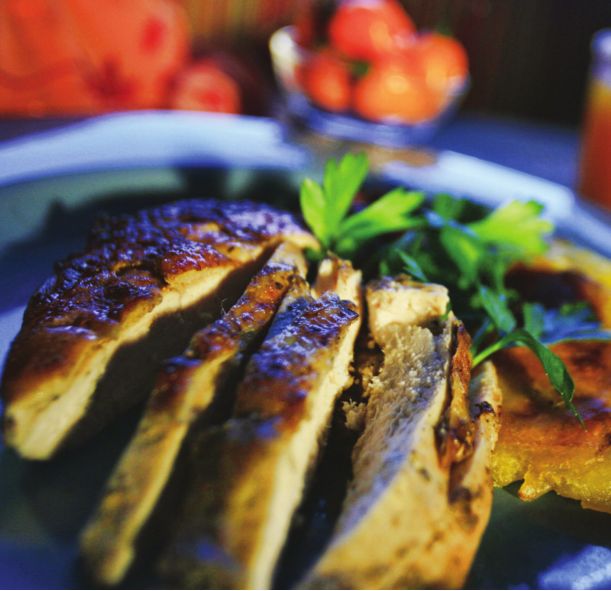
Jerk. Even the name is fun – it could have been created by fast-food marketers trying to come up with a product name appealing to adolescents.
Jerk originated centuries ago in Jamaica when maroons – runaway slaves – fled to the hills to escape their British masters. Wild boars were their main food source. Because the maroons were constantly on the run they couldn’t always hunt, and so they developed a method of preserving the meat with available ingredients: Scotch bonnet peppers, salt and allspice. Allspice isn’t a blend of spices; rather it’s the berry of the allspice bush/tree. Caribbean natives called it pimento, though it bears no relation or resemblance to the sweet red peppers often stuffed inside olives.
Origins of the term “jerk” are lost, but theories abound. There’s a Spanish word, charqui, for South American sun-dried beef. It’s undoubtedly the origin of beef “jerky,” but Jamaican jerk is quite different. Perhaps it’s because the meat is jerked (turned) on a grill, or the meat is pulled (jerked) off the bone. Pork was originally the most common jerked meat. These days chicken is the main choice, although pork is still popular.
Whatever its origin, there’s more to jerk than a cool name. Rightfully Jamaica’s most famous dish, it’s not just spice-tingly delicious; it also takes advantage of a wealth of Jamaican aromatics: spices (not least that allspice), garlic and byproducts of the island’s sugar cane plantations, molasses and dark rum.
Jerk marinade or dry rub typically includes Scotch bonnet peppers. They are among the world’s hottest, something I found out the hard way during a Jamaican trip years ago. Wandering down the beach, my family found a tiny shack/restaurant with palm-frond umbrellas shading plastic tables; each with a jar of orange-and-red pickled something. They looked as if they were peppers but were an usual shape we’d never seen before; I found out afterwards that they’d been given their name because of their resemblance to 19th century Scottish tam o’ shanter caps.
While we were waiting for our order, I foolishly popped one of the mystery peppers into my mouth. Instantly, all hell broke loose. Eons passed until our Red Stripe beers arrived. I quickly downed mine and my husband’s, as well as our children’s soft drinks. Scotch Bonnets (and their close cousins, habañeros) deliver more than heat, though: They have a unique flavor that’s essential for true Caribbean flavor, although jerks are delicious without.
In many ways, jerk is similar to Southern barbecue. There are infinite variations: dry rubs, wet rubs, marinades, sauced, unsauced – no two are alike. I’ve tinkered with jerk recipes for years but only
recently came up with a method that duplicates a unique flavor that
usually is found only in Jamaica or elsewhere in the Caribbean. Though
the rubs, marinades and sauces differ, true Jamaican jerk is grilled
over allspice/pimento wood – something not available here. But I
discovered that using whole dried allspice berries thrown onto hot coals
provides that unique Jamaican flavor.
The
list of ingredients below is long, but it’s mostly just lots of spices.
The brining and marinating need to be done the day before, but actual
prep time is short – and the delectable results are well worth the
effort.
The chicken
may be cut into individual pieces, quarters or halves for marinating and
grilling, but my current preference for this or any other grilled or
roasted chicken is leaving the bird whole and using the “beer can”
method: Empty the can (which can be a soda or other same-sized can; how
you empty it is your business) and fill it about two-thirds full with
marinade drained from the chicken. The steaming marinade infuses the
chicken with extra flavor and keeps it moist.
Making
jerk is fun and perfumes the air with spice and smoke. If it becomes
part of your regular recipe repertoire, prepare extra marinade and glaze
to freeze for next time so that on sultry summer days making jerk is
even easier. No problem, mon!
Food
Fantasies (1512 W. Wabash, 793-8009) sells spices in bulk that are
drastically less expensive – and usually fresher – than those small
containers in groceries. That’s always a good, but especially useful
when for buying a large quantity (e.g., allspice for smoking) or a small
quantity of something that you don’t routinely use.
Jerk chicken
• 1 whole chicken, 2 1/2 – 4 lbs. suitable for grilling
• 1 c. kosher salt
• 1 gallon cold water
For the marinade:
• 2 T. vegetable oil
• 1/4 c. chopped garlic
• 1 seeded and minced Scotch bonnet or habanero pepper, pickled or fresh, or more or less to taste, optional
• 3 T. minced fresh ginger
• 1/2 c. chopped onion, not super-sweet
• 1/4 c. rum, preferable a dark rum such as Myers’
• 1/4 c. unsulfured molasses
• 2 T. lime juice
• 1 T. balsamic vinegar
• 1 T. dark-brown sugar
• 2 tsp. ground allspice
• 1 tsp. dried thyme leaves
• 1/2 tsp. ground cinnamon
• 1 tsp. ground black pepper
• 1/4 tsp. ground cloves
• 1/4 tsp. ground nutmeg
For grilling:
• 1 c. whole allspice
For the glaze:
• 2 T. dark rum, such as Meyer’s
• 1/4 c. mild (unsulfured) molasses
• 2 T. balsamic vinegar
• 1 1/2 T. dark-brown sugar
• 1 T. lime juice
• 2 tsp. minced garlic
The morning of the day before you plan to serve the chicken, put the
cold water in a large pot, add the salt and stir until the salt is
completely dissolved. Place the chicken (be sure to remove the giblets)
in the brine, and make sure that the chicken is submerged by weighting
it with a plate or lid. Refrigerate for at least 4 hours.
Put
the whole allspice for smoking in a resealable plastic bag and add ¼
cup of water. Squish out the air, saturating the allspice and set aside
until the next day.
After
4 hours, remove the chicken from the brine and drain it. Combine the
marinade ingredients in a blender or food processor and purée them. Put
the mixture in a 1-gallon resealable plastic bag and add the chicken.
Squish out any air, then seal the bag and turn it several times to
ensure that the chicken is thoroughly covered and refrigerate. The
chicken should marinate for at least 24 hours but no longer than 48
hours before grilling. Turn the chicken several times while it is
marinating.
Remove the
chicken from the refrigerator 2 to 3 hours before grilling and let it
come to room temperature. At the same time, remove the whole allspice
from the bag and drain off any excess liquid.
Prepare
a medium-hot grill fire if you are using the beer-can method or a
medium fire for cut chicken. Place the chicken on the grill and throw
about 1/4 of the soaked whole allspice berries onto the hot coals. Cover
the grill and let it smoke until the smoke dies away, about 10–15
minutes. Repeat with another fourth of the allspice berries until the
allspice is completely used up. Continue cooking until the chicken is
completely done.
Remove
the chicken from the grill. If you are using the beer-can method, use
tongs and hot pads to carefully remove the can. Lay the chicken on a
flat surface and, using kitchen scissors, cut the chicken in half along
the backbone and breastbone. Return the chicken to the grill, skin side
down, and grill just until the skin is crisp, about five minutes. While
the skin is crisping, brush the inside surface with the glaze. Once the
skin is crisp, turn the chicken over and immediately brush the skin with
the remaining glaze. Turn the chicken over again and grill for about a
minute to set the glaze on the skin. Let the chicken rest for a few
minutes, then serve. The chicken can be left in halves or cut into
pieces.


