Alex Garland’s Ex Machina is a film that revolves around appearances, all of them deceptive. But none more than the movie itself, as its promise of the new is nothing but a lie. Sporting a high-tech sheen that’s impressive and containing a prescient premise that will likely be science-fact rather than science fiction before long, Garland’s script contains nothing novel as it attempts to give us a Frankenstein for the new century, a strategy that falls victim to predictability.
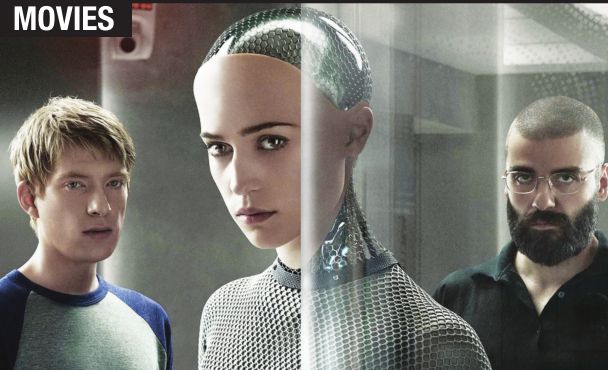
Computer programmer Caleb (Domhnall Gleeson) thinks he’s hit the jackpot when he’s chosen to visit and spend a week at the home of Nathan (Oscar Isaac), the reclusive CEO of the company where he works. He’s under the impression that he’ll be able to pick this genius’ brain and perhaps get a leg up on his fellow workers as far as moving up the corporate chain is concerned. However, once a helicopter deposits him at Nathan’s remote, mountainous hideaway, it becomes clear that something else is afoot. Caleb’s informed that he’s to interact with Ava (Alicia Vikander), a sexy piece of artificial intelligence the recluse has created in order to determine if she could pass for human. Nathan’s not so much concerned about the robot’s physical appearance but rather how she responds and interacts on a mental and emotional level, something Caleb is hardly prepared for.
Much of the film consists of conversations between Caleb and Ava, which progress in an intriguing manner, most of it thanks to Vikander’s constantly evolving performance. As her character grows and becomes more emotionally complex, the actress convincingly conveys her evolution, going from a naïve, eager-to-please creature to one who can be just as duplicitous as her creator. In many ways, she’s the most compelling thing about the movie. Isaac must be commended for fully committing to his role, giving Nathan an edge that’s genuinely frightening, a genius with a hair-trigger temper who’s genetically duplicitous by nature. His is a dominating performance and while Gleeson’s Caleb is written to be subservient, at least one step behind all that’s happening, the actor isn’t able to bring any shadings to the stereotype he’s been saddled with.
The production design by Mark Digby and art direction by Katrina Mackay is topnotch as they create a cool, sterile atmosphere that’s simply begging to be soiled. This is an aberration, a controlled environment that simply can’t survive in a world as morally muddied as Nathan’s. Darkness licks at the edges of the rooms throughout the residence, slowly encroaching on this pristine setting until chaos ensues, ruining this model of perfection, an effective metaphor for the experiment that goes awry. Equally impressive is Ava herself, a product of greenscreen technology and digital trickery that brings to life what seems to be the next logical step in robot evolution. Vikander’s mannered movements effectively create a physicality that’s as awkward as it is fluid.
As for the story itself, while Nathan and Caleb are surprised by all that transpires, had they seen just one “science run amok” movie they would have known how this all would turn out. What Garland hopes will be surprising comes off as nothing more than inevitable. That being said, the film’s final moments are chilling and as they revolve around its most fascinating character, as well as hold the promise of something far more intriguing than what’s progressed before, viewers may find themselves hoping for a sequel that will never come.
Contact Chuck Koplinski at [email protected].


