“What’s your favorite cuisine?” It’s a question I’m frequently asked – and one I’m never comfortable answering. Do I really have to choose? My answer at any given moment may depend on the season, a cookbook I’ve been reading, a restaurant at which I’ve recently eaten, recipes I’ve been developing, a trip recently taken or any number of other factors. If the questioner persists, I’ll say “Mediterranean,” because it gives me wiggle room. Mediterranean, of course, isn’t really a single cuisine; it includes the foods of Spain, France, Italy, Greece, the Balkans, the Middle East, Morocco and North Africa. I could even make a case for including Cajun/Creole food because of its Spanish, French and African origins. That’s a lot of wiggle room.
The reason people started referring to Mediterranean as a single cuisine is the commonality of certain ingredients – most notably olive oil. Researchers linked the low incidence of heart disease in the region to limited consumption of meat, especially red meat (although that concept has recently been disputed). They also “discovered” that olive oil is actually beneficial; something at the time of their research was startling because it happened back when all fats were considered bad. Consumption of red wine and lots of garlic were also linked to lower heart disease.
I’m glad those things are good for me, but the reason I love Mediterranean cuisines is that they’re so flavorful. The olive oil, all that garlic, the herbs and spices, the cheeses, meats, seafood and vegetables are combined in myriad variations by the people of each region in their own style.
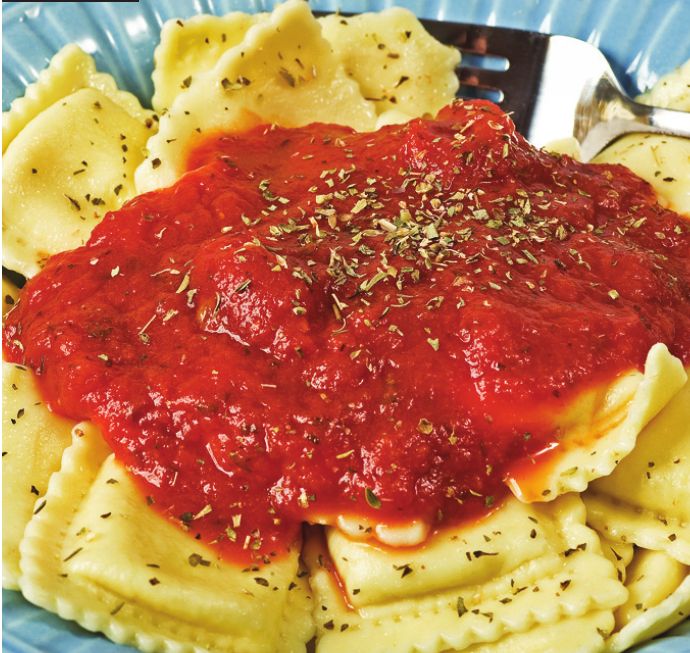
My favorite food is easier. When I was a child, if someone asked what my favorite food was, I never hesitated. It was ravioli. Though as adult I don’t really have a “favorite,” ravioli is still right up there at the top. Not just any ravioli, though: I’m not talking about Chef Boyardee or the refrigerated or frozen varieties at the grocery (although some are reasonably decent). I’m not even talking about the truly outstanding stuffed pastas I’ve had in Italian restaurants, ranging from upscale to mom-andpop red sauce joints. The ravioli I still love best, the one I always requested for my childhood birthdays, is from a recipe that goes back in my (non-Italian) family for decades. There’s even a story behind it.
When World War II broke out, my grandfather had just opened his own office supply company in Springfield. He’d scored a major coup, securing a contract with the state of Illinois to replace all of the wooden desks in office buildings and the Capitol building with the first metal desks. Before they could be delivered, however, war was declared and all orders for metal goods were canceled. He lost everything.
My
grandfather found work at a munitions plant south of Joliet. It was a
scary and difficult time for my grandparents and my then-10-yearold
mother, traumatized by the war, the loss of the business and separated
from family and friends for the first time in their lives. When one of
my grandfather’s co-workers asked them to dinner, it was a chance to
make connections in a new place.
The
co-worker’s Italian family’s warmth and hospitality more than made up
for any difficulties in communication. When everyone sat down to eat,
huge platters of ravioli were brought to the table. My mom and
grandparents had never eaten ravioli. (It’s hard to imagine these days,
but back then even spaghetti with tomato sauce was considered an exotic
ethnic dish.) The ravioli was fantastic. Seeing how much my family
enjoyed it, they were urged to take second and third helpings. Finally
the table was cleared. My family leaned back in their chairs, satiated.
That’s
when the second course arrived. It was the American part of the meal: a
classic friedchicken dinner complete with mashed potatoes and gravy.
Because it was clear that to not eat would cause offense, my family
soldiered on. The evening was a great success, though my grandparents
and mom were sick when they got home. At least they weren’t too sick to
ask for the ravioli recipe.
Making
ravioli is time-consuming and generally reserved for special occasions
in Italy. The filling is easy and a good way to stretch a little
leftover chicken into a full meal. There’s nothing that can equal making
your own pasta dough, but there are several other easier and very good
alternatives.
The first is using purchased wonton wrappers.
Available
in grocery stores, they are squares of fresh pasta, though more
delicate that typical the typical Italian fresh dough used for making
pasta. To make ravioli with wonton wrappers, place a spoonful of filling
in the center of a wrapper, very lightly moisten the edges with a
little water or beaten egg (too much and they won’t seal), top with
another wonton wrapper, press from the center outward, then press all
around to seal. Sprinkle the ravioli lightly with flour on both sides to
keep it from sticking, and place them in a single layer on parchment or
waxed paper while you make the rest.
Bring
a pot of water to a boil (It should be big enough to comfortably hold
the amount of ravioli you’re making without danger of boiling over.)
Stir in a tablespoon or so of salt, add the ravioli and cook until they
float to the top. It will only take a couple of minutes because of the
delicacy of the wonton wrappers. Serve with tomato sauce or melted
butter and chopped fresh herbs and cheese.
I
also especially like using wonton wrappers to make toasted ravioli,
because they don’t have to be pre-boiled and then coated with a flour,
egg, breadcrumb coating as are traditional toasted ravioli. Toasted
wonton ravioli can be made in squared or rounds or the customary wonton
shape: a spoonful of filling on slightly off-center of the wrapper
square, dough folded into a triangle and sealed as above, then the two
opposite sides of the triangle brought together and pinched to seal.
They can be deep fried, but just using an inch or two of oil in a
skillet works fine, too.
For
a low-calorie, low-carbohydrate meal, this filling can also be used to
stuff mushrooms, hollowed-out zucchini, baked hollowed eggplant, or to
wrap à la cannelloni in blanched large-leaves greens such as Swiss chard
and collards. Place in a baking dish, sprinkle with grated cheese,
cover the dish and bake at 350 degrees Farenheit until the vegetables
are tender and everything is cooked through. Time will depend on the
type and size of the vegetables you use. Serve with tomato sauce.
Chicken and spinach filling for ravioli
• 1 c. finely minced cooked chicken
• 1 c. finely chopped spinach (about 1 10-ounce package, squeezed dry)
• 1/2 c. breadcrumbs
• 1/2 c. freshly grated Parmigiano-Reggiano or aged Asiago
• 1/4 c. minced Italian flat-leaf parsley
• Four cloves minced garlic, or to taste
• Two eggs
• 1 T. extra virgin olive oil
• Salt and freshly ground pepper to taste
Mix
ingredients together. Allow mixture to stand for at least 30 minutes to
let the flavors blend. Can be made up to several days ahead and kept,
refrigerated or longer frozen.
Contact Julianne Glatz at [email protected].