The hills are still alive
FOOD | Julianne Glatz
This month marks the 50th anniversary of an extraordinary number of notable events. There were the three historical Selma-to-Montgomery marches in Alabama. An outgrowth of the Selma Voting Rights Movement, the marches highlighted the obstructions faced by Southern blacks in registering to vote and had a major influence on the passage of the Voting Rights Act later that year.
The first march, on March 7, was violently turned back when the nonviolent demonstrators were attacked by police. The following day was also significant, though hardly noticed by a media focused on Selma. March 8 marked the arrival of the first American ground troops in Vietnam, beginning an escalation in the war as well as protests against it.
At age 12, I was certainly aware of the protest marches; how much I was aware of the Vietnam War at that point, I don’t remember. The most significant event of March 1965 for me was on the second: The debut of The Sound of Music movie.
I was obsessed, fantasizing about being Liesl, the oldest daughter. But her boyfriend was snarky; the handsome and elegant, ohso-correct Captain von Trapp was another matter entirely. I loved the nuns’ choruses, even toying briefly with becoming a nun despite being a Methodist. Reading and rereading Maria von Trapp’s biography, I learned that the real tale differed substantially from the theatre and movie versions. The Von Trapps had been married for over a decade and had two of their own children with a third on the way when they left Austria. The Captain was gentle and a bit reclusive; Maria was temperamental and definitely “ruled the roost.” But that didn’t spoil anything. I enjoyed the reality as well as the fiction.
I wasn’t the only one who loved the movie. The Sound of Music was the number one film at the box office for 30 weeks; the original release lasted for 4 1/2 years. It is the most successful musical ever made, the thirdranking movie ever in North America and the fifth worldwide.
Perhaps part of its popularity is because it provided Americans with a needed break from the grim realities of 1965 and the years that followed. But that wasn’t – isn’t – all. After hearing about SoM’s 50th anniversary last week, I watched it again. Though it had been years, maybe decades, since I’d seen it last, the photography, Julie Andrew’s crystalline singing, the charming children and handsome captain, and the sentimental (even corny) storyline were as enchanting as ever.
My love for The Sound of Music led to an appreciation of all things Austrian, including food. Several of my first cookbooks were Austrian, and I devoured articles in the late Gourmet magazine by its two Austrian contributors, Josef Wechsberg and Lillian Langseth Christensen. Thumbing through them after the movie, I found some old favorites.
Liptauer spread is typically Austrian.
It’s wonderful as a snack with “party” pumpernickel to accompany beer, and/or at cookouts of grilled bratwurst and sausages. Try it on cucumber slices, spread on thinly sliced ham rolled up and sliced
into pinwheels or to top pork chops. A new discovery: it’s fantastic on
baked regular or sweet potatoes.
Liptauer
takes only minutes to make, but if you’ve got the time and want a fancy
presentation, try the method below. I don’t normally use dried chives –
in fact, this is the only thing I use them for – but here they make
garnishing easy.
Liptauer cheese:
• 2 c. cream cheese or fresh goat cheese or a combination, softened
• 2 T. prepared mustard such as Düsseldorf or Dijon
• 2 T. Hungarian sweet paprika
• 1 tsp. freshly ground pepper
• 1 tsp. ground caraway seed, optional
• 3 T. drained and finely minced capers Optional garnish:
• Sweet Hungarian paprika
• Freeze-dried chives Mix all ingredients in a medium bowl. Let stand
for at least 30 minutes (longer is better) for the flavors to meld.
To
garnish: Put the cheese on a small serving platter and mound into a
rounded cone or dome. Stick pieces of waxed or parchment paper around
the bottom to facilitate cleanup. Lightly score the cone into 6
sections.
Put the
chives on a small plate or in a bowl. Moisten your (clean) index finger
with water and blot it on a towel. Gently put the tip of your index
finger into the chives. Gently press the chives that adhere to your
finger onto the top of the cone. Repeat to make a small circle at the
tip of the cone, then follow the score lines down the sides, flaring the
chives a little as you go downwards. Finish by pressing chives into an
inch border around the bottom. Now take the tip of a sharp knife and
pick up a little paprika. Carefully sprinkle the paprika over the areas
covered by the chives.
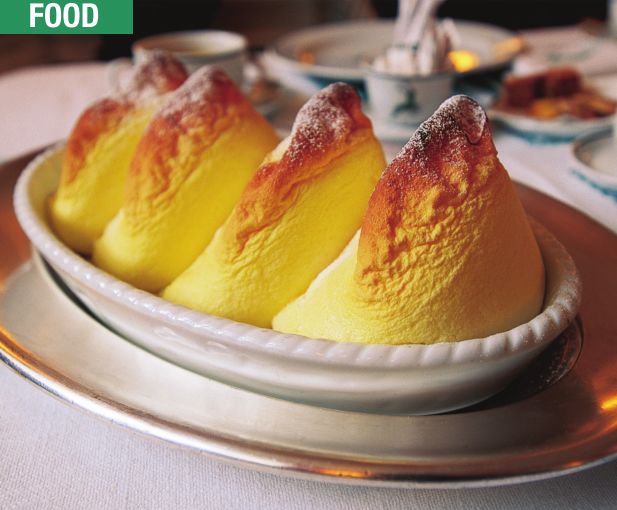
Salzburger Nockerl is an iconic dish of Salzburg, the city where The Sound of Music takes
place. (It’s also the birthplace of Mozart.) Austria is primarily
famous for its pastries, but Salzburger Nockerl is an airy, lightly
sweet soufflé. And its history is as delicious as its taste.
The
16th century Prince-Archbishop Wolf Dietrich von Raitenau of Salzburg
wanted a military career, but his family decreed he become a priest.
Young Wolf complied, sort of. He clearly wasn’t happy with religious or
celibate life, building his mistress, Salome, a palace and proceeding to
have 15 children with her. Von Raitenau lived a “dissipated” life
extreme enough that his Bavarian neighbors eventually forced him into
exile.
What does that
have to do with a sweet dessert soufflé? Some say that Salome created
Salzburger Nockerl for her; others that he loved her primarily because
of her specific version. Either way, it’s supposed to represent
Salzburg’s nearby mountains; the powdered sugar topping, snow.
Some
contemporary recipes use a fruit sauce base; my older Austrian recipes
use just the soufflé. It uses just a bit of flour and, like many egg
and/or custard desserts, little sugar. Don’t be scared off by the term
“soufflé.” Soufflés aren’t nearly the prima donnas they’re made out to
be, and this one is particularly easy and quick to assemble.
Salzburger Nokerln
For the baking/serving dish:
• Unsalted butter
• Sugar, preferably fine (baker’s) sugar For the Soufflé:
• 3 egg yolks
• 1 tsp. pure vanilla extract
• 1-2 tsp. grated lemon peel
• 3 tsp. flour
• Pinch of salt
• 1 T. lemon juice
• 6 egg whites, at room temperature
• 1/4 c. sugar, preferably fine (baker’s) sugar
• Confectioner’s sugar for dusting.
Preheat
the oven to 400 F. Butter an oval or oblong ovenproof dish,
approximately 8x10x2 inches; sprinkle the bottom and sides with the
sugar. Turn upsidedown and rap firmly to remove excess sugar.
Put
the egg yolks in a medium-sized bowl, whisk to break up, then stir in
the vanilla and lemon peel. Whisk in the flour and set aside.
Put
the lemon juice in the large bowl in which you’ll be beating the egg
whites. Swirl the bowl to coat with then juice, then discard the excess.
Add
the egg whites and salt. Beat, with a mixer, hand mixer or by hand,
until the whites are foamy, then very gradually add the sugar. Continue
beating until they are very stiff. (This is different from most
soufflés, in which the egg whites are only beaten to soft peaks to allow
for rising.)
Add a
spoonful of the stiffly beaten whites to the yolks, stirring gently, but
completely. Scrape the yolk/white mixture into the rest of the egg
whites, then fold in even more gently with an over-under motion.
Pour
into the baking dish. With a spatula, form into as many mountain-like
peaks as you’ll be serving. They can be even or rough.
Bake
for 10-15 minutes, or until the “mountains” are lightly browned. Dust
with confectioners sugar and serve immediately. Serves 3-6.
Contact Julianne Glatz at [email protected].


