Sprout into spring
FOOD | Julianne Glatz
Locally grown ones are available throughout the year, even in darkest, coldest winter. And it’s also possible to grow your own all year long.
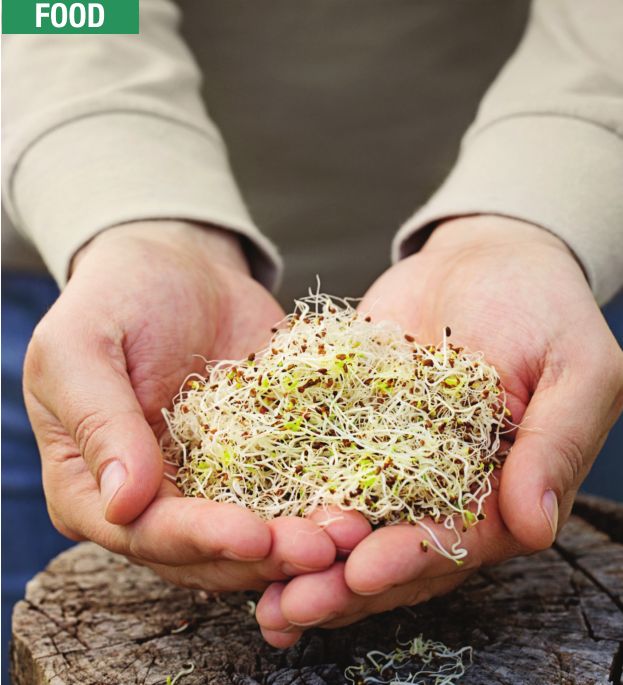
Sprouts. They are simply the first growth of seeds. There is actually very little difference – both nutritionally and flavorwise – between the first little peeps of green pushing through the earth in spring gardens and those grown indoors in colder months.
Sprouts are simply the first growth that occurs in the process that turns seeds into plants. As long as seeds are kept moist, they will begin turning into the first versions of the plants they could eventually become if they were not eaten as sprouts.
It is not an exaggeration to say that sprouts are a “super-food.” The outer covering of seeds, which protects their internal growth mechanism from harm, can be hard to digest, resulting in fewer of the seeds’ nutrients from being absorbed. It’s not unlike a digestive system having to deal with an eggshell before reaching its contents.
That doesn’t at all mean that we should avoid eating seeds. After all, those outer coverings provide fiber. And there are some seeds – notably nuts – whose shells are removed before they are consumed. (An exception is our Jack Russell terrier, Toulouse, who has a passion for peanuts still in the shell.)
Sprouts are considered a “complete” food. They contain enzymes, chlorophyll, a host of vitamins, minerals and other nutrients. Some of their enzymes are necessary for proper digestion and absorption of those nutrients. And even without the hard outer coverings, they are one of the highest sources of natural fiber.
I was surprised to discover that sprouts also contain high amounts of protein; alfalfa sprouts boast an astonishing and impressive 35 percent content. Broccoli sprouts have a far greater number of antioxidants than has full-grown broccoli.
Sprouts can be easily be added to many recipes. They can add flavor and a bit of crunch to sandwiches. Sprouts are wonderful in salads, both as an addition or primary ingredient. They can make a tasty and colorful topping for some vegetables and fish.
Different sprouts have different tastes.
I’m not particularly a fan of mung bean sprouts; for me, their raw bean taste is not appealing. When fresh sprouts first started appearing on menus and in recipes, mung bean sprouts were pretty much all that was available, and I was less than enthusiastic about sprouts. But since then, many more vegetables are being
consumed as sprouts, most of which I relish. Each variety has a
distinctive flavor: radish sprouts are slightly spicy and alfalfa has
grassy overtones. Fenugreek sprouts have a slight taste of maple syrup, a
totally different flavor than its seeds, which are used in Middle
Eastern, Indian and some Asian cuisines. And broccoli seeds pretty much
taste like broccoli.
Matt
and Debbie Daniels, owners of Bear Creek Farm and Ranch, have been
growing sprouts commercially since 2004. The Daniels use certified
organic seeds that have been tested to be free of salmonella and E.coli.
The seeds are soaked overnight and rinsed two to three times a day with
water from Bear Creek’s reverse osmosis system. Once the sprouts are
finished growing, which takes about a week, they are packaged and
refrigerated.
The
Daniels’ excellent sprouts can be purchased year-round at Food Fantasies
on Wabash Avenue, Schnucks on Montvale Drive and at HyVee on MacArthur
Boulevard. From mid-May to October, Bear Creek Farm and Ranch’s sprouts
can be purchased directly from the farm, at the Old State Capital
Farmers’ Market in downtown Springfield on Saturdays and Wednesdays from
8 a.m. to 12:30 p.m., or at the Illinois Products Farmers’ Market at
the Illinois State Fairgrounds on Thursdays from 4 to 7 p.m.
Freshness is paramount at Bear Creek.
Their
sprouts are brought into stores on a regular basis; nothing on the
shelves is ever more than a week old nor, of course, are the sprouts
available at the farmers markets. They also make deliveries once a week
in winter.
Bear Creek Farm and Ranch currently offers several varieties of sprouts:
Alfalfa
Broccoli Broccoli/alfalfa mix Spicy – radish/broccoli Fenugreek Mixed –
alfalfa/broccoli/radish/fenugreek/ mung bean For more information or to
order, contact the Daniels at [email protected] or call 899-8713.
Sprouting your own
If
you are so inclined, it is possible to spend a fair amount of time and
money to get into sprouting. But the basics of sprouting are quite
simple; all you really need to get started are the seeds, a wide-mouth
canning jar, a sprout screen and a couple minutes a day for three to
five days.
First, the
seeds. Sprouting seeds are available at Food Fantasies and also online.
It’s a good idea to make sure the seeds you purchase are suitable for
sprouting, as some seeds are chemically treated for various reasons.
If
you don’t have a wide-mouth canning jar and ring, you may want to order
a single jar specifically made for sprouting. Canning jars and lids
come in 12-packs. But you might consider getting a case. Even if you
don’t can, they can be invaluable for inexpensive storage. I use them
for everything from storing rice, pasta and beans to re-useable leftover
containers.
A
sprouting screen is really the only specialized piece of equipment
needed. They cost anywhere from $3 to $5, and can be ordered from Food
Fantasies or multiple sources online.
One
last note: For best results, the water used for sprouting should be
nonchlorinated. Depending on your household water source, you may need
to purchase spring or filtered water.
The sprouting itself involves just four simple steps:
Overnight soaking: In
the evening, pour approximately 3 tablespoons of the seeds into the
bottom of the quart jar, then add 2 cups non-chlorinated water. Put the
screen over the top of the jar, screw on the ring lid and swirl to mix
the seeds and water. Drain the water through the screen, then add more
water to fill the jar about 3/4 full. Let stand at room temperature
overnight.
Draining and rinsing: The
next morning, drain off the water through the screen, then fill the jar
3/4 again with water, swirl and drain well. Place the jar in a
container that will allow it to lay top down at a slight angle that will
keep the seeds from sitting in any water.
Repeat rinsing and draining: Repeat
the rinsing and draining procedure morning and evening for three to
five days. The sprouts will continue growing each day until they have
filled the jar and begun turning green. You may need to increase the
angle of the jar so that the water drains away from the growing sprouts.
Refrigeration: When
your sprouts have reached your preferred size and greenness (something
you can experiment with and decided what you like best), they can be
stored in the refrigerator. Before storing them, make sure that they are
fairly dry. They should be moist, but not dripping water. That way they
will stop growing. Also, excess moisture increases the likelihood of
spoilage. The sprouts should keep at least five days in the
refrigerator.
Contact Julianne Glatz at [email protected].


