Rauner butts heads with unions
Governor wants “right-to-work” zones
LABOR | Alan Kozeluh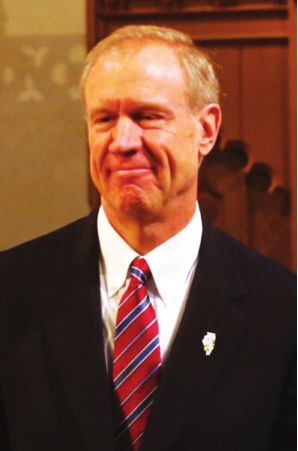
Gov. Bruce Rauner is pushing a controversial labor policy aimed at unions, but it’s unlikely the state legislature will adopt his idea. Instead, he said it should be up to cities and counties to take action.
Ahead of his first State of the State Address on Feb. 4, Rauner toured the state calling for “right-to-work” zones. Opponents say that idea would weaken unions by forcing them to provide free representation to nonmembers.
In a PowerPoint presentation to a college audience in Decatur, Rauner said local voters should decide upon right-to-work – which he calls “employee empowerment” – for their areas, but it’s pretty clear what he wants them to do.
“Communities that want to have unions and encourage them and force members or workers to join – you can choose to,” Rauner told his audience in Decatur. “And if communities don’t want that and want to compete with Indiana and Michigan et cetera, they can choose that.”
A spokesman for Rauner didn’t respond to an emailed request for comment.
Right-to-work laws exist at an intersection between federal and state law. The National Labor Relations Act requires that unions elected by a majority of employees in a workplace must bargain for all of those employees equally, including the ones who choose not to join. In Illinois and other nonright-to-work states, if someone chooses not to join a union, they pay a fee to the union for that representation.
In right-to-work states, people who don’t join the union don’t have to pay that fee, but the union still has to bargain on their behalf. Right-to-work laws don’t get rid of unions so much as give people free union representation – right up until the union dies because no one wants to pay for it.
That is why union leaders are so against right-to-work: It hampers their ability to function and increases the likelihood the unions will cease to exist.
Rauner has said that he is not advocating for Illinois to become a right-to-work state, likely because of the veto-proof Democratic supermajorities in the Illinois House and Senate. Instead, he says it should be up to cities and counties to decide the issue locally.
Anders Lindall, director of public affairs for American Federation of State, County and Municipal Employees (AFSCME) said that Rauner’s rhetoric on unions has been less than productive.
“I hope that he won’t continue down this road and certainly the claims that he has been making about state employees,” said Lindall “The so-called facts he’s been using are full of holes.”
One of those holes is his characterization of state workers as overpaid. A University of Illinois Study from 2013 showed that for their level of education, most state and local workers would be making more in the private sector. Some workers with a highschool education made less on average, but more in private-sector union jobs.
One of Rauner’s slides pointed out that the union workers give up nearly $900 a year in dues. A Bureau of Labor Statistics study showed that in 2011, union workers nationwide – both public and private sector – earned on average $3.51 per hour more than their non-union counterparts. They also earned $7.11 more in benefits. Over the course of a year, that $900 in dues gets them roughly $22,000 in extra earnings.
Lindall said despite Rauner’s remarks, AFSCME will negotiate in good faith with the governor when many of the union’s contracts come up for renewal later this year.
“We worked constructively with Republican governors for more than a quarter century,” said Lindall. “We didn’t always have to see eye-to-eye on every issue to be able to have a relationship based on mutual respect.”
Contact Alan Kozeluh at [email protected].


