The spatula
A Christmas memoir
HICKORY JOURNAL | Roy French
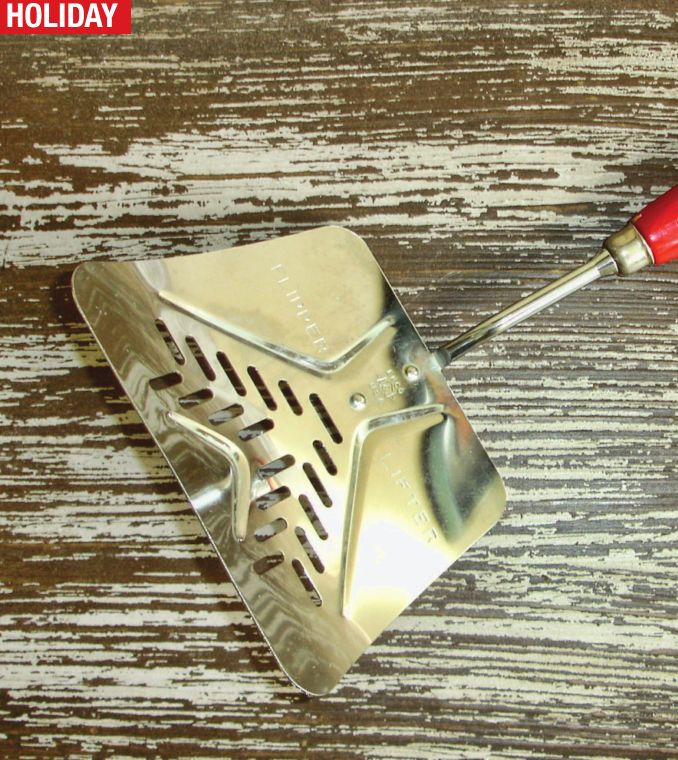
It was a year past her leaving that Anna made her request, a simple thing and reasonable, that William bring with him the spatula, the one with the red handle. “I kept it in the drawer by the stove,” she said. He thought a moment, then said, “I’ll look for it.”
They had come a long way in their marriage of more than 20 years, through good times and difficult times, committed all the while to achieving a better life for themselves and the children. Their lives were shaken by the assassination of a president, a period of social and racial unrest and a long, drawn-out, unwinnable war that divided the country. There were family losses, too, but Will and Anna worked through them, just as they did a failing economy.
In the better years, they had acquired a small apartment in town, but with no tenant now, there was no income from it. In the struggle to make ends meet, Anna found a job in town. By now the kids were old enough to work, find jobs and begin going their separate ways, following the influence of their own time. Will was tired of working so long in a profession that required strength and stamina and paid little reward. Less work came his way. Yet he plodded on, weaving a worrisome path between despair on one side and exhaustion on the other.
In the winter of the country place, it began to snow early in the season. It snowed hard and often, deep and pure, a miracle over the rural landscape. This would be the winter of their discontent, swept in on a northeastern gale. The temperature dropped steadily. This time it was more then Anna could deal with. She was very uneasy on this late Sunday afternoon, two days past Christmas – the first Christmas the kids did not come home. Will stood by the decorated tree, looked out the bay window towards the willows, heard the wind roar, saw swirling snow cascade off the roofs and the early winter darkness nudging in. There was no doubt the roads would be closed by morning.
Will noted Anna’s tenseness as she sat reading, huddled in a blanket at the end of the couch. He thought of the
empty apartment with no tenant. In a quiet steady voice he said, “Anna,
would you rather be in town closer to your work? I think I can get you
there if we leave before the snow gets any deeper.” He was startled to
hear himself present such an idea, but he knew Anna would not be happy
missing work.
Anna
did not answer but went directly to her closet and gathered some
essential clothes and put them in a shopping bag. She took an armload of
blankets and a few books. Their movements were quick and efficient from
working together so long. “When the roads clear and the weather
settles, you can come back out,” he reasoned to her. She made no
comment, but put on her coat and scarf and was ready to go.
They
were able to drive through the blowing snow, shoulder-high drifts and
uncertain footing. They reached the protection of town and a warm place.
He settled her in the apartment and made her comfortable. He’d have to
hurry along to the country place before the roads drifted shut. He
turned to leave. Looking back and seeing her standing alone, he found it
hard to go.
It was late and dark by the time he returned to the house, now quiet and empty. The blowing snow continued to fall.
In
the days that followed, the roads were cleared. He brought her things
she asked for to make her place more comfortable. With each trip, her
leaving became more real. The kids were already away, gone out of them
and lost in a world of their own. Now Anna was gone, too.
Will closed off the empty, unused rooms.
He
wore heavy sweaters and sometimes a coat in the chilling house. Will
sat close to the warmth of the wood stove for hours in contemplation and
reflection. On better days, he walked the paths and roadways of the
rural countryside. Sometimes he enjoyed a visit with neighbors.
In
the spring, Anna did not return to the country place. Will felt no
anger, just a weight of disappointment somewhat in himself and all the
things that had taken place. But change things he could not. Through it
all, a sincere respect remained. Each had concern for the other. He
could see she was happier alone and near her work. There were times,
cordial times, when the family was all together, but those times were
becoming less frequent.
Will
remembered the words of an old judge at breakfast one morning. The
judge had said, “It seems to me that an awful lot of the world’s trouble
is caused by someone thinking they own another person. They never do.”
Will was learning that it takes a lot more courage to let someone go
than to try to keep them.
It
was the following December that Anna wanted Will and the kids to come
to her place on Christmas day. That’s when Anna called and asked him to
bring her the spatula. “I really miss it,” she said.
Will
found it in a drawer beside the cook stove. The red paint was almost
gone from the smooth wooden handle. It was small to match her small
hand. He held it, a soft feeling not unlike Anna’s hand. He turned it,
studied it, held it awhile. After all they’d been through for so many
years, “Is this really all she missed?” he thought. She did not miss the
house he had built for them, did not miss the country setting, the
roses he had planted, the trees, or the brook beside the house. Only the
spatula. Will put it back in the drawer and stood there in the silence
of an empty house.
That
Christmas was years ago. Anna never mentioned the spatula again. Life
goes on and life is good for all concerned. Everyone is much older now
in William and Anna’s family. There have been marriages and remarriages,
grandchildren galore, boyfriends and girlfriends and new friends.
Smiles are on the faces of a new generation. Anna still asks them all to
come to her place on Christmas day. Respect, cordiality and a good time
prevail among the extended family who attend all the day long.
Miles
away in a drawer by the stove in Will’s kitchen rests the same small
spatula. He has picked it up so many times, turned it in his hand and
felt the smooth softness. Something in him will not let it go – at least
not yet.
Roy L. French of Virginia, Illinois, 81, has written a Christmas memoir for Illinois Times every year for more than 30 years. His new book, The Quiet Woods: Stories, Prose, and Poems from Hickory Hollow, is available for $15 from Roy L. French, P.O. Box 133, Virginia, IL, 62691.


