 Know your tree Pines, fi rs and spruces all are conifers, and all will look great in your home. Still, every decorator should know the provenance of their Christmas tree. Here is how to tell the difference.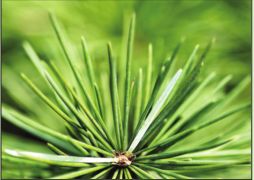 Pines The needles on pine trees are attached to the branches in clusters of two, three or five needles per cluster. Red pines have two-needle clusters; yellow pines have three-needle clusters; white pines have five-needle clusters. (The needles on firs and spruces are attached to the branches individually.) Cones on pine trees have scales that are woody and rigid.  Spruce Spruce trees’ needles are sharply pointed, square, and easily can be rolled between your fi ngers. Spruce needles also are attached to small, woody, stalk-like projections that remain on the branch after the needles are shed. Compared to pine cones, spruce cones have thinner, more fl exible scales. Spruce Spruce trees’ needles are sharply pointed, square, and easily can be rolled between your fi ngers. Spruce needles also are attached to small, woody, stalk-like projections that remain on the branch after the needles are shed. Compared to pine cones, spruce cones have thinner, more fl exible scales.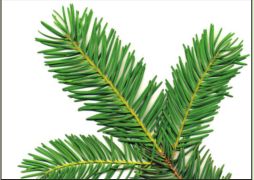
Firs Fir needles are soft, fl at and cannot easily be rolled between your fi ngers. Firs also do not have the small projections that spruce trees do and, thus, have smoother bark. Where cones on pines and spruces hang from branches, cones on fi r trees are upright and smoother in texture. Source: Iowa State University Forestry Extension; Michigan State University Extension |


