The river Lincoln loved
The state’s plan to make the Sangamon a destination
ENVIRONMENT | Patrick Yeagle
In the spring of 1831, when Abraham Lincoln was just 21, he and two other young men navigated a canoe down the Sangamon River. Lincoln grew to love the river, and his influence on it is still evident today.
The Sangamon River is a 264-mile tributary to the Illinois River, draining more than 3,000 square miles of land in central Illinois. It starts as little more than a drainage ditch near Bloomington-Normal and ends north of Beardstown as a strong but unhurried flow more than 200 feet wide in places. All but one of the 300 species of birds native to Illinois – including the revered bald eagle – live on the Sangamon River, and nearly half of the documented plant life in the state can be found there. Despite its rich history and biodiversity, the river is mostly undeveloped and overlooked. However, a movement is
growing to make part of the river more accessible and, in the process,
make it into a destination of its own.
To download the full report as two PDF files, visit: bit.ly/sangamon1 bit.ly/sangamon2
The Lincoln Heritage Canoe Trail, which spans the section of the Sangamon River between Decatur and Petersburg, was designated in 1965 by then-Gov. Otto Kerner as the first water trail in Illinois. The Illinois Department of Natural Resources last year commissioned a study on potential tourism, recreation and stewardship of the river. The resulting plan, completed in time for next year’s 50th anniversary of Kerner’s declaration, presents an ambitious but realistic future for the river, with positive payoffs for Springfield and other cities along the trail.
Flowing with history Abraham Lincoln was the only U.S. president to hold a patent, and it stemmed from his travels on the Sangamon River. The 16th president’s patent is for a series of buoyancy chambers to raise a boat in shallow water, using essentially the same principle as a submarine. The patent application was filed in May of 1849, while Lincoln was a member of the U.S. House of Representatives, nearly two decades after his first documented trip down the Sangamon River. Lincoln’s time on the river undoubtedly contributed to the development of his patent.
Lincoln’s family moved from Indiana to just west of Decatur in 1830 and built a cabin near the Sangamon River. After his first trip on the river in 1831, the 21-year-old Lincoln was hired to build a flatboat and take supplies to New Orleans with two other men. Shortly after starting the trip, however, the boat got grounded on a dam constructed to power a mill near New Salem. With help from the locals, the boat was freed, and Lincoln eventually moved to New Salem, which is now Lincoln’s New Salem State Historic Site.
Lincoln’s appreciation for the Sangamon River was so great that in his first political announcement in March of 1832, he advocated improving and clearing the river to accommodate large boats for commerce.
“I believe the improvement of the Sangamo river, to be vastly important and highly desirable to the people of this county,” Lincoln wrote in his announcement. “And if elected, any measure in the legislature having this for its object, which may appear judicious, will meet my approbation, and shall receive my support.”
Much like his patented boat buoying system, Lincoln’s plan for the Sangamon River was never implemented.
Aside from transporting goods, the Sangamon River has been used for irrigation, as a source of ice in cold months and even as the setting of the Old Salem Chautauqua, a local iteration of the nationwide public education movement during the late 19 th century. Created by the Cumberland Presbyterian Church and situated near Petersburg with the river as its western boundary, the Old Salem Chautauqua grew into a small town from 1898 to 1916 and hosted famous speakers like politician William Jennings Bryan.

For
thousands of years before white settlers even reached present-day
Illinois, the Sangamon River offered native peoples a source of food,
water, spiritual connection and more. According to one historical
account, the name Sangamon supposedly comes from a Pottawatomie Indian
word “sain-guee-mon,” meaning “where there is plenty to eat.” That
account is the most charitable of many conflicting explanations.
Poet Edgar Lee Masters wrote in The Sangamon, part
of “The Rivers of America” series, that the origin of Sangamon may come
from an Indian word “Sau-kie-min,” meaning “good earth” or perhaps from
the Sauk tribe, or even from the word “sa-gie,” meaning a lake, and
“mong,” meaning a loon.
Historian
Virgil Vogel concluded in his “Indian Place Names of Illinois” that the
most likely origin is an Indian word meaning “place of the outlet” or
“river mouth.” Local historian Chris Patton bolstered Vogel’s
explanation in the May 1982 issue of Historico, the journal of
the Sangamon County Historical Society. Patton wrote that that Jesuit
missionary Pierre Francois Charlevoix probably named the river
inadvertently in 1721.
“As
the party comes abreast of the mouth of the Sangamon, he points to it
and inquires through his interpreter, ‘What is that?’,” Patton wrote.
“The Indian guide to himself says, ‘Stupid white man, that’s the mouth
of a river!’, but aloud he speaks the
Indian word for river mouth, ‘san-ge-nong’. Charlevoix, assuming he has
been given the Indian name for the river, dutifully records in French
orthography: ‘Saguimont.’ And thus, today, our beautiful stream bears
the undignified name of ‘Rivermouth River.’”

Natural
beauty Dan Williams of Petersburg says one of the things he loves most
about the Sangamon River is its natural beauty and serenity. Williams is
tourism director for Menard County, but he’s also a photographer and
avid outdoorsman.
“Until
I kayaked, I never had an appreciation for how pretty it is,” Williams
said of the Sangamon River. “There’s essentially very little
development. You can spend all day on the river and see maybe a few
houses, and that’s about it.”
Williams
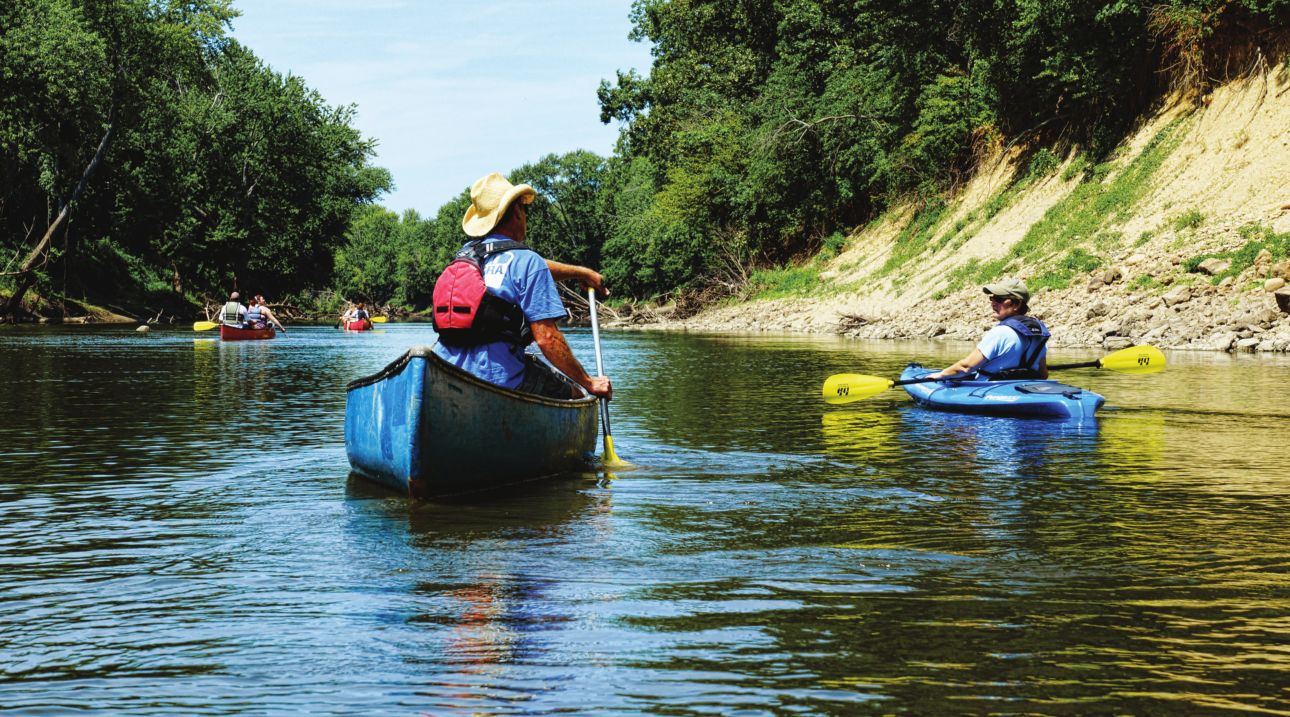
is among those interested in seeing the river become more accessible.
He points to Abe’s River Race, one of a trio of events using the river
as a race course near Petersburg.
“It’s
probably one of the few chances to see the river,” he said. “Other than
a few vantage points, people can’t get to the river, so they can’t see
that it’s really pretty out there.”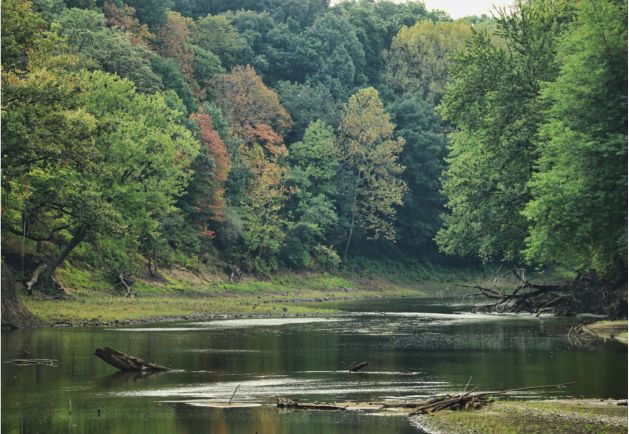
The
plan commissioned by the Illinois Department of Natural Resources for
the Sangamon River would likely encourage the development of more
events like Abe’s River Race by cleaning up parts of the river, removing
obstructions and increasing public access. Also included in the plan
are a proposed bike and pedestrian trail and a driving trail – both of
which loosely follow the river’s path, mostly along existing roads.
DNR
hired Massie Massie and Associates of Springfield to create plans for
the 85-mile portion of the Sangamon River between Decatur and
Petersburg. The state agency hopes to get that section of the river
declared a national water trail in time for the 50 th anniversary of its
designation as a state water trail. Kent Massie, who led the study,
says the plan incorporates input from landowners, governments and local
groups with a stake in the river’s future.
The
plan divides the Lincoln Heritage Canoe Trail into five sections.
Springfield is in the West Sangamon County section, which stretches from
the east side of Riverton to the spot where the Sangamon River crosses
from Sangamon County into Menard County, northwest of Abraham Lincoln
Capital Airport.
In
the report, Massie points out several concerns along this stretch of the
river, including a lack of emergency access points, inadequate public
trails, two potentially dangerous breached dams, trash dumping and more.
One of the main concerns, however, is that much of the land through
which the river runs is private, so the public can’t access the river in
many areas. One such area is the site of the long-gone Sangamo Town,
from which Lincoln launched his flatboat.
 Massie’s
plan calls for public purchase of land along the river or obtaining
easements on the land so the public can access the river. He suggests
removing the breached dam near Riverside Park, a project he says is
already under way thanks to DNR’s efforts. Additionally, he points to
several places where public access points could be added, like near the
Interstate 55 rest areas north of Springfield. Such access points would
come with restrooms, trails, picnic areas and more.
Massie’s
plan calls for public purchase of land along the river or obtaining
easements on the land so the public can access the river. He suggests
removing the breached dam near Riverside Park, a project he says is
already under way thanks to DNR’s efforts. Additionally, he points to
several places where public access points could be added, like near the
Interstate 55 rest areas north of Springfield. Such access points would
come with restrooms, trails, picnic areas and more.
Near
the river, Massie calls for a bike and pedestrian path from Camp Butler
National Cemetery to Riverside Park, offering a link from the city to
the river on existing roads. The path would cross the planned North
Inter-Urban Trail between Williamsville and Springfield, then continue
northwest to Athens. Under the plan, cars would be directed on a “river
valley driving route” from Riverton to Athens, connecting the
communities of Spaulding, Sherman and Andrew in the process.
The
DNR report contains similar suggestions for other areas of the river.
For example, the Bolivia Road Bridge, located about 14 miles east of
Springfield, would be restored and designated as a historic structure.
Built in 1901, the bridge is one of two remaining in Illinois built with
the “Parker through truss” design. It has fallen into disrepair and may
be replaced with a concrete bridge if no effort is made to preserve it.
Besides
making the river more accessible and useable, the river plan calls for
curtailing fly dumping of old tires and other trash, preserving habitat
and soil along the river and its tributaries, promoting river-based
activities like athletic events and emphasizing the river’s historical
significance with interpretive markers and public education.
Although
DNR commissioned the study, the agency may not be the primary source of
funding for projects that stem from it. Massie says funds may also come
from local, state and federal grants, as well as private donations.
In
the meantime, Massie says more historical research needs to be done to
raise the Sangamon River’s profile, especially in connection to Abraham
Lincoln.
“There is a
lot of history related to the river and its use, but it’s not part of
the Lincoln story much,” he said. “It has kind of just disappeared.”
Jim
Reed, a board member of the Lincoln Heritage Water Trail Association,
says the river offers a different kind of learning environment.
“On
the river, you can explore the Lincoln story locally and up close, not
by a walk through a museum or building,” he said. “There are multiple
stories that can be told that aren’t told now. It can be compelling to a
new audience.”
Reed
has high hopes for the project, but he also recognizes that it will take
significant involvement from the communities along the river.
“Because
of the overlapping interests – kayaking, hiking, biking, history – the
potential for the project reaches beyond any one particular group,” Reed
said. “This is a battle on so many fronts. Even if you don’t care about
canoeing, you can find your interests. I can guarantee we can find you
something to do with the project.”
Reed
first became interested in the Sangamon River more than a decade ago
through his involvement in the Menard County Tourism Council. The
council saw the river as a good way to capitalize on the building of the
Abraham Lincoln Presidential Library and Museum at the time, but only a
couple members had ever actually been on the river. They promptly
organized a canoe trip, and Reed says he was hooked.
“I
had such a good time,” he said. “It happens every time. You get in a
canoe or kayak and you kind of lose your sense of place and your sense
of time. You just kind of get lost, and that’s pretty cool.”
Contact Patrick Yeagle at [email protected].