Onward, Christian soldiers
Bishop apologizes, but holds firm
RELIGION | Bruce Rushton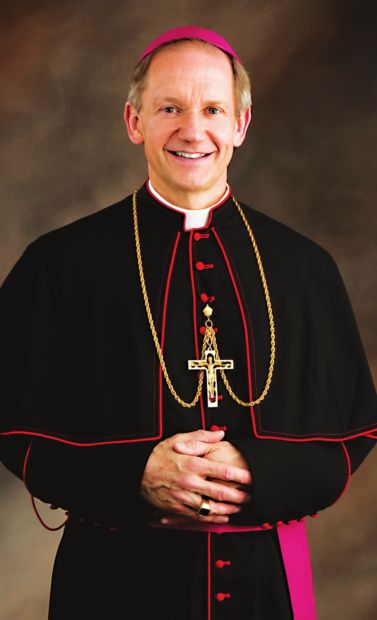
Some things – views on abortion, gay marriage and divorce – are nonnegotiable.
But Bishop Thomas Paprocki during a Monday forum at Benedictine University said that there is room for conversation on other issues raised by respondents to a survey aimed at figuring out why so many Catholics are no longer active in the Springfield diocese.
The survey by Benedictine researchers and released in September showed that an overwhelming number of lapsed Catholics who completed online questionnaires are troubled by church doctrine on such matters as abortion, birth control and homosexuality. But the survey also revealed that a significant percentage of practicing Catholics aren’t satisfied with priests.
Paprocki, who had reserved comment on the survey until Monday’s forum, said that he is planning to use the survey to help reverse a decline in church attendance.
“We don’t have a finished plan on that,” Paprocki told about 50 people who attended Monday’s forum. “We have some ideas.”
Attendance at mass has dropped by as much as 30 percent in some parishes since 1996. Paprocki said there were signs of hope in 2013, when attendance at mass increased by 1.5 percent, which was the first increase in attendance since 2000.
“Bringing disaffected Catholics back to the church will not be easy, but we must not shrink from this challenge,” Paprocki said.
In one instance, Paprocki said that he has brought in an outside “facilitator” to help foster conversations between a priest and dissatisfied parishioners. In an interview after the forum, Paprocki described differences between the priest and parishioners as stylistic issues and questions of personality conflicts.
But church doctrine that has driven some parishioners from the church will not change, Paprocki said.
“The challenge for us as a church is to make sure that we are presenting these teachings in ways that are clear and accurate so that they can be properly understood,” Paprocki told the gathering. “Some people are rejecting what they think the church teaches but which in fact may be a false understanding. Other times they do not know the reasons that underlie church doctrine. We need to do a better job of explaining not only what the church teaches, but why.”
Noting that scandals in the church were cited by lapsed Catholics as a reason for distancing themselves from the church, Paprocki issued an apology.
“There are no excuses for inexcusable behavior,” Paprocki told the gathering. “On behalf of the Catholic church and the Diocese of Springfield in Illinois, I sincerely apologize for the sexual abuse of minors, misappropriation of parish funds, acts of racial discrimination and other serious sins committed by priests and other church personnel that have harmed people of God. I am truly sorry that bishops and other leaders of the church did not always address these problems equitably or appropriately.”
That apology did not go far enough for John Freml of Springfield, who identifies himself as gay and criticized the bishop for holding an exorcism last year in response to Gov. Pat Quinn signing a bill that legalized gay marriage.
“That, to me, stung on a very personal level,” Freml told Paprocki. “It hurt me quite a bit to see a leader of my church – even though I’m inactive – it stung, and it seemed more politically motivated than an act of conversion or evangelism. I do think that the LGBT community deserves an apology. … What are you going to do to draw people like me back to the church? I’d really like to hear something concrete.”
Freml didn’t get the apology he was seeking. Instead, Paprocki said that his use of the word “exorcism” was overblown by the media. His use of the term “exorcism” in the 2013 event, the bishop said, was analogous to the prelude to a baptism or confirmation in which the presiding priest asks whether the person in question has rejected Satan and all his false works and empty promises.
“I was not suggesting that anyone who is gay or lesbian or who engages in homosexual practices is in any way possessed by the devil,” Paprocki said. “(S)o I was praying for an end to the temptation of same-sex attraction. If that was not clear, I do apologize for that, for not making that clear.”
Afterward, Paprocki in an interview said that he could have held the 2013 event and accomplished his goal without using the word “exorcism.”
Freml followed up by telling Paprocki that he doesn’t believe that the church offers an opportunity for those who disagree with doctrine to discuss differences with church leaders. Doctrine, Freml says, has evolved through the centuries.
“There hasn’t been a single issue that has remained the same through the church’s history,” Freml said. “Today, I’m just not seeing very many opportunities for that dialogue to occur.”
Paprocki responded by saying that hotbutton issues are too-often debated in the media instead of between human beings.
“Sit down with someone one-on-one,” the bishop advised. “Have a human conversation about where the church is coming from.”
The Rev. William Byron, a professor at Loyola University in New Orleans who attended Monday’s forum, said that few dioceses have allowed scholarly surveys to determine why attendance at mass has decreased.
“What you just witnessed here this evening is nothing but admirable,” Byron said. “The bishop demonstrated that his ears are not merely ornamental. You have spoken, he has listened.”
Contact Bruce Rushton at [email protected].


