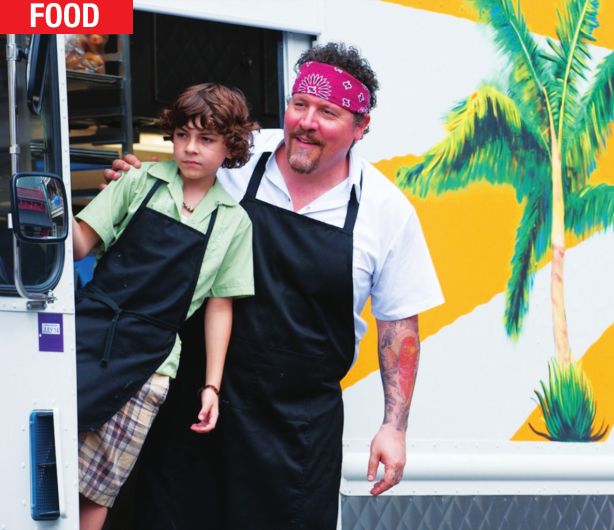
Chef, the movie
FOOD | Julianne Glatz
I first heard about Chef, the movie, months ago from Springfield native and Chicago restaurateur extraordinaire, Kevin Boehm.
“It’s about the restaurant business,” he said. “Hope they get it right. Almost none do.”
Boehm understands chefs and restaurant life. And he was right. Most professional kitchen film scenes sacrifice reality to plot necessities. There are exceptions. Oddly, the best depiction of professional kitchens and workers is the Disney cartoon, Ratatouille – except, of course, that the main character is a rat.
Chef, the movie, nails it. I missed it in theatres and had to wait for the DVD. Jon Favreau wrote, produced, directed and starred as the chef, Carl Casper. I don’t know if Favreau has a food background. But coproducer Roy Choi is legendary as the chef most responsible for the creative food truck craze sweeping the nation.
Like a stage play, the film has three discernable acts. The first plays out in a fine-dining restaurant in L.A. Casper, a cutting-edge chef originally from Miami, wants to create a special menu for a big-deal food critic; the owner (Dustin Hoffman in a bit part) insists on serving tired, albeit delicious, tried-and-true standards. In the ensuing brouhaha, Casper walks out and inadvertently engages in a Twitter battle with the critic.
In act two, Casper returns to Miami, acquires a food truck and rediscovers his roots. A parallel story line comes to the fore as he transforms from a divorced dad too preoccupied to connect with his 10-year-old son, Percy, to becoming a functioning father and mentor. My favorite bit reveals that loving mentorship and Casper’s principles and work ethics as they make their signature Cubano sandwiches for guys who helped move a commercial stove into the truck.
“Whoa! You can’t serve that. It’s burnt,” Casper says.
“So? They’re not paying for it,” Percy replies.
“Get off the truck. … Is this boring to you?” “No, I like it,” Percy says. “Well, I love it. I might not do everything perfect in my life, ok? And I’m sorry if I’ve not been the best father. But I’m good at this. And I want to share this with you. I want to teach you what I learned. I get to touch peoples’ lives with what I do. And it keeps me going. … And I think if you give it a shot, you might love it, too. Now, should we have served that sandwich?” “No, Chef.” That’s my son. Now get back in there; we have hungry people to feed. He’s ready to cook!” The last act is their journey from Miami back to L.A., with their father-son relationship evolving and Percy’s Twitter know-how creating hordes of followers from Miami Beach to New Orleans and Austin, Texas; in stark contrast to Casper’s earlier techno-doofus mangling of the medium – something to which I can relate.
In the conclusion, the critic makes a surprising reappearance and Casper and Percy move in yet another direction.
I can’t recommend this film highly enough to anyone interested
in food and discovering what’s involved in restaurant life. But be
forewarned: there’s lots of offensive language (part of what makes it so
realistic). My other favorite bit in the film comes after most of the
credits have rolled. It’s not part of the film per se, but a clip in
which Roy Choi demonstrates grilling a cheese sandwich to Favreau:
“You’re
controlling it all the time. … You’re looking … you can see the whole
sandwich starting to evolve. … You’re changing your grips, you’re
changing your positions … you’re not too busy … but you’re precise. This
is the only thing that exists in this world right now. And if you f–-
this up, everything sucks in the world.”
Cubano
(pronounced koo-BAHN-oh) sandwiches are reason enough to marinate and
slow-cook a pork roast, although I usually make enough roast pork meal
with accompaniments such as rice and black beans, then use the leftover
roast for sandwiches.
Traditional
Cubanos use Ball Park mustard and dill pickles. Good as they are, I
prefer Dijon mustard and either bread-and-butter pickles or the
similarly-flavored quick zucchini pickles below.
Cubano sandwiches
For brine
• 12 c. water
• 3/4 c. coarse kosher salt
• 1/3 c. sugar
• 4 large thyme sprigs, or 1 1/2 T. dried thyme leaves
• 2 heads garlic, halved horizontally
• 2 bay leaves, crumbled
• 2 whole star anise, crushed
• 1 T. whole black peppercorns
• 1 cinnamon stick, broken
• 1 tsp. whole allspice, crushed
• 2 large oranges, halved
• 1 1/2 c. apple juice
• 1/2 c. Worcestershire sauce
• 2–4 lb. boneless pork shoulder, preferred, or loin roast
For sandwiches
•
French bread, cut into approximately 8-inch sections, or rolls with
crusty exteriors and fluffy interiors, sliced horizontally
• Thinly sliced ham, about 2 slices per serving
• Swiss-type cheese (good domestic is fine), sliced about 1/4 inch thick, 3-4 slices per serving
• Prepared mustard, either Ball Park type or Dijon
• Sliced dill pickles or bread-and-butter pickles or Zucchini Pickles (recipe below)
•
Melted butter for brushing the bread In a heavy, large pot, place 2
quarts (8 cups) water, the salt, sugar, spices and herbs. Bring to a
boil over medium-high heat, stirring until the sugar and salt dissolve,
then simmer for 5 minutes.
While
the mixture is simmering, squeeze the juice from the orange halves into
a container, then chop the orange shells coarsely and add to the pot.
Remove
the pot from the stove and let stand until room temperature. Fill a
quart measure with ice, then water and add to the brine to chill it. Add
the apple and orange juices and the Worcestershire. Refrigerate if the
mixture is not completely cool/cold before proceeding.
Place
the pork in a large resealable plastic bag and refrigerate at least
overnight and up to 3 days, turning the meat occasionally. Remove from
the refrigerator and let the meat in the brine come to room temperature.
Preheat
oven to 300 F. Remove the pork from brine and thoroughly pat dry with
paper towels. Heat a roasting pan on the stove over mediumhigh heat.
Brown the pork on all sides, then place in the oven and roast until the
meat is tender and cooked through. Cooking time will depend on the size
and thickness of the roast. Begin checking after an hour. When cooked,
cool the pork to just warm or room temperature before slicing.
Assembling the Cubanos If the bread’s interior is thick, you may want to remove some of it to make a shell.
Lightly
brush the outsides of both halves of the bread with butter, then their
interiors with mustard. Line both halves with slices of Swiss cheese.
Place the ham on the bottom half, then cover with a single layer of
pickles and top with roast pork slices. Cover with the buttered top
bread.
Grill the
sandwiches on both sides until they are golden brown and crispy on the
outside and the cheese is melted and the interior is heated through. If,
like me, you don’t have a panini press, use a heavy skillet on medium
heat with another heavy skillet to press the Cubanos down, then flip
them once the undersides have browned.
Zucchini pickles
• 2 1/2 lbs. zucchini, trimmed, cut crosswise
into 1/8-inch-thick slices
• 1 onion, thinly sliced
• 2 T. kosher salt
• 2 c. white vinegar
• 1 c. sugar
• 1 2-inch piece fresh ginger, thinly sliced
• 1/2 tsp. celery seeds
• 1/4 tsp. ground turmeric
• 1/4 tsp. mustard seeds Toss first three ingredients in large
colander. Place in sink and let drain 2 hours. Rinse vegetables; drain.
Transfer to kitchen towels and gently blot. Place in a large
non-reactive bowl.
Bring
vinegar and all remaining ingredients to boil in small saucepan,
stirring to dissolve sugar. Reduce heat to medium and simmer 10 minutes.
Pour vinegar mixture over zucchini mixture, pressing on vegetables to
submerge. Cool to room temperature. Cover and chill overnight. Zucchini
pickles will keep refrigerated for about a month.
Contact Julianne Glatz at [email protected].


