Waste not. Why not?
Is recycling food waste a fad or the future?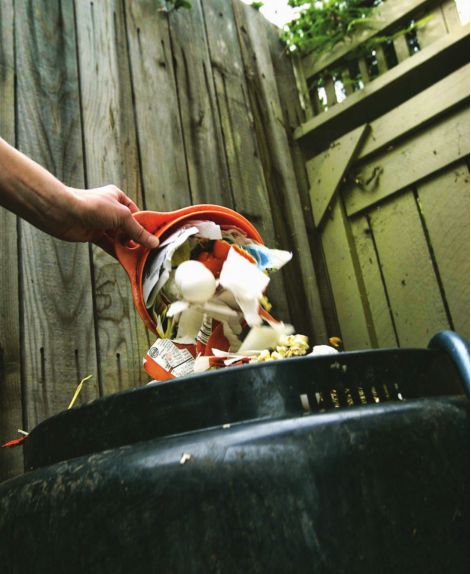
DYSPEPSIANA | James Krohe Jr.
As much as 40 percent of the food that Americans buys in the supermarket is tossed uneaten into the trash, according to estimates from the USDA and the federal EPA. Edibles go bad in the fridge at home, they’re left on the cutting board, in the pan, on the plate, in the back of the fridge. The fastidious among us toss food when it reaches its “sell by” date, not knowing that sell-by dates are meant to inform retailers the last day on which food ought to be sold, not the last day it can be safely eaten.
Plainly a nation that believes it eats too much doesn’t eat nearly enough. Is this bad? I don’t know; you’ll have to ask your minister or your hairdresser or whoever else you rely on for such things. I do know it’s stupid, but in this country that’s a recommendation. Americans will do anything bad if it’s convenient and nothing good if it isn’t, and reducing food waste is not convenient. You’d have to not buy stuff you won’t eat, store what you do buy sensibly and appropriately and eat all you fix. That’s not the country that Jefferson and Sam Adams had in mind.
The only thing worse than food waste from a public interest point of view is compounding it by wasting the waste. The traditional alternative to tossing unwanted food into the trash is home composting. I did it for years, beginning at my house on East Monroe, where I once lived. I wouldn’t call it fun but it’s interesting and useful, and how many things can we say that about? But it’s messy and – despite the promises by peddlers of home composting kits – it requires muscle power.
How nice it would be if you could pay somebody to come to your house to take away your putrescibles (lovely word) and compost them for you. It’s very nice, as I can tell you from experience. In suburban San Francisco, where I once lived, we put food scraps into the same recycling cart into which I put yard debris, which was removed once a week and the contents eventually ground up and composted for use by area farmers. (Much the same service is offered as part of regular garbage pickup in Portland, Oregon, where I once lived.)
“Food scraps” inadequately describes what such curbside programs accept: any leftovers, including bones; eggs and eggshells; coffee grounds, filters and tea bags; dirty paper napkins and paper towels; pizza delivery boxes; and spoiled food. The volume of our household trash was cut in half by diverting such gunk to the recycler.
Such things might be done in foreign cities like San Francisco and Portland, but will it ever happen in Illinois? We don’t even recycle politicians who are past their “bestby” dates. Nonetheless, Highland Park (where I once lived) started a popular food scrap composting program in 2012. Up in Oak Park (I’m pretty sure I lived there too) the city has a pilot project underway along those lines.
Sadly, these things don’t seem to come naturally to Illinois. Highland Park had to stop its program after six months because the composting firm in Waukegan that processed it stunk up the joint so bad that the EPA shut it down. And only 10 percent of the households in Oak Park have signed up to make the world safe from soggy Fruit Loops.
Not to worry. The world won’t be lost if you don’t recycle your eggshells, because your eggshells aren’t the problem. The energy and water wasted to grow and ship the stuff in the first place is the problem. Shoppers who won’t buy an apple with a worm hole in it or who demand fresh grapes in January are the problem. Politicians who vote for subsidies to the corn ethanol industry are the problem. Parents who don’t teach their kids how to shop, cook and eat are the problem.
Why do such programs exist then? Mainly, to please those many consumers for whom the real problem with our wasteful lives is not the state of their landfills but the state of their consciences. Tribune Columnist Barbara Brotman is one of the participants in the Oak Park trial program. She confessed in print the other day that she was troubled by guilt at how much food her family throws away. “Now the guilt is gone,” she writes. “I’m not wasting food; I’m providing the ingredients of a valuable natural resource.”
You can’t go far wrong in places like Oak Park or Highland Park relieving the guilt of the educated middle class about the consequences of their lifestyles. Now if science could get to work to recycle guilt into a usable product, we could eliminate the messy middle man.
Contact James Krohe Jr. at jkrohe#@illinoistimes.com.
Editor’s note
Mddle
East peace could begin in the Midwest, at Illinois College in
Jacksonville. Why not? The historic progressive institution is thinking
big and reaching wide by inviting Jimmy Carter, the former president and
indefatigable peace campaigner, to speak there on Tuesday, Oct. 14,
initiating the college’s Pathways to Peace proposal for resolving the
Israeli-Palestinian confl ict. Carter, who presided over the 1978 Camp
David Accords, wrote earlier this year that unity of the Palestinian
government and that government’s decision to embrace the United Nations
provides new opportunities for peace. Though Carter frequently
exasperates the American Jewish community with his criticism of Israel’s
policies, the Nobel Peace Prize recipient has standing and credibility
for his proposals to be taken seriously. And the time may be right for a
war-weary world to act on good and hopeful ideas. Carter’s 1:15 p.m.
lecture at Sherman Gymnasium is free and open to the public. It will be
followed with discussion by a panel including former congressman Paul
Findley and Khalaf Ahmad Al Habtoor, who heads an international
conglomerate based in the United Arab Emirates –Fletcher Farrar, editor
and publisher