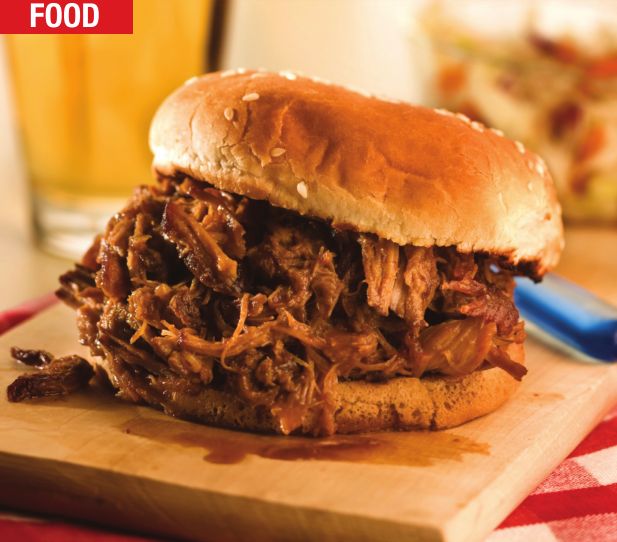
Barbecue nation
FOOD | Julianne Glatz
“Geez, I’m so sorry, but I can’t do it this year,” I told Jeff Ball. “I haven’t been able to visit my grandson in Brooklyn for ages. And I haven’t seen my son, Robb, since he moved to Vermont last November. Unfortunately the week of Blues and BBQs is the only one that works for everybody.”
I wasn’t being polite when saying I was sorry. Since 2006, I’ve been a judge for the barbecue competition at Springfield’s Blues and BBQs Festival almost every year. Ball has been in charge of the competition since then as well. Sounds like fun, right? But coordinating the multiple entries in multiple categories, deciding how the judges will be allocated for preliminary tastings, answering judges’ questions about the admissibility of some garnishes or ingredients, and a host of other minutia can make Ball’s job a logistical nightmare.
It’s much more fun to be a judge, although that does entail responsibility. Contestants have spent long hours and a significant amount of money preparing their entries. But I love barbecue not just for its deliciousness, but also for its stories and legends, and the exploration of its origins and many American regional variations.
There’s another downside to judging barbecue. Much as I love it, every year when the judging is over, I feel as though I never, ever could eat another bite of barbecue. “Oh, well,” I thought after my conversation with Ball ended. “At least I won’t have barbecue burnout this year.”
Wrong. My journey eastward was initially barbecue-free, primarily because my family’s Brooklyn contingent is vegetarian. And I assumed Vermont wouldn’t be a barbecue haven. I knew from Robb that sourcing local foods/producers was the rule rather than the exception in Vermont restaurants, but I wasn’t anticipating any barbecue.
That perspective changed as soon as I arrived in Brattleboro. Robb is a true barbecue aficionado. He’d quickly located the few best barbecue joints when he moved to Boston (actually Cambridge) years ago. In Vermont, we’d barely said “hello” before he told me that the highlight of our dining excursions would be The Top of the Hill Grill – an outdoor barbecue joint open only in summer. The chef/proprietor was from Louisiana who spent summers in Vermont and returned to Louisiana for the winters.
As you might expect, The Top of the Hill Grill was located up high, with a gorgeous view of surrounding mountains. The barbecue was the real deal, clearly smoked long and slow. The sauce wasn’t traditional Louisiana-style, which is very onion-y, but it was delicious and appropriately served on the side so as not to obscure the wonderful flavor of the smoked meat.
The next day I headed west, driving through upstate New York’s equally gorgeous scenery. Approaching dinnertime I called my husband, Peter, to ask if he could locate a good restaurant in Syracuse that’d be open on a Sunday. After a few minutes, he called back, “Looks like your best
bet is a barbecue restaurant, Dinosaur. It’s got really enthusiastic
reviews.” “OK,” I sighed, “I had barbecue last night, but I guess
there’s no reason I can’t have it again.” But really, how good could
barbecue be in Syracuse, New York?
It
was fantastic! Two blocks from the restaurant, I could smell wood smoke
and hear a live rock band. There was an outdoor seating area next to
the restaurant and folks stood around table-topped barrels lining the
restaurant’s other perimeters; dozens more hung around outside perusing
menus.
Once seated, I
ordered the barbecue combo, figuring that I’d have leftovers for Peter,
which I certainly did. The pulled pork was excellent; the ribs were
outstanding. But the beef brisket was phenomenal, perhaps the best I’ve
eaten. The Syracuse restaurant is the original location, but there are
outposts throughout the region. And in 2015, the first Dinosaur barbecue
restaurant will open in the Midwest, in Chicago.
My
barbecue road trip didn’t end when I returned to Springfield. Five days
later I was in Chicago for a Cochon 555 Heritage Barbecue fundraiser.
I’ve written twice before about the Cochon 555 competition, which pairs
farmers who raise heritage breed hogs with top regional chefs throughout
America. Regional winners compete for top honors each June in Aspen,
Colorado. Local farmer Stan Schutte participates in both events; his hog
provided the raw material for Chicago’s Jason Vincent’s dishes that
were voted America’s best in 2012.
Cochon
555’s barbecue competition doesn’t feature traditional barbecue; rather
competing chefs create riffs on barbecue classics.
Low
and slow barbecue had its beginnings in the South. But now it has
spread to Springfield, the Midwest, and even New England. Truly America
is the nation of barbecue.
Cooking
the meat on low after smoking is definitely against barbecue
competition rules. But virtually all of the permeation of smoke into
meat, be it pork or beef, happens in the first three hours. Tightly
covering it and baking at a low temperature guarantees that the shreds
of meat are moist and juicy, never dried out. And once popped into the
oven, it needs no further attention for hours, making it ideal to serve a
crowd.
My pulled pork
• 4-5 lbs. or more, pork shoulder, butt or picnic roast
Dry rub:
• 1/4 c. kosher salt
• 1/4 c. dark brown sugar, packed
• 1/4 c. sweet Hungarian paprika
• 2 T. freshly ground black pepper, or more to taste
• 1-2 tsp. cayenne pepper, optional (Be careful! Different brands of cayenne can vary widely in heat.)
• Up to 2 T. each of
various herbs and spices: Garlic powder Onion powder Freshly ground
cumin Chili powder Dried oregano leaves Ground celery seed Dried
marjoram leaves Dried thyme leaves Most pork roasts have already had the
skin removed; if you happen to get one with the skin, trim it off.
Combine
the ingredients for the dry rub and press all over the meat. Extra dry
rub can be stored in a tightly lidded jar for a month or two, longer if
stored in a freezer. It can be used on such things as chicken, pork
chops or beef brisket.
Build
a small fire of hardwood charcoal in a charcoal starter. When the
charcoal is covered with white ash, place in the side chamber of an
offset smoker, the bottom of a bullet smoker or on the far third side of
a grill.
If using an
offset smoker, place the meat on the side of the grill farthest from the
side chamber and close the lid. If using a bullet smoker, fill the drip
pan with water or apple juice, place the rack at the top, and set the
meat on it and cover. If using a grill, set the meat as far away from
the coals as possible. Vent the offset barbecue or grill slightly.
Put
a handful of green smoking twigs (from an apple or other fruit tree) or
soaked and drained wood chips on the hot charcoal. Smoke for at least 3
hours, adding more green twigs or soaked chips every 30 minutes, or
whenever smoke stops emanating from the barbecue. After the first hour,
add a handful of charcoal to the fire periodically to keep it going,
about every 30 minutes.
After 3 hours, preheat an oven to 200 F.
Put
the pork in a deep roasting pan and cover it tightly with foil. The
meat will give off a lot of fat and liquid, so be sure the pan is at
least 2 inches deep.
Place the pan in the oven, and cook overnight, or between 8-12 hours.
Remove
the pork from the pan, and pour off the fat and liquid. When the fat
settles on top, spoon off and discard as much as possible. Return the
pan juices and the meat to the pan. Using two forks, pull the meat into
shreds and mix with the pan juices.
Contact Julianne Glatz at [email protected].


