Danville’s underground forest reveals the ancient past
A warm, moist breeze blows through the swampy forest at what is now Danville, Illinois. An eight-foot-long millipede scurries by. Nearby, a dragonfly with a foot-wide wingspan zips through the 100-foot-tall fern trees. It’s 300 million years before the present day – before the supercontinent Pangaea broke apart, and long before any dinosaurs walked the earth.
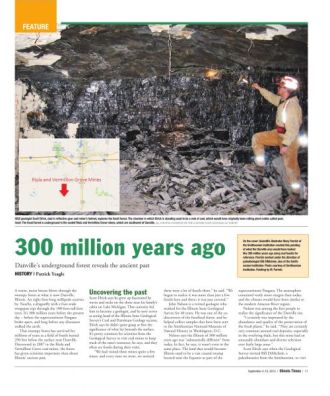
That swampy forest has survived for millions of years as a field of fossils buried 250 feet below the surface near Danville. Discovered in 2007 in the Riola and Vermillion Grove coal mines, the forest has given scientists important clues about Illinois’ ancient past.
Uncovering the past
Scott Elrick says he grew up fascinated by waves and rocks on the shore near his family’s cabin on Lake Michigan. That curiosity led him to become a geologist, and he now serves as acting head of the Illinois State Geological Survey’s Coal and Petroleum Geology section. Elrick says he didn’t quite grasp at first the significance of what lay beneath the surface. It’s pretty common for scientists from the Geological Survey to visit coal mines to keep track of the state’s resources, he says, and they often see fossils during their visits.
“We had visited these mines quite a few times, and every time we went, we noticed there were a lot of fossils there,” he said. “We began to realize it was more than just a few fossils here and there; it was just covered.”
John Nelson is a retired geologist who worked for the Illinois State Geological Survey for 40 years. He was one of the codiscoverers of the fossilized forest, and he helped collect samples that have been sent to the Smithsonian National Museum of Natural History in Washington, D.C.
Nelson says the Illinois of 300 million years ago was “substantially different” from today. In fact, he says, it wasn’t even in the same place. The land that would become Illinois used to be a vast coastal swamp located near the Equator as part of the supercontinent Pangaea. The
atmosphere contained vastly more oxygen than today, and the climate
would have been similar to the modern Amazon River region.
Nelson was among the first people to realize the significance of the Danville site.
“I
certainly was impressed by the abundance and quality of the
preservation of the fossil plants,” he said. “They are certainly very
common around coal deposits, especially in the overlying shale, but this
mine had an unusually abundant and diverse selection over fairly large
areas.”
Scott Elrick says when the Geological Survey invited Bill DiMichele, a paleobotanist from the Smithsonian, to visit the fossilized forest, “His jaw dropped. He couldn’t believe what we had.”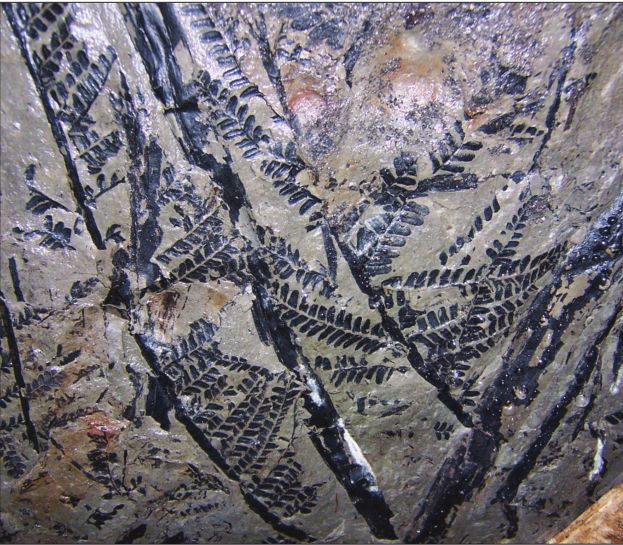
Dr.
Howard Falcoln-Lang, a palaeontologist at Royal Hollaway, University of
London in the United Kingdom, has also been to the fossil forest at
Danville.
“We were absolutely amazed,” he said.
“You’re
going underground, and the tunnels are illuminated by the light of your
miner’s lamp, and then, out of the darkness, you see these
extraordinary fossil trees. This is a very extraordinary site, quite
unlike anything else anywhere in the world.”
The
find turned out to be the largest continuous Pennsylvanian-era
fossilized forest in the world – four square miles. It contains numerous
fossils of ferns, horsetails and extinct trees known as giant
lycopsids. Some of the lycopsid fossils have trunks six feet wide and
more than 100 feet long.
Although
those plants were common across the area 300 million years ago, fossil
remains today are usually much more sparsely distributed than they are
at Danville. Elrick explains the anomaly as “a bit of geologic luck.”
When
most plants from the Pennsylvanian Age died, they fell into the swamp
and rotted into peat, the precursor to coal. At Danville, however,
Elrick says a series of small earthquakes caused the forest to sink
about 15 feet along the now inactive Royal Center fault that runs
through Indiana and Illinois. The sunken swamp filled with mud and silt
over a period of days or months, burying the plants in an oxygen-poor
environment that prevented them from rotting.
How
does Elrick know the sunken swamp filled up relatively quickly? The
waves that fascinated him as a child on Lake Michigan by leaving
alternating ripples of fine and coarse grains did the same thing in the
ancient swamp. Those “tidal rhythmites” were preserved at Danville,
providing a calendar for scientists to count tides – and thus days – by
counting the alternating bands of fine and coarse sediment.
Although
the sunken swamp filled with mud quickly enough to prevent the plants’
decay, Elrick says it was slow enough for animals to easily escape.
That’s why the fossilized forest doesn’t contain any remains of insects,
amphibians or other fauna from that period to speak of.
“Even
though it was fast, your basic ground-level insect could have easily
walked out of the way,” he said. “If you were sitting in a beach chair
at the edge of the swamp while the sea level was rising, you could
easily stand up every hour or so and move inland a bit, but if you tried
to stay in place for a week, then your beach chair would be covered
up.”
An important discovery
Besides
being the largest continuous fossilized forest in the world from the
Pennsylvanian Age, the Danville site is important because it helped
scientists resolve a couple of unanswered questions.
Prior to the discovery at
Danville, scientists weren’t sure whether those ancient plants grew in
segregated patches or whether they were mixed together. Elrick says the
site, southwest of Danville, offered a large exposure of fossils from
the same period, allowing him and his colleagues a rare opportunity to
view a landscape frozen in time. It revealed the existence of “ecologic
gradients” – gradual shifts between different clusters of plants, much
like how modern plants tend to grow in certain areas While that’s not an
earth-shattering result, it helps scientists more accurately understand
ancient swamps and the plants in them.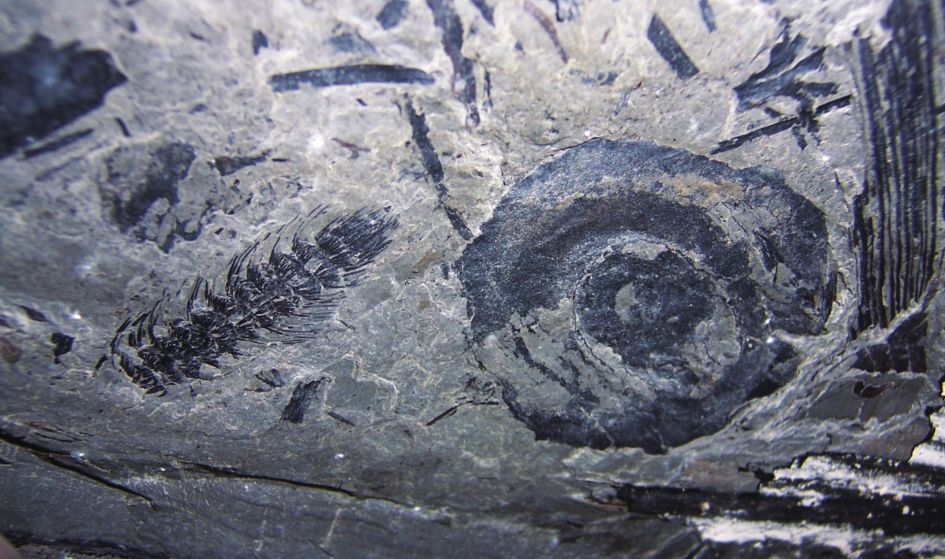
The
discovery also gave the Illinois State Geological Survey a more
complete picture of the Royal Center fault, which was responsible for
sinking the swamp 300 million years ago. The fault was previously known
to run from northern Indiana to near Danville, and a 1,000-foot-long
vein of clay in the coal at Danville lined up with where the fault was
expected to continue.
While
Elrick says another, larger section of fossilized forest has been found
in southern Illinois near Galatia, but it isn’t in one continuous piece
like the Danville find. The study of Danville’s fossil forest has
helped scientists at the Geological Survey recognize the newer discovery
as one cohesive landscape, Elrick says.
Since
Elrick and crew conducted their study of the Danville fossil forest,
the mines have been closed and sealed. St. Louis-based Peabody Coal,
which owns the mines, did not respond to calls seeking comment. Elrick
says it’s probably too dangerous for the public to ever be allowed
access to the site because the clay that makes up part of the coal
chamber expands and contracts with moisture, weakening the walls and
ceiling. In fact, he says, some of the chamber has already collapsed.
Still,
Elrick says the Museum of Science and Industry in Chicago has a slab of
fossils from the Riola mine on display, although they are not labeled
as such. The slab was extracted before the site was recognized as a
fossil forest, he said. While several fossil samples were collected from
the mines, they are at the Smithsonian in Washington, D.C., and are not
currently on display. A coal company in Indiana has expressed interest
in purchasing a mine in the same area as the Riola and Vermillion Grove
mines, Elrick said.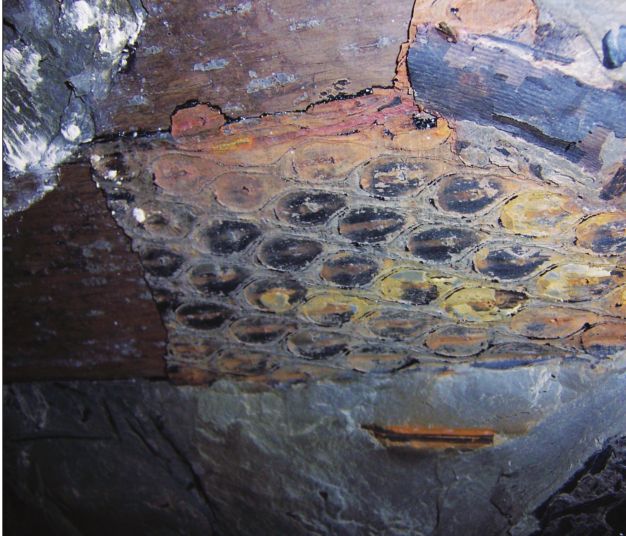
“For
my own highly personal reason, I would love to see them open up so I
could get some more access,” Elrick says. “We’re really interested to
see if it continues on and to see what else happens with it.”
Elrick
says it’s exciting to work with fossils that have been buried since
before the human race existed, before dinosaurs walked the earth and
even before the continent of North America was actually in the Northern
Hemisphere.
“I think
by far the hardest thing to communicate to the public, to students and
honestly even to ourselves, is the concept of geologic time,” he said.
“We throw around 300 million years like it’s no big deal, and it is no
big deal in the larger context, but trying to internalize what that
actually means is difficult.”
Howard
Falcoln-Lang points to the concept “deep time,” which is shorthand
among geologists for millions or even billions of years.
“We
can sort of grasp archaeological time going back hundreds or thousands
of years, but going back millions of years is an extraordinary step
further,” Falcoln-Lang said. “I love that phrase ‘deep time,’ as if
you’re going back and receding deep down into the geological record.”
Like
Elrick, Falcoln-Lang was interested in geology and paleontology from an
early age, and he says visiting sites like the fossil forest near
Danville still fuels that “spark of excitement” he felt as a child.
“I’ve
been in this game working professionally for more than 20 years, and
there are still extraordinary moments where you see something for the
first time and your heart is pounding around your chest,” he said. “You
never lose that. It’s always an amazing moment.”
Contact Patrick Yeagle at [email protected].