Cool off in Mammoth Cave, the world’s longest
TRAVEL | Mary Bohlen
Jerry Brandsford knows a thing or two about Mammoth Cave National Park. You could even say his affinity for the massive cavern in central Kentucky runs deep.
Brandsford is the fifth generation of his family to introduce visitors to Mammoth, 360 miles from Springfield. If you are lucky enough to land him as your National Park Service tour guide, you will learn about Mat Brandsford, his great-great-grandfather, a slave who worked as a cave guide in the 1800s.
You also will learn that Mammoth has some 400 miles of surveyed passages and many more uncharted ones, making it the world’s longest known cave. Only 10 of those miles are open for tours, but taking even one of the 12 tours offered can give visitors a sense of the cave’s history and natural wonders.
The park became a World Heritage Site in 1981 and a core area of an International Biosphere Reserve in 1990. “The park gets 500,000 visitors a year with 400,000 of them going on cave tours,” according to spokeswoman Vickie Carson. She says visitors come from around the world and, while the park is open year round, summer months are the busiest and when the park offers the most tours.
A hot summer day is a great time to visit Mammoth as the temperature in the internal passages hovers in the 50s and 60s. Admission to the park is free but paying $5 to $24 for a tour is well worth the cost as that is the only way to enter the cave. Just be sure to reserve your tours if you go in the summer, when they fill up quickly, and bring a jacket and good walking shoes.
Visitors also should pay attention to the NPS repeated warnings about how difficult each tour can be before deciding if they want an easy, moderate or strenuous route. The most strenuous is the Wild Cave Tour, a sixhour excursion into miles of undeveloped passages requiring lengthy crawls through wet areas and tight openings.
Brandsford
takes the lead three times a day, often on the two-hour, two-mile
Historic Tour, a moderate choice popular with families. Visitors descend
to the Historic Entrance, which Native Americans discovered thousands
of years ago and pioneers found in the 1790s.
Evidence
suggests that prehistoric people also explored and mined minerals from
the cave, which was formed from leaks through the shale and sandstone
cap to limestone below.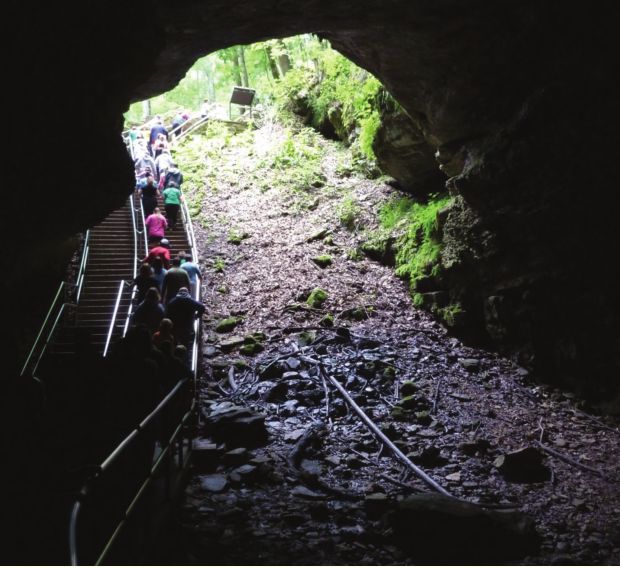
As
tourists enter the cave, the temperature drops noticeably and the light
diminishes. The first stopping point is 140 feet down to the Rotunda
with a display of artifacts from the cave’s days as a nitrate mine.
Slaves mined nitrate, used to make saltpeter, a key ingredient of
gunpowder for the War of 1812. Brandsford points out the irony of slaves
helping the cause of freedom, something they did not enjoy themselves.
The
Historic Tour also includes the Bottomless Pit, where you can look down
102 feet; and Fat Man’s Misery, where tourists squeeze through tight
passages with ducked heads. Many passageways are broad and high, but
some may make claustrophobics cringe. The floor often is uneven.
Along
the way, rangers explain the cave’s features, including names that have
been scrawled on the walls and ceiling, sometimes with smoke from
candles. A particularly poignant one is “Mat 1850,” the signature of
Brandsford’s ancestor.
The
guides also briefly turn off all lights during some tours so visitors
experience the cave’s total darkness. A guide then strikes a match to
show how even a small light can provide illumination.
Near
the Historic Tour’s end is Mammoth Dome, 192 feet from ceiling to
floor. Visitors ascend 155 steps to a passageway out of the cave.
Other
tours include such highlights as the Frozen Niagara formation, one of
the few areas with dripstones in the otherwise fairly dry cave system,
and the Star Chamber, where a traditional illusion from early
exploration is recreated on the ceiling.
The underground Styx River is visible on some tours when not flooded.
Displays
at the Visitors’ Center explain the cave’s one-time use as a
tuberculosis hospital; it also was designated a fallout shelter in the
1960s. Brandsford says, however, that was not a wise choice as the cave
continuously “breathes” in air from outside so any radioactive material
would have made its way inside.
The
park features 60 miles of hiking trails, fishing in the Green River,
bicycle paths, scenic drives, camping, evening ranger programs and the
Mammoth Cave Hotel and restaurants, open all year. Lodging also is
available in Cave City or Park City near the park’s southern entrance.
See www.nps.gov/maca for more information about Mammoth Cave National Park. For tour reservations, call 877-444- 6777 or go to www.recreation.gov.
The park offers the least strenuous tours less often so they fill
quickly. No cave tours are wheelchair accessible, but some aboveground
trails are.
Mary
Bohlen is a freelance writer and editor in Springfield and an emeritus
journalism professor at the University of Illinois Springfield. She and
Mary C. Galligan of Chicago alternate monthly columns on Midwestern
travel for Illinois Times.