The silliest catch
I survived the Redneck Fishing Tournament
INSANITY | Bruce Rushton
I am sitting at the Brick Tavern when I feel someone tug on the back of my t-shirt. It is a fluorescent yellow hue, the color favored by highway workers, Kid Rock fans and the dentally challenged. This one came from Las Vegas, purchased from the back of one of countless Mexicans who stand on nearly every corner of The Strip handing out cards decorated with naked women and phone numbers promising companionship for a price.
A tug at the bottom, a tug on one side, then the other before a female voice orders me to turn around. I swivel in my barstool to face a woman only somewhat besotted – the night is yet young – who appears to be in her mid-20s. She scrutinizes the front of my shirt and after 10 seconds or so breaks out in a wide smile.
“It says the same thing on the front as the back!” she exclaims.
Hot sexy girls direct to you in 20 minutes.
702-726-6666. 2-Girl Shows. Bachelor Parties. Discreet. In big black can’t-miss-’em letters, next to a silhouette of a buxom Barbie chick who would be at home on any semi-truck mud flap in the nation.
“I think you rock!” my new best friend squeals.
Whoever it was who said “Get thee to a redneckery” meant Bath in the wilds of Mason County, and so I am here for the annual Redneck Fishing Tournament. So are a lot of other people. From New Jersey. From New York. From Denver, and all points between. Forget Fustercluck in California, with its belly flop contests, and the Roadkill Cook-off Contest in West Virginia. Bath, population 320 on a good day, is where it’s at when it comes to aficionados of cheap beer and camouflage.
By now, the story is well-known. It began when Asian carp invaded the Illinois River, brought to America’s heartland in the 1970s by pea-brained fish farmers who figured they’d found a nifty way to control algae in catfish ponds near the Mississippi River. Of course, the carp soon escaped, thanks to floods that made fish farms and the Big Muddy essentially one and the same, and they’ve spread like only a fish that lays a kazillion eggs at a time can.
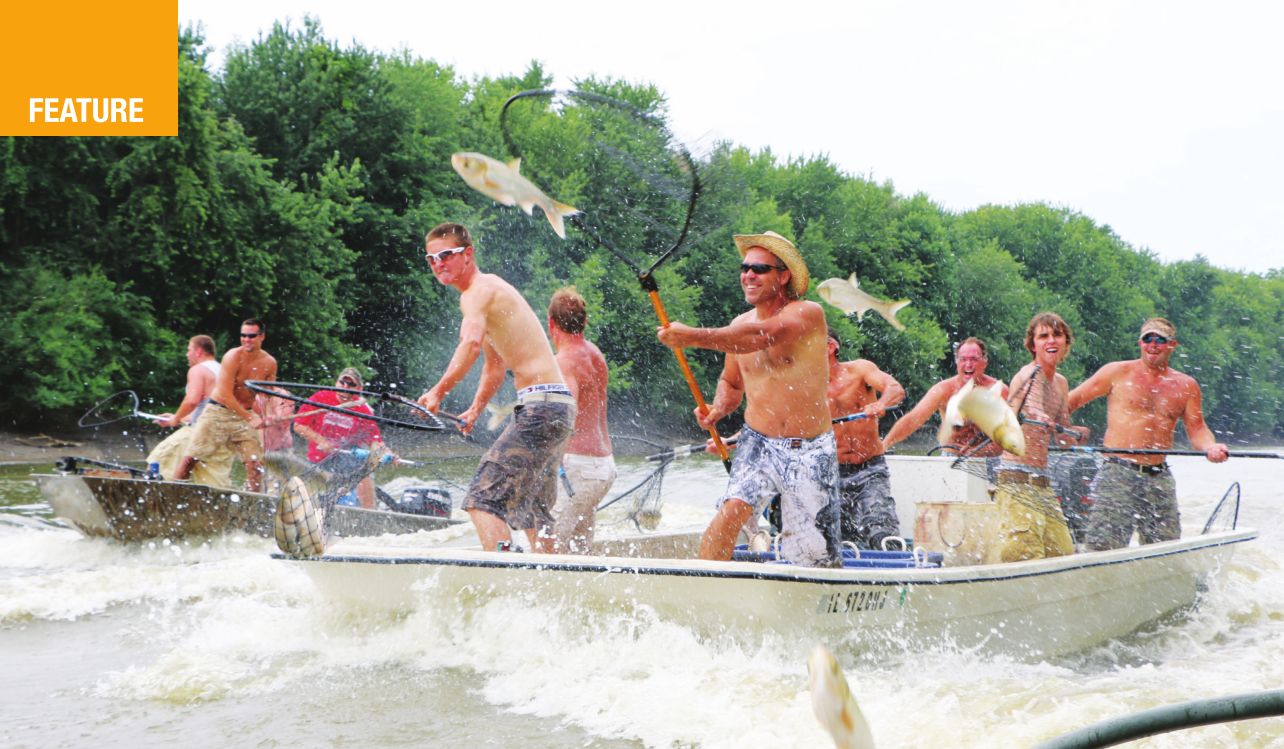
No one knows, or, perhaps owing to fear of prosecution, will say exactly when, but the annual tournament began about 15 years ago, when a small group of erudite duck hunters gathered in Bath while local law enforcement was otherwise occupied at an out-of-state police convention featuring free Kevlar and Krispy Kreme. The carp, which jump high into the air at the sound of a boat motor, were sitting ducks, as it were, for a hick version of skeet. To see a clay pigeon disintegrate upon impact by bird shot is one thing, but to witness a 200-pound carp explode in mid-air is quite another, and so the tournament quickly grew. Police were powerless to control the hordes that subsequently descended on Bath each year, an equal mix of jon boats bristling with shotguns and spectators on shore, everyone out for blood. And they got it. Thanks to free ammunition from Remington and kegs supplied by Anheuser-Busch, the early years of the Redneck Fishing Tournament were salad days, marred only by a surprisingly low number of human fatalities and maimings. The old-timers will tell you that there was nothing quite so satisfying as to sit on the bank in the aftermath, hair stiff with blasted-apart carp innards dried by the sun, breathing in cordite and gazing at the river running red with blood and fish mush barely visible through a haze of gun smoke that hung low over the water while cover bands in makeshift beer gardens blasted three-chord rock and roll, “Enter Sandman,” “Smoking In The Boys Room,” “Stranglehold” and the like for the dancing pleasure of all.
No good thing ever lasts, and so it was with the earliest incarnation of the Redneck Fishing Tournament, brought to a close by the collective efforts of conservation police, PETA and the Illinois Commerce Commission, which determined that rotting carp remnants threatened to clog the river channel and thus posed a hazard to navigation.
With crowds no longer approaching 75,000, the Redneck Fishing Tournament is not what it once was, and the fish are smaller, too. But rednecks are a determined lot, and the event has survived, even thrived, with dip nets replacing firearms and eager journalists from such organizations as Time and National Geographic sucked into covering the frenzy. I arrive one day early, provisioned with 36 cans of Stag beer, a tent, blue tarp, camera, notebook and not much else. I bring no food, or toilet paper, for that matter. I will be living off the redneck land for nearly three days. And I have faith.
“Don’t
fight, don’t piss in people’s yards, throw away your beer cans and
nobody’s going to fuck with you,” Bath Mayor Floyd Foutch tells me. “And
that’s the way it should be.”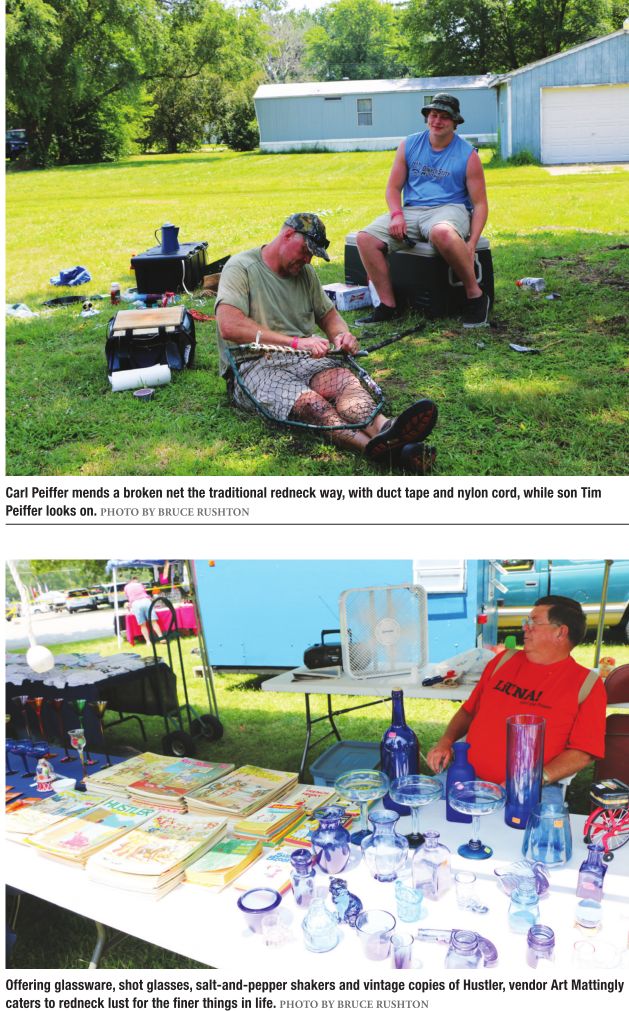
A celebration of stupid
The
first day of the two-day tournament dawns with the awful taste of last
night’s whiskey and beer thick in my mouth and threatening to calcify.
Having no water, I head to the cooler and brush with a chunk of ice and
Crest. Personal hygiene addressed, I head to the river, where I find
Matt Roth of Morton at the registration table.
Roth,
a farmer, is no ordinary redneck. He has arrived in Bath with a motor
home, a crew of nearly a dozen dubbed the Sushi Slayers and a surplus
U.S. Marine Corps boat purchased yesterday.
The
Rigid Raider is a fearsome-looking craft, the kind that can be sawed in
half and still float. It is designed to land troops on hostile beaches,
which explains mounts on the hull for a machine gun that, sadly, is no
longer allowed in the tournament since firearms were banned. It is olive
drab, 18 feet long and powered by two 70-horsepower Johnson motors,
which Roth, a committed horsepower addict, deems insufficient for carp
fishing. It will have to do.
This
is not the only boat in the Roth flotilla. He has also brought a
fiberglass skiff along with a friend who has an 18-foot aluminum boat
with plenty of ponies in a 90-horsepower Mercury. They have a whistle
from a freight train, just in case. With backup plans to backup plans,
it is clear that these rednecks do not fuck around. Is there room for
me? Sure, says Roth, who has competed here before, placing as high as
third and once receiving a trophy and $800 in cash – fives, tens and
twenties – stuffed in a shoe box wrapped in duct tape and mailed a week
or so after the tournament’s conclusion. This, he promises, will be more
fun than the Super Bowl.
To
most everyone’s surprise, the Coast Guard is present and rigorously
inspecting boats prior to launch. Life vests? Whistle or horn? Fire
extinguisher? Throwable cushion? Registration papers in order? You’d
think this was a race across the Atlantic. Then it’s on to the captains’
meeting, where a Coast Guard officer, a state conservation cop and a
tournament official talk about safety.
“No one hanging off the front, no one hanging off the back, no one looking stupid,” the tournament official intones.
Nothing
stupid? This entire event is a celebration of stupid, from the fish
themselves that are too dumb to stay underwater to the people who flail
nets in pursuit of a finned pest that they will throw away afterward.
I
take a seat in the Rigid Raider and we push off, joining dozens of
other boats that are massed near the boat launch. The captains have been
warned that the start area is a nowake zone but this rule is entirely
forgotten at the sound of an air horn that sends the fleet rocketing
down the Bath chute of the river to which the competition is confined.
There
are no nets in my boat. As in NASCAR and the Tour de France, drafting,
so to speak, is key when massacring Asian carp. The sound of the lead
boat is supposed to prompt jumping, making airborne fish easy pickings
for the trailing vessel. We are on point, which is considerably less
risky than being behind. Get too close and getting swamped by the lead
boat’s wake is a very real risk, as are collisions between boats in the
trailing pack. Roth’s crew has survived two sinkings in past events, but
this is hardly the Bering Sea.
“I just swam to shore,” Roth recalls. “No big deal.”
We are on the carp within minutes, with fish hurtling themselves at us and those behind with death-wish intensity. Whap! A
fish hits someone in the head, provoking wails of laughter from Roth’s
crew, all of whom are shirtless and in shorts. Many are barefoot and
none wear protective gear of any sort, in open defiance of grave
warnings by so-called experts that carp can hurt, perhaps even kill,
you.
I like these
guys. The two-hour heat – there will be a total of four heats in the
tournament, two per day – becomes an exercise of fits and starts, with
brief periods of calm interrupted by barrages of flying fish. The Coast
Guard rescues a swamped boat within the first 45 minutes, and we are
briefly grounded while attempting to stir up fish in the shallows. The
Rigid Raider takes on a considerable amount of water before we free ourselves, but the bilge pump handles it with aplomb.
A
flurry that comes seven minutes before the end of the heat is the
equivalent of a Fourth of July grand finale. Fish explode out of the
water, raining down on us and trailing boats like giant slimy
hailstones, so many that I hunker in terror after putting away my camera
for fear of having the lens irrevocably stained by scales and fish goo.
Dozens of doomed carp flop frantically in the bottom of the boat.
It has been excellent, if not steady, fishing.
With
nary a net aboard, the Rigid Raider has landed 50 or so carp. The
trailing skiff piloted by Roth with a crew of six netters, has brought
in an astounding 531 carp; the second-place boat has managed just 422.
The
tournament is all but over. The winner is determined by the biggest
haul in a single heat, and the fishing is usually best early on. Carp
are stupid, yes, but not that stupid. After two hours of
boats-turned-Cuisinarts zigzagging, doing donuts and otherwise churning
the Bath chute as if to turn the muddy waters into a milkshake, fish
tend to become noticeably scarce.
With
the counting over, large cardboard containers of dead carp, coated with
flies, are fork-lifted into a refrigerated semi-trailer. I ask a
tournament fish counter what will happen to them. They will be
processed, he answers. For eating?
“I don’t know what they use it for,” he answers. “All I know is it gets processed.”
Oh.
If everything goes as hoped, the carp will become cannabis. Brian
Kruse, assistant manager for SF Organics and salesman for the parent
company Schafer Fisheries, is here to collect fish no one else wants and
turn them into fertilizer. He’s been calling on marijuana cultivators
from coast to coast for the better part of a year, extolling the virtues
of fish-based fertilizer to grow pot. He has big plans for Illinois,
where the state has legalized medical marijuana and is now licensing
cultivation operations, and can rattle off potential sale figures if
only a fraction of growers opt for fertilizer made by his company based
in Fulton, Illinois, on the Mississippi River about 175 miles north of
Springfield. He figures 1.25 million gallons of fish-juice fertilizer a
year, more than double current sales, isn’t an unreasonable goal in the
short term.
Kruse
collects carp and other species at a half-dozen or so fishing contests
each year, but the Redneck Fishing Tournament stands out.
“I can’t believe these guys are getting these kinds of numbers,” he exclaims “Dip nets? It’s phenomenal.”
But
it’s more than fish. “This is America,” Kruse observes. “It’s like
going to rodeo or NASCAR. It’s about community – you can look around and
see that.”
Dangerous waters
I grab a net for the second heat and join Roth and his crew in the skiff.
The
Rigid Raider, with its fiberglass hull, has proven inferior to aluminum
craft for raising fish, and so Roth plans to follow metal boats in this
second round, with the military assault vessel left to churn the river
on the pack’s perimeter. Pontoon boats are considered especially worthy
to work the point – only the carp know why, but pontoon vessels,
preferably ones powered by two-stroke motors that emit a different sound
than four-strokes, have a knack for getting fish to jump. Carp killers
talk about this sort of thing a lot, as if strategy makes a wit’s bit of
difference.
We are
soon cruising alongside a smallish jet boat equipped with what is surely
the largest pair of speakers ever to be installed on a boat of any
size, and the afternoon hunt begins with “Jukebox Hero” cranked at top
volume. Foreigner never sounded so good.
The
fishing is slow, but there is still plenty of excitement. Attention is
focused on a skiff that appears to be no longer than 20 feet crowded
with no fewer than 17 rednecks. Water reaches within three, even two,
fingers of the gunwale, especially when the overloaded craft ventures
close behind other vessels. How the Coast Guard allowed this is anyone’s
guess. It is only a matter of time.
Sure
enough, the skiff hits a partially submerged log, with a branch from
the notsubmerged part bending, bending, bending before snapping back to
catch a someone square in the face while the bow of the boat tips
ominously toward the sky, the stern dangerously low in the water – a
Bath version of the Titanic playing out before our very eyes.
“My jaw’s broke!” the stricken redneck howls as blood streams down his face.
It
is over in seconds as the skiff frees itself and continues down the
river, and the guy with the busted face is soon smiling. His jaw, it
turns out, is perfectly fine.
“I
popped it back in,” he declares. Our catch of 111 fish is tiny compared
with the morning haul, but we remain in the carp-bird seat in the
competition, thanks to the first heat. Even with a relatively meager
catch, the slime is considerable and remarkably resilient. The Bath Fire
Department offers group showers in a hazmat decontamination station
that might be perfectly fine for getting rid of nerve gas residue and
leavings from meth labs, but carp slime is a different matter. After the
longest shower of my life, I emerge wearing only a too-small bath
towel, there being no room for fresh clothes inside the decon station.
With
dry clothes in one hand and slimed ones in the other, I walk through
town wearing only my tiny towel wrapped around my waist as securely as
possible. Passersby do not seem to find this unusual, and I eventually
find a yard bordered by a broken-down Cadillac to shield me as I change
into carp-free clothing.
I bed down that night feeling as if I am on the outskirts of glory.
Controversy on shore 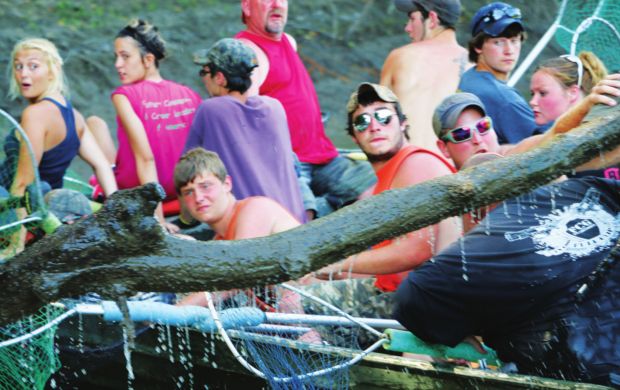
I awake to the sound of reveille and a PA announcement that breakfast is being served at the fire department.
This
being Saturday, I expect mostly tourists and pretenders, and I am not
disappointed. Every redneck, would-be or otherwise, from all four
corners of the planet has come to Bath today. There are rednecks dressed
as The Village People, rednecks disguised as Amish farmers and rednecks
clad as Boy Scouts.
The
fishing proves poor. The best entertainment is now on shore, where Chef
Philippe Parola, who would put Ron Popeil to shame, convinces a
skeptical crowd that Asian carp are haute cuisine.
“Are
you from the U.S.A.?” a man asks as Parola, who lives in Louisiana,
whips up a batch of carp croquettes, looking decidedly out of place in
his spotless white chef uniform and Rolex.
“No, I’m from France,” replies Parola, who has an accent to prove it.
“Do you have these in your country?” the man queries.
Not
exactly, but of course – Europe is populated by the common carp, Parola
explains, which dines on worms and other nasty things and so is
inferior to the flying Asian carp, a more discriminating eater that
limits itself to microscopic fare.
“You
can drink a beautiful glass of wine with this fish because you’re not
destroying the balance of the wine, understand,” asserts Parola, who
guarantees that Asian carp flesh is indistinguishable from crab. “This
is so clean, it’s incredible. Put this on the dining table. Feed your
kids. These days, where is the natural protein?” After offering a
croquette to a boy who declares that it tastes like chicken, Parola
gives me a chunk of fish from a soup. It does not taste like crab, but
it also does not taste like carp. When I point this out, Parola blames a
lack of proper cooking facilities here in the hinterlands. Given a
proper kitchen, he says, there is no discernible difference between
crabmeat and carp. Have there been blind taste tests? Yes, at least 50,
he says.
I make my way to the river for the final heat.
Fishing
is so bad that we wrap it up 15 minutes early so as not to miss the wet
t-shirt contest at the Brick. T-shirts, it turns out, have little to do
with it, as one contestant after another bares all in hopes of taking
home the $300 prize. Afterward, squabbles break out about who should
have won.
“She was the only one with piercings,” complains the boyfriend of one unsuccessful entrant.
Controversy
also surrounds the tournament, which culminates with 7,126 fish caught
by 115 boats. Roth’s crew is accused of transferring fish between boats,
which is grounds for disqualification. Others are accused of venturing
out of the Bath chute, also verboten.
While
tournament officials ponder options, Roth huddles with his crew. They
briefly discuss the lack of video evidence before deciding to donate
their prize money to homeless veterans, designated beneficiaries of any
profits from this year’s tournament.
“It’s better than getting shot at,” Roth offers.
And so they depart Bath the next morning with only a trophy and, if they’ve done it right, massive hangovers.
Contact Bruce Rushton at [email protected].
Visit www.Illinoistimes.com for more photos and video of the Redneck Fishing Tournament.


