Stuck in Illinois . . .
. . .with the Indiana blues again
DYSPEPSIANA | James Krohe Jr.
I’m packin’ up darlin’, down the road I go …a black top road running to a gravel road then a sand top road and I’ll be gone –“You Don’t have To Go” as performed by Jerry Lee Lewis
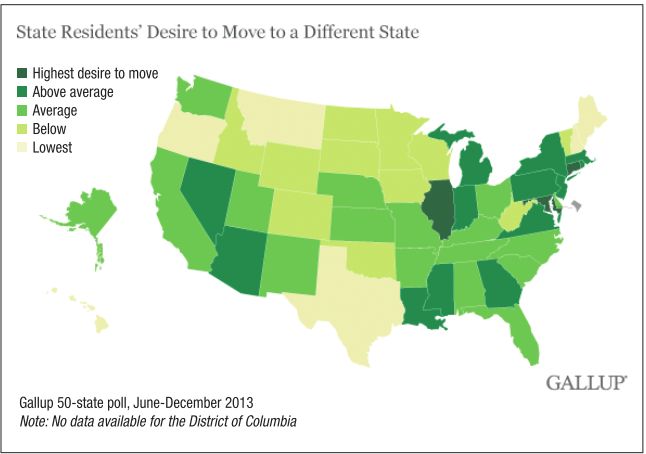
The pollsters of the Gallup organization asked people around the country whether they would move away from their home states, given the chance. Half of the Illinois residents asked said yes. No state had more residents dreaming of faraway places.
Of course, public opinion polls are to public opinion what marriage vows are to marriages, but the announcement of the Gallup results excited much wringing of hands and I-told-you-so’s from commentators. A few more sober public wise men – Rich Miller for one – dismissed the poll as just people talking, and with reason. After a tax rate increase and a rotten summer followed by a winter you wouldn’t wish on Sarah Palin, asking Illinoisans if they’d like to be somewhere else was like asking someone in the 1970s who’d just been mugged in Central Park what he thinks of life in New York City.
Did Gallup stumble upon some undiscovered social fault that threatens the foundation of the commonwealth? Damned if I know. What I do know is that there have always been Illinoisans who have always yearned to become ex-Illinoisans, and that millions of them have done just that. I was reminded of that recently while reading a study done by historian K.J. Winkler in the 1990s and published in the Journal of Social History. His study of Migration and Political Participation among Springfield voters of the time found that population turnover in mid-Illinois in those days was remarkably high; anyone living in the same town as long as five years qualified as rooted in the community. Indeed, Lincoln’s presidential campaign advisors opted for the Railsplitter theme in part because by the time he was being talked about as a presidential prospect, Lincoln’s backwoods origins were forgotten by the larger public, if they were ever known.
And
so it has gone, for 150 years. The unskilled move to where it’s
booming, the semiskilled move to where it’s cheap, the old move to where
it’s warm, the young move to where it’s fun. According to the IRS, from
1993 to 2011, 438,000 more households moved out of Illinois than moved
into it.
Very often
it’s good riddance. Diana Sroka Rickert, by day a mouthpiece for the
Illinois Policy Institute, reacted to the Gallup findings in a Tribune op-ed.
“Indiana has become a destination spot for Illinoisans . . . who still
want access to our airports and city, without paying the high prices.”
By “high prices,” she means the costs of providing airports and a city
worth having access to. Seeing the backs of such freeloaders ought to
gladden Illinoisans.
Rickert
also introduced us to a pair of newlyweds who are leaving suburban
Chicago to start their new life in Texas, because, as the wife put it,
“I just don’t see us getting ahead by staying here.” Elected officials
are obliged to pay attention to the views of foolish young people who
head off to new states, as these people are doing, without jobs, where
they know no one, where jobs are likely to pay less than here, who
think, in short, they can get ahead without training, without planning,
without patience. The rest of us should pay them no mind at all.
This
kind of mobility is thought (by economists at least) to be good for
America, because talent thus moves to where it can be best used.
Mobility also serves as a social safety valve; discontent never rises to
explosive levels where people can leave a place and take their
unhappiness with them. Even mere chronic disgruntlement of the sort
detected by the Gallup poll has soured Illinois politics and weakened
the bond – never strong in Illinois to begin with – residents have with
the civil community.
Which
is why I for one considered the Gallup poll to be good news – if only
they would actually leave. Americans, once a famously footloose people,
have become stuck in the mud. The percentage of the U.S. population that
moved from one state to another was only half as large – 1.5 percent
compared to nearly 3 percent – in 1990 as it was in 2011. As America
goes – or does not go in this case – so goes Illinois. Of those who told
Gallup they were fed up with Illinois, nearly all are just daydreamers
with no plans to actually leave. And why don’t they leave? Because they
have a house they can’t sell, or kids in school, or aging parents who
need tending to, or they’re drawing a seniority-based salary they don’t
deserve and couldn’t possibly command if they started over somewhere
else. In short, what’s wrong with life in Illinois is life, not
Illinois.
Contact James Krohe Jr. at [email protected]
Editor’s note
“This
is a complicated topic,” said Sen. Andy Manar, one of the panelists on
the May 20 program about “Smart streamlining” – fi nding ways to improve
government effi ciency by consolidating and downsizing (see article p.
15). Others on the panel agreed how very complicated it all is. But
former Mayor Karen Hasara pointed out that Springfi eld and Sangamon
County successfully combined their election commissions, their health
departments and parks, all to good results. Evanston residents recently
voted to eliminate Evanston Township, which had the same boundaries as
the city. Capital Township, which has the same boundaries as Springfi
eld, could easily be eliminated the same way. It’s not complicated, just
politically diffi cult. And necessary, to save money and restore faith
in government. “If you love the Land of Lincoln as much as I do and we
all do,” said Andy Shaw, head of the Better Government Association, “we
need to restore the glow on the statue outside the Capitol building. We
need to restore the image and the functionality of this state, and smart
streamlining is one of the ways to do it.” –Fletcher Farrar, editor and
publisher


