
Let the sunshine in
Springfield’s troubles with open government
GOVERNMENT | Bruce Rushton
Mayor Mike Houston calls the shots at Springfield city council meetings. And hizzoner wasn’t much interested in following rules or listening to anyone when nine people signed up to speak about Hunter Lake, the city’s proposed alternate water source, at the March 4 council meeting.
“There’ll be a three-minute limit on each individual,” Houston announced before testimony began. “Then we can have a discussion after we’ve heard from members of the audience.”
That didn’t sound right to Ward 5 Ald. Sam Cahnman.
“Don’t our rules say that citizens have five minutes?” the alderman asked.
The mayor was in no mood. “Our rules indicate we can adjust that based on the number of people that we have,” Houston responded. “We’ve done one minute, we’ve done two minutes.”
And so local attorney Don Hanrahan walked to the podium and began explaining why he thinks that Hunter Lake is a bad idea. Hanrahan, who’s been fighting the project since 1989, knows a lot about the proposal, considerably more than he can squeeze into three minutes or even five. Having done his homework, he’s precisely the sort of person that elected officials like – or should like – to hear from when deciding whether to spend $80 million or more on an alternate water supply for a city that has never run out of water.
“The construction cost index…” Hanrahan was saying when the meter expired in midsentence, signaled by a loud buzzer that would be more at home in a basketball arena or hockey rink than a government forum.
BEEP! BEEP! BEEP! BEEP!
“Your three minutes are up,” Houston announced. “Thank you.”
“Mr. Mayor, I thought we were going to let the public have a discussion,” said Ward 2 Ald. Gail Simpson.
“Let’s go through all of them,” the mayor responded, as if listening to citizens who took the time to come to City Hall was a burden to be endured instead of an opportunity to learn something.
Cahnman, who had reviewed the council’s rules of procedures during Hanrahan’s presentation, tried again.
“The rule basically says the presiding officer can give more than five minutes but it doesn’t say he can give less than five minutes,” Cahnman explained.
“We’re giving three,” the mayor shot back. “We should amend the rule then, if that’s what we want to do in the future,” Cahnman said.
And that was that. None of Cahnman’s colleagues on the council, who collectively have held elective office for nearly a century, spoke up or otherwise joined the alderman in defending the rights of citizens to address elected officials who have a history of breaking laws intended to ensure open government and public input into policymaking.
The city’s disregard of so-called sunshine laws has cost taxpayers. Since Houston took office in 2011, the city has lost or settled five lawsuits filed under the state Freedom of Information Act and the state Open Meetings Act. Taxpayers have shelled out nearly $170,000 to plaintiffs and lawyers, and the tab is still open on two lawsuits, thanks to city appeals of adverse rulings by judges. The city hasn’t won a single case.
The city, by all appearances, just doesn’t get it.
Injunction no help 
Houston’s
recent refusal to follow rules regarding the public’s right to speak
during council meetings came exactly two weeks after Sangamon County
circuit court judge John Schmidt issued an injunction in a lawsuit filed
by yours truly under the Open Meetings Act. I sued after the city
council went into executive session last November to talk about
privatizing Oak Ridge Cemetery. Schmidt ordered the city to release a
tape of the illegal meeting and issued an injunction forbidding future
violations of the Open Meetings Act.
The city has asked Schmidt to reconsider his order banning future violations of the law.
“The
nature of the violation found by the Court was indicative of a one-time
inadvertent topical detour, rather than an ongoing violation of the
OMA,” the city argues in its plea to rescind Schmidt’s order to obey the
law. “(T)he City submits that the facts present in this case do not
warrant an injunction against ‘future violations of the Illinois Open
Meetings Act.’ Such a broadly worded, open-ended injunction is
inappropriate and unnecessary.”
Really?
The city on March 4 broke the law again by not following established
rules allowing citizens to address the council, according to attorney
Don Craven, who successfully sued the city for violating the Open
Meetings Act by discussing Oak Ridge Cemetery behind closed doors. It’s
not complicated: State law says that the public must be allowed to
address public bodies such as the city council according to rules made
by the public body.
“It
is my opinion that the actions of the mayor in denying Mr. Hanrahan his
five minutes does not comport with the requirements of the rules set by
the city council, and since it doesn’t comport with the rules set by
the city council, it doesn’t comport with the Open Meetings Act,” Craven
says. “It would be yet another violation.”
It
would have been nice if Todd Greenburg, the city’s top lawyer who
attends council meetings to provide legal advice, had spoken up and made
that point so that Hanrahan could have completed his thoughts instead
of being cut off by the mayor. Instead, Greenburg, who has practiced
municipal law for more than 20 years, remained mute while Cahnman
explained requirements to colleagues who didn’t seem much interested.
Hanrahan
said that he found out about Schmidt’s injunction the day after the
council meeting during a conversation with a law partner.
“I thought, ‘Well, so much for injunctions when it comes to the city,’” Hanrahan said.
Hanrahan
says that he doesn’t plan to sue the city, but that doesn’t mean that
the mayor and council should be able to make things up as they go along
instead of following rules and laws.
“To
be cut off like that just seemed wrong,” Hanrahan said. “It’s very
important that they not cut off public debate. I think the public
deserves to know, when they go there (to council meetings), they may be
cut off, too. It could be anything. It could be a person’s livelihood, a
bar license or something that’s on the line.”
Or it could be the fate of Abraham Lincoln’s final resting place.
Secret cemetery talks
The
zeal with which the Houston administration kept secret a
dead-on-arrival proposal to put Oak Ridge Cemetery under private
management began long before the council broke the law
by discussing the idea behind closed doors in November. Consider what
city budget director William McCarty told a cemetery consultant last
spring as the consultant prepared to visit the graveyard in the course
of preparing a report that recommended the city consider putting Oak
Ridge under private management.
“We
told the cemetery director that a consultant had been acquired to look
at Oak Ridge’s operations,” McCarty wrote in an email to the consultant,
who charged $3,000 for his services. “You will need to interview him
during your site visit because otherwise the report would not be
considered credible. That said, he has no idea that we are looking at
bringing in an outside entity to take over its operations and it is
important that he remain in the dark on that. Please remember that when
you are speaking with him.”
Cemetery
director Michael Lelys says that he was on his way out of his office
when the consultant stopped by with McCarty and public works director
Mark Mahoney, who explained that the consultant was exploring ways to
increase revenue. The conversation was brief, Lelys recalls, and no one
brought up privatization. Lelys says he was surprised to read in the
final report that the consultant had interviewed him and toured the
cemetery.
“When I read
the report, I was flabbergasted,” Lelys says. “I didn’t take him on a
tour, nor did I consider our brief discussion an interview.”
When
the city council finally found out about the plan during a November
executive session later ruled illegal by Judge Schmidt, it apparently
didn’t occur to aldermen that they were breaking the law. Instead of
moving to adjourn the illegal meeting, aldermen for nearly 30 minutes
jawed about putting Oak Ridge under private management. No one raised
the obvious question: Why are we talking about public policy behind
closed doors?
After the city was served with a court summons, aldermen talked a good game.
“We
can’t keep doing this over and over and over and opening the doors for
somebody to sue us,” Ward 1 Ald. Frank Edwards thundered during a
council meeting two weeks after the illegal session. “I think it’s
wrong. I get tired of going into executive session. I don’t know what
we’re going to discuss in there, mayor. You called the meeting, I
didn’t.”
But neither
Edwards nor any of his in private. “And, in my opinion, we didn’t
violate the Open Meetings Act during that session.”
After
being sued, the council had a chance to make amends by voluntarily
releasing a recording and minutes of the illegal meeting before a judge
could issue an order. Ward 7 Ald. Joe McMenamin sponsored an ordinance
in December to do precisely that, but couldn’t get enough votes to get
the measure out of committee, with aldermen saying they feared such a
move would weaken their defense of my lawsuit. Ward 8 Ald. Kris Theilen
made an colleagues on the council
had moved for adjournment a month earlier, when they had the chance to
put an end to the meeting held behind closed doors on the pretense that
they were discussing matters pertaining to personnel and collective
bargaining. The mayor responded to Edwards’ tirade by insisting no laws
had been broken.
“It is a fundamental obligation of government to operate openly.”
“I’ve never gone into
an executive session where I’ve knowingly violated the Open Meetings
Act,” Houston said shortly after the city landed in court for discussing
the cemetery offer that was easy to refuse.
“If
the reporter wants to withdraw his case, I’ll be glad to release this
(recording) immediately,” Theilen offered during a December committee
meeting when McMenamin’s ordinance failed. “As long as there’s something
hanging over our heads, legally this is not a very good idea. I think
it’s putting our heads on the chopping block in some ways.”
Two months later, the city lost the case.
In
addition to ordering the city to release the recording of the meeting,
Judge Schmidt told my attorney to prepare a bill for services rendered
that taxpayers will pay.
A fundamental obligation
The city’s failures to obey sunshine laws aren’t limited to violations of the Open Meetings Act.
The
city’s notorious shredding of police internal affairs files last spring
cost taxpayers more than $100,000, the amount paid to settle a lawsuit
filed under the state Freedom of Information Act by Calvin Christian
III, a gadfly who had requested files that the cops destroyed rather
than turn over. The settlement marked the third time since Houston took
office that either Christian or his lawyers or both have collected money
from taxpayers after suing to obtain police internal affairs files.
With
a litigation record like that, you’d think that the city would want
better legal advice when it comes to sunshine laws. And so the hiring of
Greenburg as corporation counsel in January is perplexing.
Greenburg
replaced former corporation counsel Mark Cullen, who OK’d the shredding
of police files last spring and ended up under investigation by
Illinois State Police because of it. Greenburg came to Springfield from
Bloomington, which parted ways with him last year after a very public
spat over public records.
In
the Bloomington incident, Greenburg had balked at releasing police
records regarding an accident involving an assistant police chief who
was suspected of being under the influence. Ordered to release the
records by the state attorney general’s office, Greenburg said that the
city should consider asking a judge to overturn the attorney general, a
stance that brought strong criticism from Bloomington mayor Tari Renner.
“We
should release these documents and we should do it as soon as
possible,” Renner told WJBC radio in Bloomington last June, when
Greenburg balked in the face of the attorney general’s order. “The legal
counsel is supposed to report to the elected officials and they are
supposed to do what we tell them. This is not government by bureaucracy,
this is government by the people and its elected representatives, namely the mayor and the city council. We make the decision, not Todd Greenburg.”
Ultimately,
Bloomington released the records without litigation. Houston and the
city council knew about this FOIA flap when they hired Greenburg. And it
didn’t take Greenburg long to flub a sunshine matter in Springfield.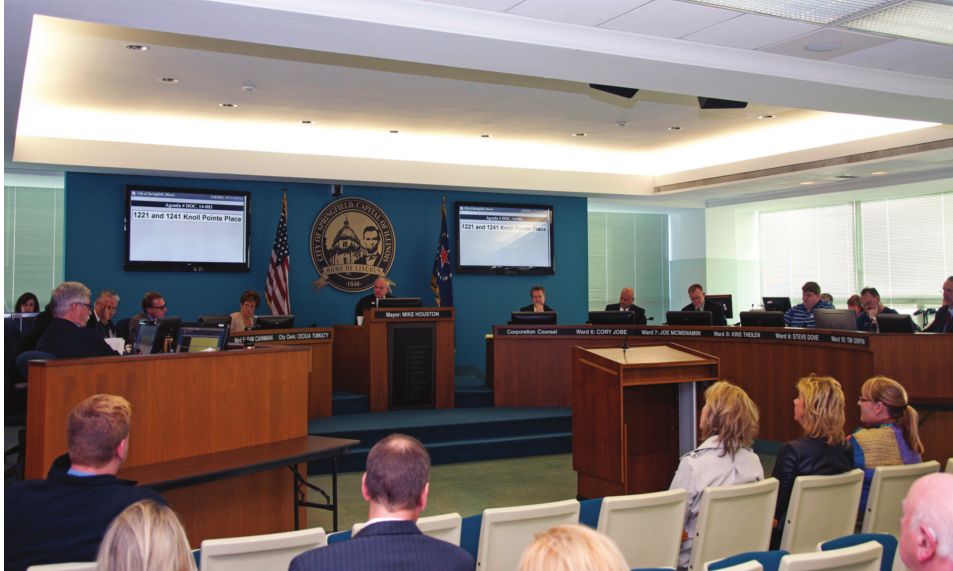
On
Feb. 4, less than one month after joining the city payroll, Greenburg
allowed the city council to move a resolution regarding the Abraham
Lincoln Presidential Library and Museum from first reading to final
emergency
passage. The
resolution wasn’t controversial, but the process violated the Open
Meetings Act, according to a letter that Craven wrote to Greenburg the
day after the council approved the resolution.
Matters
on first reading typically are not discussed by the council, and so
anyone interested in a resolution or ordinance that appeared on a
council agenda as subject under first reading would have no reason to
attend the meeting. By moving resolutions or ordinances from first
reading to emergency passage with no advance warning, the council
deprives the public the chance to comment
or otherwise provide input to the council, Craven argued in his letter to Greenburg.
“Frankly,
if I were a member of the council, I would be concerned about the use
of this process to pass more controversial items in the future, perhaps
at a time when a council member or two could not attend the meeting,”
Craven wrote.
The
council ended up holding a special meeting to vote again on the
resolution, this time with plenty of advance notice to the public.
Then there is the matter of an Illinois State Police report on the inner workings of the Springfield Police
Department. The city for years resisted release of the 2005 report that
documents shoddy police practices that led to the dismissal of two
detectives, one of whom was reinstated by an arbitrator, and the
dismantling of the department’s major case unit that once investigated
murders and other high-profile crimes.
Thanks
to amendments to the Freedom of Information Act that took effect in
2010 and lawsuits filed by Christian, internal affairs files are now,
finally, considered public records in Springfield. The city has always
characterized the ISP report as an internal affairs file, and so I and
other reporters requested it last fall, when we discovered that the city
still had the file that had reportedly been destroyed pursuant to a
policy that allowed the city to dispose of such documents after five
years. Then we waited. And waited. And waited some more.
The
law gives cities five business days to respond to records requests.
After more than three months passed, I asked the city for a date when
the report would be released. Greenburg responded by making up a
deadline.
The city,
Greenburg wrote in a February email to aldermen, will release the report
in nine installments over the course of nine months. Furthermore,
Greenburg wrote, it could take even longer if the city loses a FOIA
officer tasked with redacting birth dates, Social Security numbers and
other private information from the report.
Nine months. The law says five days. The law also says this:
“It
is a fundamental obligation of government to operate openly and provide
public records as expediently and efficiently as possible in compliance
with this Act.”
Fundamental
obligation. Put another way, providing public records is as important
as plowing streets and putting cops in patrol cars. That’s what the law
says. And the city would do well to start obeying sunshine laws instead
of making stuff up.
Contact Bruce Rushton at [email protected].


