Dead dogs walking
Strays get saved in Springfield
ANIMALS | Bruce Rushton
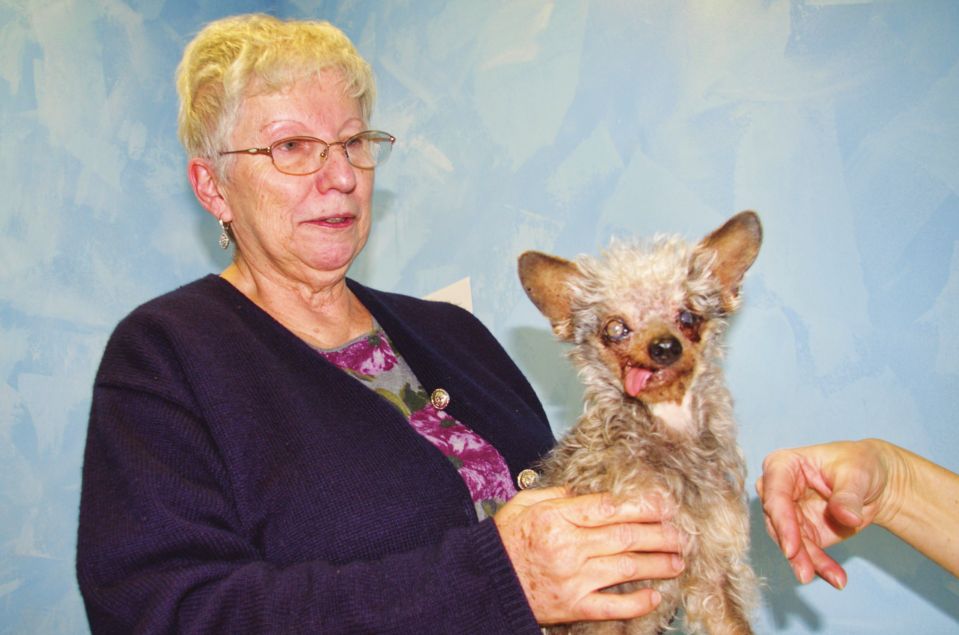
The dog on the exam table looks like a creature from a Star Wars sequel.
Even with a doggie sweater on, it weighs just four pounds, five ounces, with hair so sparse it would risk a sunburn if this were summertime instead of mid-February. She is deaf, blind and toothless, with cloudy eyes and a tongue prone to hanging limp from the side of her mouth.
No telling the breed, or more accurately, breeds. Volunteers at the Sangamon County Animal Control Center figured her for a poodle mix when she was brought in after she was found, apparently lost or abandoned, in someone’s yard. Gary Minder, veterinarian here at Grace Veterinary Clinic in Chatham, guesses a blend of terrier and Chihuahua.
“She could be 12 to 15 with some really hard miles on her or she could be 16 or 17,” says Minder as he examines the malnourished mutt.
Dubbed Masha at the pound, her new owner, Pat LeComte, who has a thing for the letter “g,” has re-named her Gina to go along with her other dogs named Griff and Gordy. If it has been a challenge caring for a sightless dog that constantly bumps into things and isn’t housebroken, LeComte isn’t complaining.
“As I’ve gotten older, my point of view has changed,” LeComte explains.
Minder goes down the list. Does Gina vomit? No. How’s her appetite? Like she’s never seen food before, although LeComte is limiting her to three teaspoons of canned dog food twice a day. Anything at all unusual? She sleeps a lot and whines as if crying as she snoozes. Perfectly normal – she’s probably dreaming. Dogs do dream, Minder says, although, in this case it might be nightmares, considering what Gina has been through.
A stethoscope against Gina’s chest carries good news.
“It’s amazing she doesn’t have any respiratory infection this time of year,” Minder says. “She’s obviously weak and she has a bit of arthritis. At this point, who wouldn’t?” Blood tests will reveal problems that aren’t obvious, and there is nary a whimper as the needle goes in. No matter what, Gina’s life has improved dramatically, and things are about to get much better.
Give her as much food as she wants, Minder tells LeComte, but not dog food. She needs sweet potatoes, baby food, perhaps tofu.
“Not all table food is bad food,” Minder advises. “She’s got a lot of ground to make up.”
Blood test results reveal no issues save for a bit of anemia, which may or may not go away. LeComte has no illusions. When she agreed to take the dog, she understood that this was a matter of providing hospice care. Even though Gina is healthier than first suspected, it’s impossible to say how much time she has left.
“With
proper care, she might live another year,” says Carol Rodgers, founder
of Helping Paws, a new animal welfare organization dedicated to saving
elderly pooches that connected LeComte with Gina. “You just don’t know
when they get that old if they’re going to last two years or two
months.”
Making
progress Just a few years ago, strays as old and feeble as Gina stood
virtually no chance in Sangamon County, which has realized remarkable
progress in reducing euthanasia rates.
Last
year was the first year ever that no dogs were put down at the Sangamon
County Animal Control Center for lack of space, according to Greg
Largent, animal control director. Cats, being more plentiful, are a
tougher issue to solve, but euthanasia rates for felines are also down,
with 40 put down in 2013 as of Nov. 30 due to lack of room. It is, in
part, a product of fewer admissions. In 2008, the county boarded 4,800
animals and euthanized 861 for lack of space. By 2012, the number
boarded had plummeted to 3,445, with 33 euthanized because there was no room.
No
single thing explains why strays are facing better odds than ever in
Sangamon County, where private rescue groups and the countyowned animal
control center are taking steps to improve the plight of homeless dogs
and cats.
The county
is keeping animals longer, from an average of 6.74 days in 2008 to
nearly 14 days last year, even though state law allows unclaimed strays
to be euthanized three days after they’re picked up if the owner is
unknown. If the owner is known, the animal must be kept for at least
seven days.
Life isn’t
cheap at the county’s animal control facility, where per-day boarding
fees for municipalities that contract with the county for animal control
are expected to increase.
Under
a proposal approved last month by the county board’s public health
committee, the per-day fee for cities and villages would increase from
$20 to nearly $60 beginning in 2015. However, the county has dropped a
plan to make cities and villages bear the full cost of keeping dogs and
cats as long as room
is
available instead of the minimum three days required by the state.
Increases would be dramatic if municipalities paid the full cost of
keeping animals longer than required by law. Pawnee’s costs, for
example, would go from less than $1,000 in fiscal year 2012 to more than
$19,000. Springfield’s tab would nearly double, from $290,000 to nearly
$565,000. Sticker shock prompted municipalities to mull alternatives to
the county facility.
Under
the current proposal, municipalities beginning next year would pay for
the first three days, the statutory minimum for keeping a stray animal
when the owner can’t be identified. After that, the county would absorb
boarding expenses. It costs about $1.2 million a year to run the center,
which generates revenue of slightly more than $600,000 from adoption
fees and charges to municipalities.
“It’s
a policy decision of the county to have as close to a no-kill facility
as possible,” says county administrator Brian McFadden. “With policy
comes a cost.”
Public safety, not finding homes for Fluffy and Fido, is the county’s top priority, Largent says. Unlike private shelters, the county must take in any animal, regardless of health, temperament or age.
“We’re not going to refuse an animal when it’s presented at our door to us,” Largent says. “That leads to a surplus of animals.”
While
animals are less likely to be euthanized for lack of space, the county
still puts down animals if they’re deemed dangerous or have intractable
health issues that cause them to suffer. Some pets are brought to animal
control by owners who choose the county instead of a private
veterinarian to perform euthanasia. More than 1,300 dogs and cats each
year were euthanized in 2012 and 2013, down considerably from more than
2,800 that were put to sleep in 2008. But that still leaves 2,000 or
more would-be pets.
The
county is not set up to find owners for homeless dogs and cats. If it
were, the animal control center would be open to the public for longer
hours on weekends instead of just 2 ½ hours on Saturdays. It is open
from 10:30 a.m. until 4:30 p.m. on weekdays. Besides kenneling dogs and
cats, the agency must also answer calls for strays spotted in
neighborhoods, investigate incidents of animals biting humans, respond
to animal cruelty cases and otherwise enforce all state laws and local
ordinances aimed at dogs and cats.
“Our priority is public safety,” Largent says. Enter the private sector.
A
never-ending job Sangamon County is home to at least six nonprofit
groups that help homeless dogs and cats. Collectively, the groups bring
in as much as $1.8 million in annual revenue, half again more than the
county’s animal control budget.
The
largest, Animal Protective League, had nearly $1.6 million in revenue
in 2011, the most recent year financial records are available from the
Internal Revenue Service.
Private
groups augment kennel space with foster homes where people care for
dogs and cats on a temporary basis until permanent homes can be found.
The foster homes must be licensed, with each license allowing as many as
four animals per home. In any given year, the state Department of
Agriculture issues more than 100 foster home licenses in Sangamon
County.
Every
situation is different. In Gina’s case, a volunteer at the animal
control center knew Rodgers had an interest in old dogs and called her.
Rodgers put out an email alert. A woman on Rodgers’ email list thought
her mother might be interested. And so Gina and LeComte found each
other.
A new nonprofit
group, Friends of Sangamon County Animal Control, gets much praise and
credit, providing volunteers who walk dogs, give them beds so they don’t
have to sleep on concrete and act as adoption counselors who answer
questions and otherwise pair prospective owners with would-be pets.
Organized in 2011, when the county euthanized 157 animals for lack of
space, the group also raises money to subsidize adoption costs, figuring
that low fees encourage people to become pet owners. Like volunteers
with Animal Protective League and other rescue groups, they also take
dogs and cats to stores on weekends in a never-ending search for homes.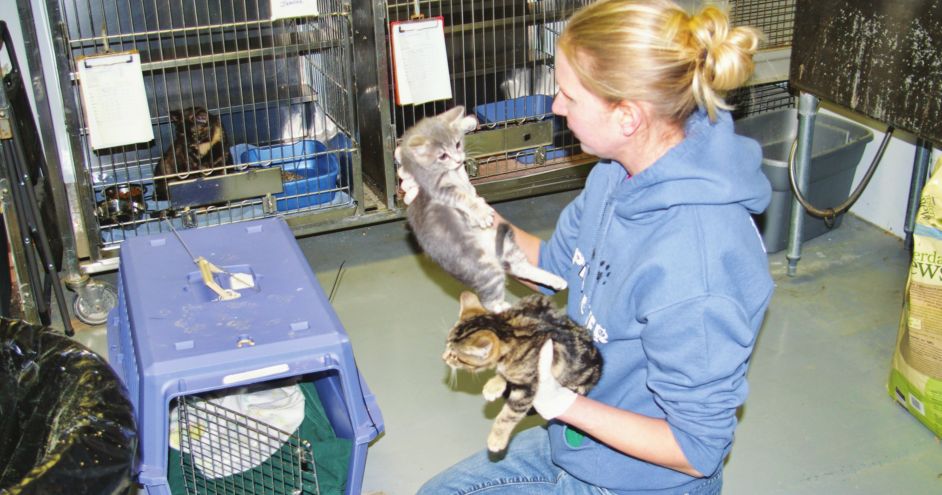
The progress is reflected in empty cages.
Two
weeks ago, while APL kennels were filled to capacity, there were just
13 dogs available for adoption at the animal control center.
“We’ve
never had this few dogs since I’ve been here,” says Mary Ann Morris,
president of Friends of Sangamon County Animal Control.
Morris
has been volunteering at the center for years. Before retiring as a
high school biology teacher six years ago, she interrupted
her daily commute to walk dogs at the center.
“There
weren’t many volunteers at that time – there were three of us,” recalls
Morris, whose group now boasts 40 volunteers. “We walked as many as we
could in an hour.”
The animal control center once had a reputation as a doggie death camp, but that image is changing.
“Before
we were formed, there was very little focus on adoptions,” says Cheryl
Peck, a Friends of Sangamon County Animal Control board member. “Some
people would not even come to the shelter. There’s a stigma about the
place we’re trying to dispel. It’s a wonderful place to look for a dog
or cat.”
The center
now advertises dogs and cats on the Internet, and it has also joined a
network of public and private shelters organized by the American Society
for the Prevention of Cruelty to Animals called Moving Animals Places,
or MAP, that moves animals facing euthanasia to locations with more
room. The county facility serves only as a source of dogs and cats, not a
destination. MAP was launched last spring, but animals from county
kennels have been moved via less formal channels since 2012, with more
than 60 dogs relocated to shelters as far away as Oak Park.
“I’d
like a lot of the negative perceptions of animal control to be a thing
of the past,” Largent says. “We’ve got a good thing going here. I like
our model. We’re not modeled after anyone. I don’t think we’re
pioneering anything here other than these relationships (with animal
welfare groups).”
The
county wins praise from Rodgers. “It’s a huge, huge improvement over
seven or eight years ago,” says Rodgers, a former APL volunteer
coordinator who recalls pulling dogs out of the center to save them from
the needle. “They’ll always be short-staffed, yet they’re one of the
best shelters in the state.”
But there are still more critters than the county can handle. APL last year took in more than 300 kittens from the county center and hundreds more from other animal control facilities where they faced euthanasia.
“I think there’ll always be a need for us and for animal control,” says Deana Corbin, APL executive director.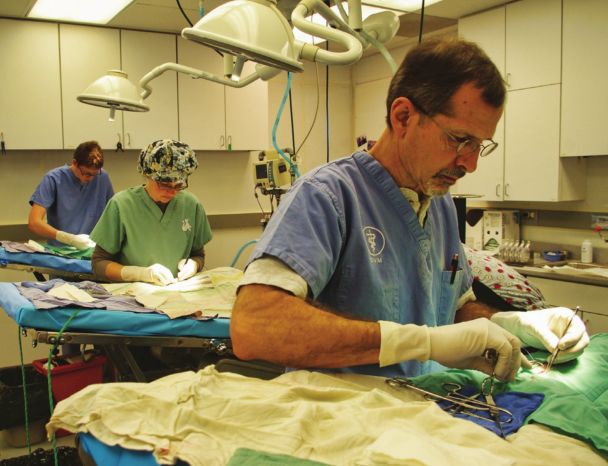
With
1,700 adoptions last year, APL finds homes for more dogs and cats than
any other agency in the county. But that’s only half the mission.
Cutting
off the supply For every stray that finds a new home through APL, the
agency spays or neuters nearly eight dogs and cats.
It
is a sterilization machine that employs two full-time veterinarians,
averages more than 50 surgeries per day and has altered more than 70,000
animals since opening in 2006. The single-day record is 113, thanks to a
scheduling snafu that resulted in two shipments of animals showing up
on the same day. Each surgery takes about 10 minutes, with assistants
constantly prepping animals while veterinarians move from one table to
the next.
When it
comes to fixing dogs and cats, APL is a regional facility that pulls
animals from shelters and rescue groups in 18 counties within a 90-mile
radius. Just 20 percent of surgeries are performed on animals from
Sangamon County. The standard fee is $65 for a dog and as little as $25
for a cat. Pitbulls, which are dramatically overrepresented in the stray
dog pool, and cats from certain Springfield zip codes with
overpopulation issues, are fixed for free, thanks to Petsmart, which is
subsidizing surgeries.
“We try not to turn anyone away who can’t afford it,” Corbin says.
The
APL also participates in the ASPCA’s animal relocation program, both as
a source facility and a destination. The program has roots in greyhound
rescue projects that sprang up during the 1980s to save racing dogs
whose running days were over, says Sandy Monterose, senior director for
community initiatives for the ASPCA. Tens of thousands of greyhounds
that otherwise would have been destroyed were saved by moving them from
racetracks to distant cities where new owners could be found.
 Formed
less than a year ago, MAP includes nearly 400 shelters and rescue
groups in 47 states and the District of Columbia. Animals have been
moved as far as 1,800 miles, Monterose said, with the average distance
being a bit over 500 miles.
Formed
less than a year ago, MAP includes nearly 400 shelters and rescue
groups in 47 states and the District of Columbia. Animals have been
moved as far as 1,800 miles, Monterose said, with the average distance
being a bit over 500 miles.
Animal
lovers have been moving dogs and cats to dodge euthanasia for years –
the phenomenon really took off, Monterose says, in the aftermath of
Hurricane Katrina, when thousands of dogs and cats were left homeless
and volunteers flocked to New Orleans to rescue them. The rise of
websites, particularly www.petfinder.com,
which features photos, videos and written descriptions of more than
300,000 homeless dogs and cats from coast to coast, has facilitated an
oftenpatchwork movement that has been dubbed a canine underground
railroad, with volunteers driving animals hundreds of miles and
sometimes handing them off to other volunteers Pony Express-style to
complete longer journeys.
It
is not, Monterose says, a perfect solution. “It’s one tool in the
toolbox,” she says. Sheer numbers preclude moving animals as a solution
to the surplus population, says Daphna Nachminovitch, senior vice
president for cruelty investigations for People for the Ethical
Treatment of Animals, which has been criticized for euthanizing animals
at a PETA-owned shelter in Virginia, where 2,000 dogs and cats are
euthanized each year and fewer than 30 are adopted, according to a New York Times report published last year.
All
too often, Nachminovitch says, the nokill movement has resulted in
animals being given to hoarders whose purported shelters are collections
of crates in basements, and PETA has produced stomach-churning videos
of dogs and cats warehoused by people who weren’t properly screened.
There have also been cruelty prosecutions of people caught transporting
animals en masse. There must be safeguards to ensure that dogs and cats
aren’t simply being moved from a bad situation to something worse,
Nachminovitch says.
“I
am concerned about animals being moved across state lines without a
very thorough inspection of any place that is going to take these
animals,” Nachminovitch says. “If someone says ‘I’ll take 50 cats,’
that’s a red flag – there are cats everywhere. ... People get pulled
over, they have 30, 40, 50, 60 dogs and cats in a moving truck. Why did
anyone think that was a humane thing to do? What we’re seeing with the
no-kill movement is animals being put in harm’s way in order to have lower euthanasia rates.”
From
afar, however, Sangamon County and private groups appear to be doing
the right things, Nachminovitch says. That the county has been able to
work with private groups is a plus not present in other communities, she
says.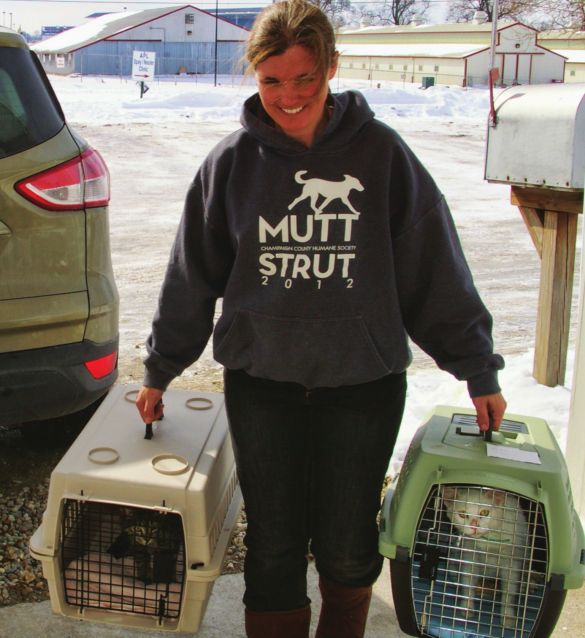
“What
we see are very aggressive attacks on the animal control agency in a
way that almost puts the blame on animal control for having to
euthanize,” Nachminovitch says. “That’s not just detrimental to
collaborations, it really ends up creating a lot of resentment.”
Nachminovitch also applauds the emphasis on spaying and neutering animals.
“The key is to lower the intake through prevention,” she says.
Another
happy ending Amy Fischer of Urbana wears a smile as she unloads seven
crates containing four cats, two kittens and a mutt from her Ford
Escape.
“I can’t thank
you guys enough for helping out,” Fischer tells Kathy Ritzmann, APL
shelter veterinarian, as the two carry the crates inside. “This is
amazing.”
Fischer, a
teacher in the University of Illinois animal sciences department, has
been transporting animals for a decade, driving as far as Minneapolis
to
save a life. These creatures came from Danville, where the Danville
Humane Society is in turmoil. Most of the agency’s board has resigned
amid accusations that the agency has been euthanizing dogs and cats
without a state license. The group, which had a contract with the City
of Danville, has ceased performing animal control duties. But dogs and
cats remain.
Fortunately
for Lannie, an apparent labshepherd mix who appears to be about a year
old, a space opened up at APL just last night. Ritzmann, APL
veterinarian, chose Lannie from an emailed lineup of six pooches from
the Danville pound. Lannie, who has bright eyes and loves to nuzzle, got
lucky because she’s relatively young, not big and not a pitbull. That
makes her attractive to the typical would-be pet owner.
“It
was her age and adoptability that raised her high on the list,” says
Ritzmann, who figures it will take no more than two weeks.
After
a quick checkup reveals no health issues save a minor ear infection,
Lannie is put in the kennel. She’s spayed and microchipped the next
morning and put on the adoption block 24 hours later, looking and acting
no worse for wear. Ritzmann’s prediction proves accurate. Lannie goes
home with her new owners just days after arriving at APL, but she leaves
her name behind.
As often happens with shelter dogs, Lannie’s owners rechristened her. She now answers to Hope.
Contact Bruce Rushton at [email protected].


