Sniffing out trouble
Inside the Springfield Police Department’s K-9 training program
DRUGS | Patrick Yeagle
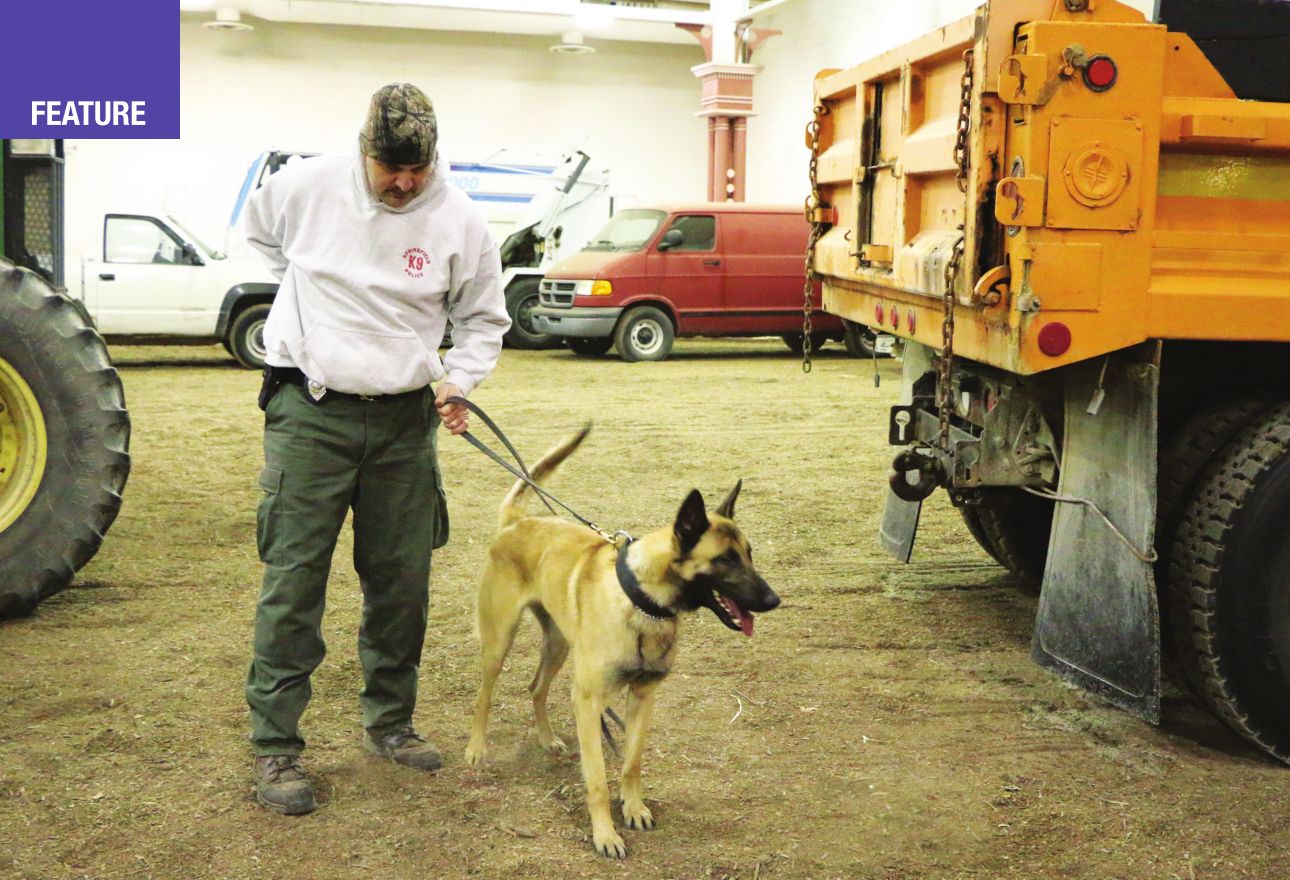
Inside a livestock building on the Illinois State Fairgrounds, a man is hiding stashes of marijuana, methamphetamine, heroin and cocaine in state-owned work vehicles parked inside for the winter.
Outside the building sit several new Ford Explorers with Springfield police markings, each one containing a highly trained police dog eager to sweep the building for contraband. It’s easy to tell which police cruisers in Springfield are with the police department’s drug dog unit: Only the K-9 officers drive Explorers, and each vehicle displays prominent window stickers admonishing passersby to stay back. The dogs are trained to bite, and they’re not afraid of anything.
The man inside the building isn’t a devious criminal hiding his drugs. He’s patrol officer Ron Howard, head of the Springfield Police Department’s drug dog unit, and he’s preparing a training run for the dogs and their handlers.
Illinois Times wrote about the Springfield Police Department’s drug dogs last month. [See “Drug dogs fail the sniff test,” Jan. 9, 2014, by Patrick Yeagle.] Using traffic stop data collected by the Illinois Department of Transportation, the article said Springfield’s drug dogs found contraband in only 13 out of 51 searches – a rate of only 25 percent.
Acting police chief Kenny Winslow was on vacation that week and wasn’t able to return phone calls until after the article had been published. When Winslow returned, he put the newspaper in contact with patrol officer Howard, who invited Illinois Times to watch a training exercise with his unit. Howard demonstrated the dogs’ capabilities and explained why he believes IDOT’s data on drug dog searches during traffic stops doesn’t accurately represent the results his department sees in the field.
While Howard believes the dogs are an important law enforcement tool in the War on Drugs, critics of drug dogs question their reliability and say they are used to circumvent the Fourth Amendment to the U.S. Constitution, which prohibits “unreasonable searches and seizures.” The amendment requires governmental bodies to obtain a warrant from a judge for most searches. But the use of drug dogs often allows police to establish “probable cause” – a belief supported
by evidence that a crime is being or has been committed – which may allow the police to search a person or their belongings without a warrant. Critics of drug dogs say the Fourth Amendment is too precious to entrust to an animal.
Finding the dope
Ron Howard will celebrate his 25 th year with the Springfield Police Department in October, and he has run the department’s drug dog unit for about 18 years. He says he enjoys working with the dogs so much that he has passed up several opportunities for promotion to remain in the unit.
“Your dog is going to protect you, and he will put his life on the line to protect your life,” Howard said. “He’s trying to make sure you go home to your family, and you’re trying to make sure he goes home with you.”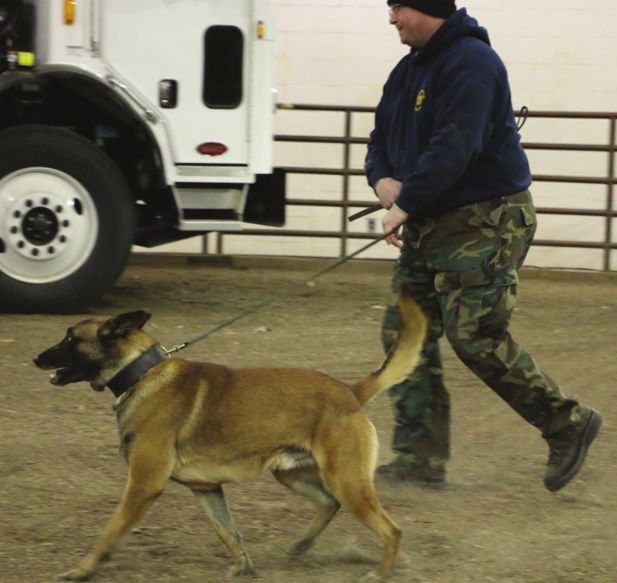
As
head of the drug dog unit, Howard is in charge of training the
department’s six narcotics-sniffing dogs and one explosivesniffing dog,
along with their respective handlers. When the dogs train for vehicle
searches, a member of the team – usually Howard – hides samples of real
drugs from the U.S. Drug Enforcement Agency in small metal boxes that
have ventilation holes. The boxes prevent the dogs from accidentally
ingesting the drugs. The other handlers are not present in the building
when the drugs are hidden, so neither they nor their dogs know where to
look. Howard says he randomizes the locations of drug hides and
sometimes doesn’t include any drugs at all so that the dogs and handlers
can’t fall into a routine.
On the training day attended by Illinois Times, Howard
first has a handler run his dog around a water truck with no drugs
hidden on it. The dog doesn’t alert, and the handler moves on to the
next truck, a large end loader. No drugs are hidden there, and the dog
doesn’t alert. The third truck, a large orange dump truck, has a stash
of crystal meth hidden deep inside the dashboard.
The
dog first sniffs the exterior of the truck quickly, then returns to the
seam of the passenger door. The dogs are taught to alert by scratching
at the point where they think
the
smell originates, so this dog scratches at the door seam until the
handler opens the door and helps him climb up into the cab. After
sniffing around a bit, the dog locates the approximate area where the
drugs are hidden, though it’s stuffed far enough into the dash that he
can’t quite reach it. Howard notes that the dog’s alert on the outside
of the vehicle would be enough legal justification for the officer to
search it by hand in a real life situation.
Next,
the dog is run along a long stretch of collapsed bleachers to simulate a
school locker search. After a preliminary pass, the dog returns to the
hiding spot and easily finds the stash of heroin that Howard planted
about four feet off the ground inside the bleachers. In a nearby storage
room, it takes the dog only a few seconds to find a stash of marijuana
in the drawer of a busted desk.
The
grand finale is a special test set up by Howard to show that smells of
contraband can linger even after the contraband is removed. Howard hides
powdered cocaine in the glove box of an old Chevy pickup in the
building’s lower level and leaves the vehicle running with the fan
circulating air through the cab. Before bringing a dog and handler into
the lower level to search the vehicle, Howard removes the cocaine and
turns the vehicle off.
As before, the dog and handler move around the truck quickly for a preliminary run, then return for a
more detailed sniff. The pair returns to the passenger door seam, where
the dog alerts and is then allowed into the truck cab. It begins
sniffing the interior and pawing at the cloth seats. The handler
instructs the dog to keep searching, eventually directing the dog to
sniff the glove box. After a couple of sniffs, the dog paws the glove
box to alert its handler to the smell of contraband.
Fourth Amendment issues
 That
last test illustrates one of Howard’s main gripes with the IDOT traffic
stop data. His test showed that smells may linger after contraband has
been removed, so a dog may alert to an old smell and prompt a search
that turns up nothing. The form IDOT uses to record traffic stop data
doesn’t take that kind of situation into account, Howard says.
That
last test illustrates one of Howard’s main gripes with the IDOT traffic
stop data. His test showed that smells may linger after contraband has
been removed, so a dog may alert to an old smell and prompt a search
that turns up nothing. The form IDOT uses to record traffic stop data
doesn’t take that kind of situation into account, Howard says.
Paris Ervin, a spokeswoman for IDOT, says the questions on the reporting form are set by state law, not by the agency.
The
reliability of drug dogs is hotly contested in court between law
enforcement officials and lawyers. If judges believe dogs are reliable,
then police can use a drug dog’s alert to establish probable cause for a
search. The U.S. Supreme Court has ruled that a drug dog sniffing the
“free air” around a vehicle doesn’t constitute a search because no one
can expect privacy in the air that drifts out of their vehicles. When a
dog sniffs that free air and smells one of the odors it’s trained to
detect, it alerts the police, who then have probable cause to search the
vehicle. The Supreme Court also struck down lower courts that required
drug dogs to show their reliability in the field, saying a drug dog’s
training certification is enough proof of its reliability.
Barry
Cooper is a former drug interdiction officer and dog trainer who served
on the Permian Basin Drug Task Force in west Texas and eventually quit
his law enforcement job to become an activist against the War on Drugs.
Cooper doesn’t dispute that drug dogs can detect lingering smells, but
he says those lingering smells can trick drug dogs into alerting for
something that isn’t a crime. Because drug dogs aren’t able to tell the
difference between actual drugs and a lingering smell – which is not a
crime by itself – the dogs are able to trigger a police search for
something that only appears to be a crime at first sniff.
Cooper
notes that several states now have laws allowing marijuana for medical
or recreational use. Illinois is soon to join them with a medical
marijuana law that takes effect in June. Cooper gives the example that a
person who can legally possess marijuana in one state might drive
across the border into another state without such laws, and the mere
scent of their legal marijuana would be enough to alert a police dog and
allow the police to search the vehicle, even if the marijuana was not
in the vehicle at the time. The same holds true for people who buy used
vehicles that may contain the scent of drugs.
In effect, he says, the people in those examples would have been falsely accused of committing a crime by an animal.
“A
canine has no business deciding that Fourth Amendment issue on the side
of the highway,” Cooper said. “As long as the drug war continues, cops
should only be able to use a dog to help them locate drugs they know are
there, never to establish probable cause.”
Asked
whether a dog’s alert could trigger a police search of a used car that
held drugs before it was sold, Howard seems unconcerned. He says
lingering odors lessen or disappear over time.
“If you bought a used car, I think you’d be pretty good unless there’s something hidden in it somewhere,” he said.
Another
reason Howard doesn’t put much stock in the IDOT traffic stop
statistics has to do with what’s known as “leaf shake,” which is a small
amount of marijuana that has been spilled or dumped onto a vehicle’s
carpet. Although the dogs find the drugs easily and the officer can
clearly see the particles, it’s often not worth the extra paperwork and
hassle of writing a citation for such a small amount of marijuana,
according to Howard. In that situation, he said, they simply tell the
vehicle owner to clean out their car. As a result, the dog search
appears as a false positive when it’s reported to IDOT.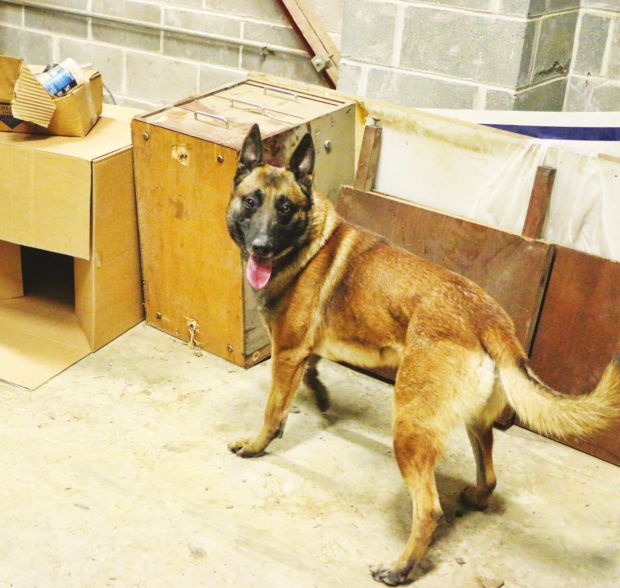
Springfield
defense attorney Mark Wykoff says that is one of many excuses police
use to justify a search that doesn’t turn up any contraband.
“Every
single time there is no tangible substance they can march out of the
vehicle with, they’re going to say ‘Our dog was right, and weed has
permeated the upholstery,’ ” he said. “You could say that every freaking
time, and there’s no way to prove or disprove that.”
According
to Howard, another explanation for the poor IDOT statistics is that
drug dealers have started to tie drugs to their genitals or stuff them
inside their bodies on the assumption that police won’t search there.
When a dog indicates that a suspect has drugs on them, an officer may
take the suspect to the hospital for a strip search or cavity check
supervised by a doctor. If the officer who transported the suspect to
the hospital isn’t the same officer who performed the dog search, Howard
says, the results of the strip search or cavity
check often don’t get recorded in the IDOT statistics, resulting in what
appear to be unsuccessful searches.
Again,
Wykoff is skeptical. “It would seem to me that then the law enforcement
entity would want to report that because it enhances their statistics
and credibility,” he said.
Wykoff
is less concerned about the veracity of the IDOT statistics, however,
and more concerned about the state of the Fourth Amendment.
“I’m
just very, very hopeful that at some time, the courts come to the
realization that they’ve really outsourced a lot of their role as judges
to an animal,” he said. “The courts should be dubious and circumspect
that animals have taken on the role of a neutral and detached judge,
because although a dog may have gone through 12 weeks of canine
training, he certainly doesn’t have an undergraduate degree, he didn’t
go to law school… and he didn’t have to run for election. Why in the
world would someone who is at the pinnacle of their legal career
basically shroud a dog with that same decision-making power and
authority?”
Tough training
Getting
into the Springfield Police Department’s drug dog unit isn’t easy. Each
handler faces a series of tests and a panel interview, and they’re
limited to only seven years in the unit. When a dog is retired around
age seven and becomes “surplus property,” the handler is given the
chance to adopt the dog.
Basic
training takes 560 hours, which Howard points out is more than the 400
hours required to become a police officer in the first place. The dogs
and their handlers do 16 hours of ongoing training per month, which
consists of several areas of emphasis: obedience, agility, handler
protection, suspect apprehension – ominously nicknamed “bite work” – and
searches. The dogs learn how to search vehicles and buildings, how to
search people, and how to search open areas like grassy fields for
evidence that may have been tossed by a suspect.
The
dogs and their handlers are certified together through both the United
States Police Canine Association and the Illinois Law Enforcement
Training and Standards Board. Howard points out that the Springfield
Police Department started getting its dogs certified in 1985 by USPCA,
long before a 2012 state law that mandated certification at the state
level.
Howard notes
that Springfield’s drug dogs and handlers regularly get high scores
during the combined tests and competitions. At a recent dog trial in
Chatham, a handler and dog from Springfield took first place. Another
Springfield handler and dog took fifth place, and the team representing
the Springfield Police Department took first place overall in the
competition, beating out teams from all over Illinois and Missouri.
Whether
or not the IDOT statistics are flawed, it’s clear the dogs used by the
Springfield Police Department are highly trained and quite capable of
sniffing out contraband. Howard and his men work hard to ensure the dogs
are reliable and disciplined. Howard is passionate about their job and
his dogs, believing completely in their ability to help get drugs off
the street.
“The dog
is a very valuable tool,” Howard says. “We’re using the same tools for
public safety, for our safety, and also to fight the War on Drugs. It’s
just an exceptional tool that can’t be replaced by a machine.”
Contact Patrick Yeagle at [email protected].


