Two techniques for better birds
FOOD | Julianne Glatz
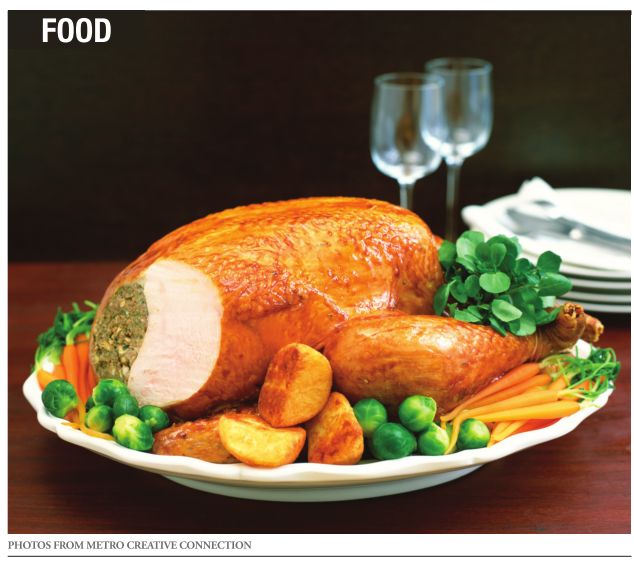
Since I first wrote about them in 2009, I’ve had several requests for two techniques I use when preparing roast turkey and dressing: brining and an unusual method of cutting up the turkey prior to roasting. By popular request here they are again.
For many home cooks, preparing roast turkey and dressing is the most challenging task they’ll ever undertake. The problem is that dark and white meat have different cooking times. If the breast is done yet moist and juicy, the dark meat is often undercooked and rubbery. Perfectly roasted dark meat frequently means the breast is unappealingly dry.
Then there’s the dressing. The best dressing cooks inside the bird, so the turkey juices flavor it. But only a small amount of stuffing can go inside the turkey. And there’s that nasty problem of potential bacterial contamination: If the dressing is cooked thoroughly enough for safety, the turkey itself is often overcooked and dry.
Several years ago, I began using two techniques for roasting turkey and stuffing. The first, brining the turkey overnight, imbues it with flavor and helps insure juicy meat, both dark and light. The second technique, which I adapted from the PBS cooking show Julia and Jacques Cooking at Home, takes a fair degree of advance preparation, but virtually guarantees a moist and evenly roasted bird and, best of all, enables the turkey juices to flavor as much stuffing as you want to make while eliminating the threat of bacterial contamination. Use just one or both as you prefer.
Brining the turkey
• 1 turkey, any size
• Brine to cover turkey: 1 c. kosher salt (do not use regular table salt) to 1 gallon water (2 gallons of brine usually covers a 12-15 lb. turkey, more for a bigger bird, depending on the container size)
• Herbs and spices, optional (suggestions: a bunch of fresh thyme, a few bay leaves, crushed garlic cloves (unpeeled is fine), a halved onion, handful of peppercorns, celery, cloves, coriander seeds, allspice berries)
The day before roasting the turkey
Prepare the brine: Stir the salt and sugar in cold water until completely dissolved. If using aromatics, bring them to a boil with a cup or 2 of water. Cool completely before adding to the brine.
Place the turkey in a nonreactive container (a clean 5-gallon plastic bucket works well, as does an ice chest). Add enough brine to completely submerge the turkey. Place a plate or tray on top to weigh the bird down and keep it submerged. Refrigerate overnight. If your refrigerator isn’t big enough, use an ice chest, with some ice added to the brine. You can put a container without ice outside if it’s cold enough (40 F. or less).
The next day
Remove the turkey from the brine and pat it dry. Let stand for 1-3 hours to come to room temperature, if possible in front of a fan to facilitate crispy skin.
Cutting up and roasting the turkey and stuffing
Read through these instructions several times before beginning to get an understanding of how everything comes together.
• 1 turkey, any size • Aromatics for stock: a halved onion, 2 celery stalks, 1 T. peppercorns, 2 bay leaves
• Freshly ground pepper
• Melted unsalted butter
•
Stuffing/dressing of your choice (A minimum of 8 c. for a small turkey,
but as much as you want. Stuffing should be at room temperature before
beginning to roast the turkey.)
•
Flour for thickening gravy Preheat the oven to 450 F. Cut the skin
along the inside of the turkey’s leg/thigh portion where it attaches to
the body. Bend back the joint where the thigh connects to the body until
you feel it pop. Using a thin flexible knife, cut along the backbone to
cut out the “oyster” (the oval-shaped nugget nestled in the backbone)
so that it stays attached to the thigh.
Continue cutting, separating the leg/ thigh completely.
Now lay the leg/thigh skin side down.
Cut
down the middle of the thigh where the meat is thinnest against the
bone, scraping the meat away from the bone. Bend the joint between the
leg and thigh to disconnect it (again, it’ll pop). Scrape and cut the
meat away, then remove the bone with the knife. Set the bone aside.
Repeat with the other leg/thigh.
With a heavy cleaver, cut the knobs off the bottom of the turkey legs; set aside.
With
heavy kitchen scissors or a sharp knife, cut between the rib bones on
each side to separate the breast from the backbone. Set the backbone
aside. The breast should now be in one piece with the wings attached.
Fold the wing tips behind.
Put
the reserved bones (leg knobs, thigh bones and backbone), plus the
neck, gizzard and heart (not the liver) in the pan to be used for
roasting the turkey. The pan should be suitable for the stovetop, as
well as the oven.
Roast
the trimmings until well-browned, 45 minutes to 1 hour. Remove the
browned pieces to a large stockpot. (Leave the browned bits in the pan
bottom.) Add aromatics and water to cover – about a gallon. Bring to a
boil, then reduce to a bare simmer. Cover and simmer while the turkey
roasts. The stock will be used to make gravy.
Reduce
the oven heat to 350 F. Pour off excess fat from the pan and reserve.
Put 1/3-1/2 cup of the stuffing in the middle of each boned thigh. Fold
over to enclose the stuffing and fasten with skewers.
Arrange the stuffing in an oval mound in the pan. Put the turkey breast over it.
Pull
the sides of the breast out and press on the breastbone to make it
wider if necessary. Arrange the leg/thigh quarters along the sides. The
stuffing should be almost or entirely covered by the turkey.
Alternatively, the leg/thighs can be roasted in a separate pan.
Brush the turkey skin with melted butter and sprinkle with pepper.
Place
the pan in the oven. Baste with drippings, reserved turkey fat and/or
butter about every half hour. After 1 1/2-2 hours, begin checking the
temperature with an instant read thermometer. Inserted into the thickest
part of the meat, the turkey is done when it reaches 165 F. Check both
the breast and leg/thighs; removing each as they’re done.
Transfer turkey pieces to a platter as they are done, cover and keep warm. Remove the stuffing to a bowl, cover and keep warm.
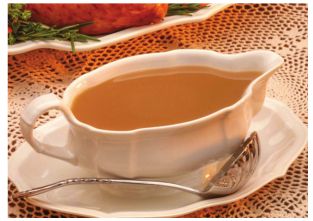
Making gravy
There
should still be browning on the bottom of the pan. Remove any big
chunks of stuffing; little browned bits are OK – actually desirable.
Pour off any excess fat and add to the fat reserved from roasting the
trimmings.
Pour
the stock through a fine mesh strainer into a large container; discard
the solids. Measure out the stock you need, reserving any extra for
another use. Place the pan on the stove over mediumhigh heat. For each
cup of stock that you use, add 1 tablespoon flour and 1/2 tablespoon
turkey drippings/fat and/or butter to the pan. Cook, stirring constantly
and scraping up the browned bits from the pan’s bottom, until no lumps
remain and the flour/fat mixture is golden brown, 2-3 minutes. Cook for a
couple minutes, stirring constantly. Whisk in the stock and bring to a
boil, stirring constantly, until the gravy reaches the desired
consistency.
To serve
With
a pair of clean needle-nosed pliers, pull out as many of the tendon
bones as possible from the base of the turkey legs. To present a “whole”
turkey for carving, place the breast/ wings on a platter, and arrange
the leg/thighs so that the bird appears whole.
Note: I make another batch of stock from the turkey carcass and freeze it to use in the next year’s stuffi ng.
Contact Julianne Glatz at [email protected].