
Engineered to succeed
Hanson’s global experience gets rail consolidation rolling
BUSINESS PROFILE | Patrick Yeagle
What does the future hold for Springfield? That depends largely on what happens with the proposal to consolidate rail traffic on the 10th Street rail corridor.
If the project withers without funding, downtown Springfield may be doomed to choke on a twofold increase in trains hemming in the city’s core. Relocating the Third Street rail corridor onto the 10 th Street corridor with added underpasses, however, would clear the way for a major redevelopment of the downtown and nearby neighborhoods, bringing more foot traffic, drastically less noise and potential for new businesses and residences. The project is projected to bring hundreds of millions of dollars in planning and construction contracts to Springfield, along with numerous jobs and the possibility of a new transit center on 10 th Street linking trains to buses, taxis and other forms of transport.
The project’s movers and shakers have so far been government officials like Springfield Mayor Mike Houston, Illinois Department of Transportation director Ann Schneider, and Sen. Dick Durbin, Illinois’ senior senator in Washington, D.C., who has helped the state secure millions of dollars for high-speed rail projects and design funds for Springfield’s rail consolidation. But working behind the scenes is an experienced team of engineers and designers at Hanson Professional Services in Springfield. The company has a long legacy of working on important projects around the globe. Who are the people whose vision could become Springfield’s future, and what are they doing to ensure that future includes everyone?
Hanson Professional Services Inc. started out in 1954 as W.E. Hanson & Associates, founded by Walt Hanson, a Springfield resident who previously served as the state’s first official bridge engineer. The company grew steadily, expanding both its services and its reach, with much of the growth occurring since the 1980s. One of the firm’s earliest clients was communications giant AT&T, which current Hanson president and CEO Sergio Pecori credits with exposing the company to new markets, both in terms of location and type of work. The name of the company has changed several times, most recently switching in 2001 from Hanson Engineers to the current name.
Hanson has handled projects in more than 40 countries, including designs for radio broadcast stations in Afghanistan, an airfield in Nigeria, a hydroelectric dam in the Dominican Republic, and numerous projects across the U.S. The company works on aviation, infrastructure, energy, telecommunications and rail projects, while also providing consulting and design services to the federal government.
Headquartered in Springfield, Hanson maintains 23 additional offices throughout the U.S. The private, employee-owned firm has 380 employees who each own stock in the company, though no person owns more than 4 percent of the stock, including Hanson’s board of directors. Of those employees, 166 work in Springfield.
Hanson has won several awards from the U.S. Department of Defense, the American Council of Engineering Companies and the American Association of Retired People, which twice chose Hanson as one of the top 50 best employers for workers more than 50 years old. Many of the company’s employees have worked there for multiple decades, and workers at the main campus at 1525 S. Sixth St. seem proud of their company.
Hanson’s experience with rail projects like Springfield’s rail consolidation is extensive. The company not only designs physical structures, but also listens to input from the public, conducts environmental assessments, helps companies obtain permits, oversees construction and finds ways to make projects happen without significantly disrupting existing rail traffic. Hanson engineered the relocation of rail lines near Wabash Avenue in Springfield during the early 1990s, which moved the Norfolk Southern tracks from along Wabash to Interstate 72.
Hanson
engineer Jim Moll, who was project manager for the Wabash relocation,
said the project shifted the tracks away from residential  neighborhoods,
eliminated a dangerous at-grade crossing at Park Avenue, eliminated a
narrow underpass on Chatham Road, provided the opportunity to extend
MacArthur Blvd to a new interchange at I-72, allowed construction of the
Wabash Bike Trail and opened up large tracts of land for development
like the sports retailer Scheels.
neighborhoods,
eliminated a dangerous at-grade crossing at Park Avenue, eliminated a
narrow underpass on Chatham Road, provided the opportunity to extend
MacArthur Blvd to a new interchange at I-72, allowed construction of the
Wabash Bike Trail and opened up large tracts of land for development
like the sports retailer Scheels.
In
northern Illinois, the company helped design a rail-to-truck loading
facility for the Union Pacific Railroad near Rochelle in 2003 and
studied potential environmental impacts of Chicago’s proposed Beltway
Corridor rail project in 2009. Elsewhere, Hanson designed a replacement
rail bridge over the Des Moines River near Ottumwa, Iowa, in 2002,
helped design a rail-to-truck loading facility in Memphis, Tenn., in
2009, and helped the U.S. Army Corps of Engineers design a rail facility
in Alaska to unload military equipment in 2009. Those are only recent
examples from the company’s long history of rail projects.
Hanson’s
work on rail projects means the company already has a working
relationship with the railroad companies involved in Springfield’s
current rail consolidation effort. Hanson project manager Jim Moll said
the Union Pacific and Norfolk Southern railroads were originally
skeptical about the consolidation because neither wanted to give up
their existing rights of way. The two railroads are now on board with
the consolidation, and it’s likely that Hanson’s established
relationship with both railroads contributed to their willingness to
trust that the project would preserve their rights.
Sergio
“Satch” Pecori, 63, is president and CEO of Hanson. He first worked at
Hanson in 1967 as a “gopher” before college, and he says it was that
contact with engineers that inspired him to become an engineer himself.
He’ll celebrate his 40th year as an engineer with the company in 2014.
Pecori’s
family emigrated from Trieste, Italy, to the U.S. in 1951, when he was
about a yearand-a-half old. They moved to Springfield, where they lived
in a duplex on 19 th Street. Pecori says his nickname came from an older
neighbor who couldn’t pronounce “Sergio” and instead called him
“Satch,” taken from the 1940s and 1950s movie series The Bowery Boys, which featured a character named Horace DeBussy “Sach” Jones.
Pecori
went to the now-closed St. Joseph School and graduated from Griffin
High School – now known as Sacred Heart- Griffin High School – in
Springfield, then went to the University of Illinois Urbana- Champaign,
where he earned his bachelor’s and
master’s degrees. After graduate school, he returned to Springfield to
work for Hanson, where he spent his first two years working on power
plants as a field engineer.
Pecori says he enjoys his job because of the diversity of topics it brings up.
“There’s
a different challenge every day,” he said. “What I really like about it
is the opportunity to take a look at different opportunities and see
how our company can get involved.”
Community
involvement is a high priority for Pecori, as evidenced by the long
list of boards on which he serves: Memorial Health Systems, the Abraham
Lincoln Presidential Library Foundation, the Hope Institute and more. He
says the corporate culture of Hanson emphasizes community involvement.
“When
my family first came to this country, the people who first helped us
out were Catholic Charities and the American Red Cross,” he said. “In
taking a look at the community and some of the needs that it has, we’re
big on giving back. We feel as though the community helps us, so we can
help the community.”
Jim
Moll, 61, is a project manager at Hanson. Originally from Indianapolis,
Moll graduated from Purdue University and spent five years in Denver,
Colo., working for the U.S. Bureau of Reclamation, a division of the
U.S. Department of the Interior. Moll went back to Purdue to earn his
master’s degree in civil engineering, and then moved to Springfield to
work for Hanson in 1980.
He
laughs as he admits that he didn’t intend to stay in Springfield for
long when he first joined Hanson. He says he ended up staying because he
likes the size of Springfield and the pace of life.
“After enough years in big towns, I realized I really hate this big city stuff,” he said.
As a child Moll always wanted to be an engineer.
“My favorite part is projects where nobody knows what the solution is, and you have to figure it out,” he said.
The
current rail consolidation is one of those projects, Moll notes, adding
that he has enjoyed taking the public’s input and crafting plans that
meet the community’s needs. He says the relocation is especially
important to him because it’s a “hometown project.”
“I
see the problems associated with the railroads in Springfield,” he
said. “We all live through it every day. It isn’t just a few people;
this is a big, community-wide impact.”
Other
groups in Springfield have taken note of the rail consolidation’s
potential effect on the community. Chief among the concerns of the Faith
Coalition for the Common Good is how the project will affect
minorities, women and people who currently live along the 10 th Street
rail corridor. Federal regulations require that projects funded with
federal money over a certain amount set aside money for training of
minority and female workers, so the Faith Coalition drew up a Rail
Community Benefits Agreement that sets out goals for job training, jobs
for local people, safety expectations, and more.
Hanson
has signed on to the agreement, along with Springfield Mayor Mike
Houston, the Sangamon County Board, Illinois Department of
Transportation Secretary Ann Schneider and Sen. Dick Durbin. Leroy
Jordan, chairman of the Faith Coalition’s Rail Task Force, said Hanson
has been very supportive of the agreement. His committee has been in
talks with Hanson to ensure the tenets of the agreement are followed.
Pecori says Hanson is almost ready to release the details of a specific
plan on minority training and hiring.
Jim
Moll, the Hanson project manager, notes that one of Hanson’s first
moves on the rail project was hiring a minorityowned public relations
firm, Vector Communications of St. Louis.
“I
have to say, though, we didn’t pick Vector because they’re a minority
firm,” he says. “We picked them because they’re really good.”
Additionally,
Hanson has subcontracted work on the project to Infrastructure
Engineering, Inc., a minority-owned business based in Chicago. Michael
Sutton is president of Infrastructure Engineering and has about 30 years
of experience with transit engineering. In March, Sutton established an
office in Springfield to take part in the rail consolidation work.
Infrastructure Engineering will provide the design for one of the rail
bridges in the consolidation and provide construction services, Sutton
says, adding that his firm has worked with Hanson many times in the
past.
“We’re looking
forward to working on the project with Hanson,” Sutton said. “We have a
good relationship with Hanson on past and current projects, and we’re
hoping to enhance and continue that relationship in the future.”
Sutton believes the
African-American community of Springfield does stand to benefit from the
rail consolidation, especially with Hanson at the helm.
“There
are a decent amount of African- American workers in Springfield. It’s
just a matter of spreading the work around,” he said. “It will be really
beneficial for Springfield to get as much African-American
participation as possible.”
Teresa
Haley, president of the Springfield chapter of NAACP, opposes the rail
consolidation on 10 th Street. Haley believes the project will cut off
the city’s east side, which has the largest concentration of African-
American people, from the rest of the city. She says a Hanson
representative did meet with NAACP to listen to the group’s concerns,
though she was unable to attend the meeting.
Haley
is concerned that if pressure on Hanson and the City of Springfield
wanes, so will the effort to hire minorities to work on the project.
Additionally, she worries that the underpasses planned for several
current 10 th Street crossings will flood during heavy rain, much like
the underpass at 10 th and Cook streets does.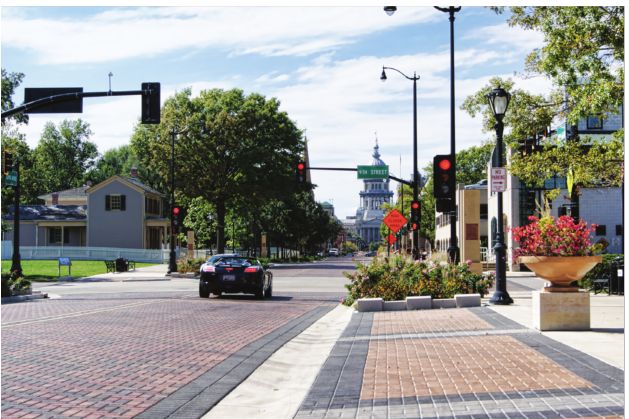
“Those
issues need to be dealt with,” she said. “People on the east side are
used to being promised a lot and those promises not being fulfilled. We
need some followthrough.”
Jim
Moll at Hanson says the underpass at 10 th Street and Carpenter Avenue
will have a dedicated pump house to prevent flooding. He also says
Hanson is committed to maximizing the number of local firms and labor in
the project, which includes minority-owned businesses and people of
color.
“Our first focus is on making sure as much of the work as possible can be done by people right here in Springfield,” Moll says.
Contact Patrick Yeagle at [email protected].


