Looking good
Tools and tips for over-the-top taste
FOOD | Julianne Glatz
Since beginning to write this column in 2006, I’ve kept a file of potential topics. Some I’ve jotted down on the back of a paper napkin or sent as a voicemail or text message to myself before entering them into a computer file folder. Some are so complex that it’s difficult to fit them into my column’s space allotment, but not appropriate for a feature story. Others are simple tips, tools or techniques that don’t warrant enough space for a full column. Here are four that will make your food look as good as it tastes. Much of what makes restaurant offerings look so cool and creative can be done with a minimum of effort and equipment, easy enough for every day.
Squirt bottles
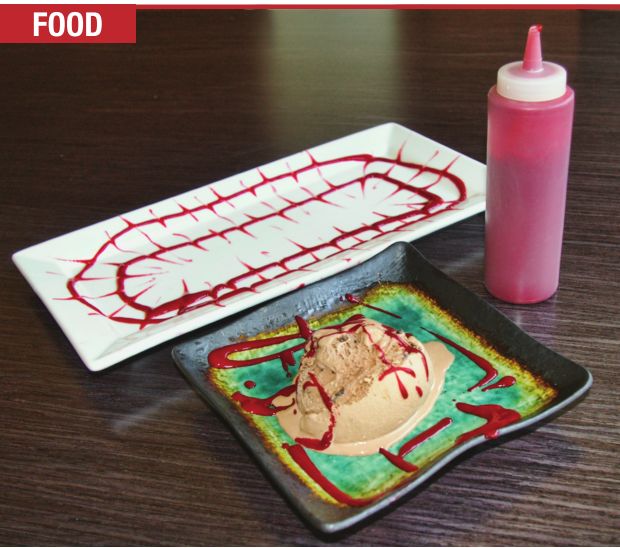
I’m talking about the kind that can be found in retro diners holding catsup and mustard. Put a sauce into the bottle, then use it to make squiggles, free-form strafing lines. For the most gorgeous of all, make concentric circles, squares or rectangles or even lines, on the plate, then drag a toothpick through it, first one way, then the other, to create a chevron design. This works with all kinds of sauces, as long as the sauce is not too thick (such as plain mayonnaise) or too thin/watery. It can be anything from an herbed olive oil, a stock reduction, mayonnaise thinned with some lemon juice or other liquid (perhaps flavored with a bit of curry powder or mustard), to chocolate, caramel or fruit sauces. A squirt bottle filled with red raspberry coulis (puréed raspberries, strained and sweetened to taste) can usually be found in my freezer. After letting it come to room temperature – if it’s last minute, I put the bottle in a bowl of tepid water to thaw – I use it to straife a simple piece of pound cake or bowl of vanilla ice cream, instantly making a mundane dessert special. The coulis can’t be frozen and rethawed indefinitely, but can usually be used four to six times.
The squiggles and chevron designs are usually used on the plate itself, but the straifing lines can go under or over the main ingredient. This is something kids love to do, although it must be said that in young hands, activities with sauce-filled squirt bottles can easily get out of control if not closely supervised.
It’s important to make sure that whatever sauce you’re using is an integral part of the dish. I once had a rack of lamb in a restaurant. The meat and accompanying vegetables lay atop a wine reduction sauce (basically stock and wine simmered until reduced and slightly thickened, as opposed to liquid thickened with flour). There were decorative squiggles around the rim of the large plate; I assumed they were the wine sauce. Then I dragged my fork through one. They were – could they possibly be? – barbecue sauce. I tasted again; sure enough the squiggles were barbecue sauce. Seriously? The dish was otherwise delicious, but I couldn’t get past my annoyance at the inappropriate incongruence of those squiggles.
Paint brushes
Brushes have many uses in the kitchen, from glazing breads and pastry with egg wash for a shiny brown crust, or brushing lightly with icing after baking, to coating meats with marinades and sauces before,
during and after cooking. A recent innovation is using a brush to swipe a
decorative painterly smear of sauce on a plate. As with the squirt
bottles, for the best effect, sauces both sweet and savory must be
neither too thin or too thick. Kitchen brushes are easily found in
cooking shops, online and in groceries with cooking implements
departments, but I eschew them in favor of small natural bristle paint
brushes from hardware stores. They’re cheap (usually less than a
dollar), and in my experience last just as long as more expensive
brushes marketed for cooking. Even more expensive heat-resistant
silicone brushes have recently become available, but I still prefer my
hardware store brushes.
Portion control scoops
Most
people refer to them as ice cream scoops, the kind with a squeeze
handle that turns a lever to run a thin metal strip around the utensil’s
bowl to release the contents. Ice cream scoops are portion control
scoops. But portion control scoops (in my kitchen, they’re referred to
simply as scoops) come in a wide variety of sizes, from those holding a
mere tablespoon or less to as much as a cup. Almost all are round, but
there are also oval shaped scoops, which mimic the traditional
egg-shaped French quenelles (light-as-air dumplings, usually made of
puréed fish and egg white), formed by a tricky technique of rotating two
spoons around the mixture before poaching in fish stock. Oval scoops
make the process a snap, but are also good for forming cool-looking
“eggs” of ice cream, especially good when served alongside another
sweet, such as a piece of cake or a tart.
Portion
control scoops aren’t just used for esthetics. In fact, they’re mainly
used for just what the name implies: a reliably exact amount, used in
school cafeterias and other institutional food settings. As I write
this, I still shudder when remembering a hospital meal tray of my
grandfather’s over a decade ago:
A perfect mound of instant mashed potatoes covered with unnaturally yellow “gravy.”
So
why am I including portion control scoops in a column about making food
look good? Because they’re wonderful for making consistently-sized
cookies, chocolate truffles, meatballs, and a host of other things, look
professionally produced.
Holding back for the top
I’ve saved the best for last. OK, maybe not the best per se, but the
easiest, something that requires absolutely no effort beyond preparing
the dish in question, something that will make anything you make more
attractive. It’s something I do everyday, something that’s become so
second nature, I don’t even think about it. It’s good if you are plating
for each person individually, or to use for family-type serving in
bowls or on platters. It’s good for hot or cold, sweet or savory
preparations.
Hold
back a proportion of suitable ingredients to scatter over the top of the
dish. Possibilities include chopped herbs; nuts or seeds; chopped
vegetables such as peppers, scallions, cucumbers, tomatoes or avocados;
and hardboiled eggs, croutons, olives and grated or cubed cheeses.
The
amount you hold back to scatter over the top will depend on whether
it’s for individual or group servings. But this isn’t rocket science;
there’s no exact amount appropriate. Even a small sprinkling over the
top works.
There’s a
culinary, as well as aesthetic reason for incorporating fresh herbs in
the preparation itself, as well as saving some for the top.
Herbs
that have been cooked – as well as those integrated into a cold salad
dish with any kind of tart dressing – will have a nuanced flavor
somewhat different than fresh, raw herbs sprinkled on top, giving the
finished product the full range of that particular herb’s flavors.
Contact Julianne Glatz at [email protected].


