More than vegetables
Community gardens bring people together
GARDENING | Jeanne Townsend Handy
An idea that is a good one never quite goes away. Instead it rides the waves of interest, research and possibilities – it grows and melds with the times. Such is the idea of community gardens and urban agriculture.
The aspirations for food production within an urban setting have always gone beyond the desire for fresh produce. The American Community Gardening Association claims that the act of growing food can become a catalyst for neighborhood and community development, social interaction, self-reliance, beautifying neighborhoods, conserving resources and providing opportunities for recreation, exercise, therapy and education.
Such are the current expectations for an old but good idea that has certainly never gone away.
Springfield’s “roots”
Excitement was high for the promise of community gardening and urban agriculture following a recent showing of the 2011 film, Urban Roots. Sponsored by Slow Food Springfield, the University of Illinois Extension office, and the Abraham Lincoln Unitarian Universalist church, the movie traces efforts of Detroit residents in their attempts to reclaim vacant lots while fulfilling their vision for the production of locally grown, sustainably farmed food in areas where fresh produce is all but nonexistent.
Follow-up emails between members of the sponsoring groups revealed a desire for continued conversation revolving around Springfield’s own local community food production efforts. And, according to Deborah Cavanaugh-Grant of the University of Illinois Extension office, the conversation soon evolved into questions: Where are all of these community gardens? Who is doing this work? What is the work they are doing? What are some of the issues that are facing these community gardens?
From these questions came Springfield’s “Roots to Rooftop” tour of eight community sites (the “rooftop” being the garden atop Maldaner’s restaurant providing fresh ingredients for the establishment’s cuisine).
It was time to check out some of Springfield’s diverse efforts.
The third space
With the Food-A-Rama sign in the distance, conjuring thoughts of state fair food and all things fried, the small vegetable plots that flourish within the Illinois Department of Agriculture Community Garden provide a visual oxymoron.
Now in its fifth year, the program is more popular than ever. “The past two years we sold out very quickly. The first few years were a lot slower, but now people get really excited, and we have a lot of returning gardeners who have done it since the first year. It’s just been really cool,” states Kendra Buchanan of the Illinois Department of Agriculture.
At first the plots, neatly segregated between organic and non-organic divisions, do not readily suggest a sense of community. Yet, as Buchanan points out, the central compost bin (with the compost created at another area on the fairgrounds), the shared toolshed and the University of Illinois extension Master Gardener demonstration plots, the shared goals of gardeners become more visible. This is where people come to share experiences, ideas and admiration along with the compost and tools. It is a place of community – a “third space.”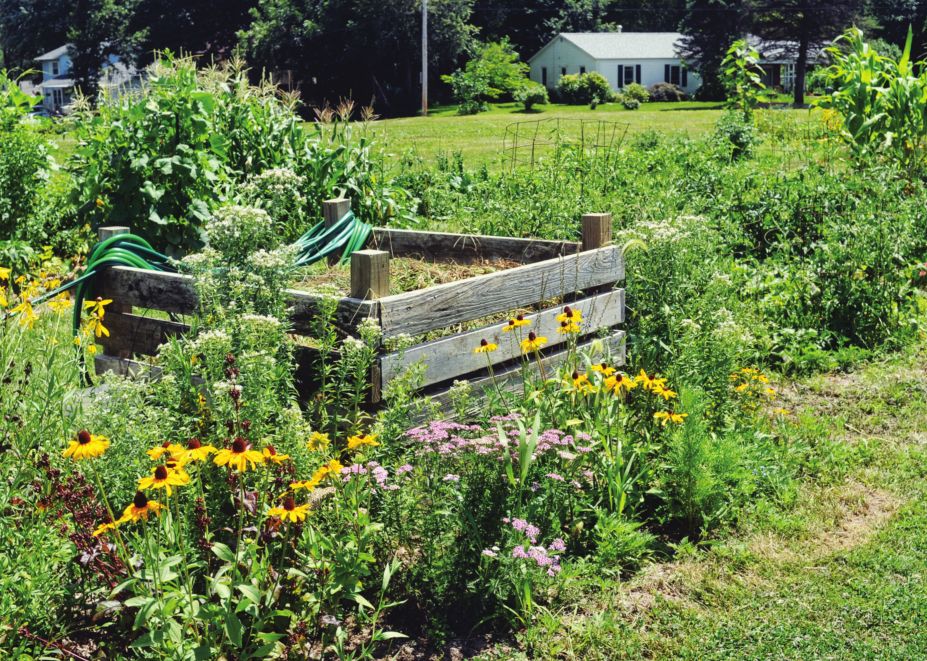
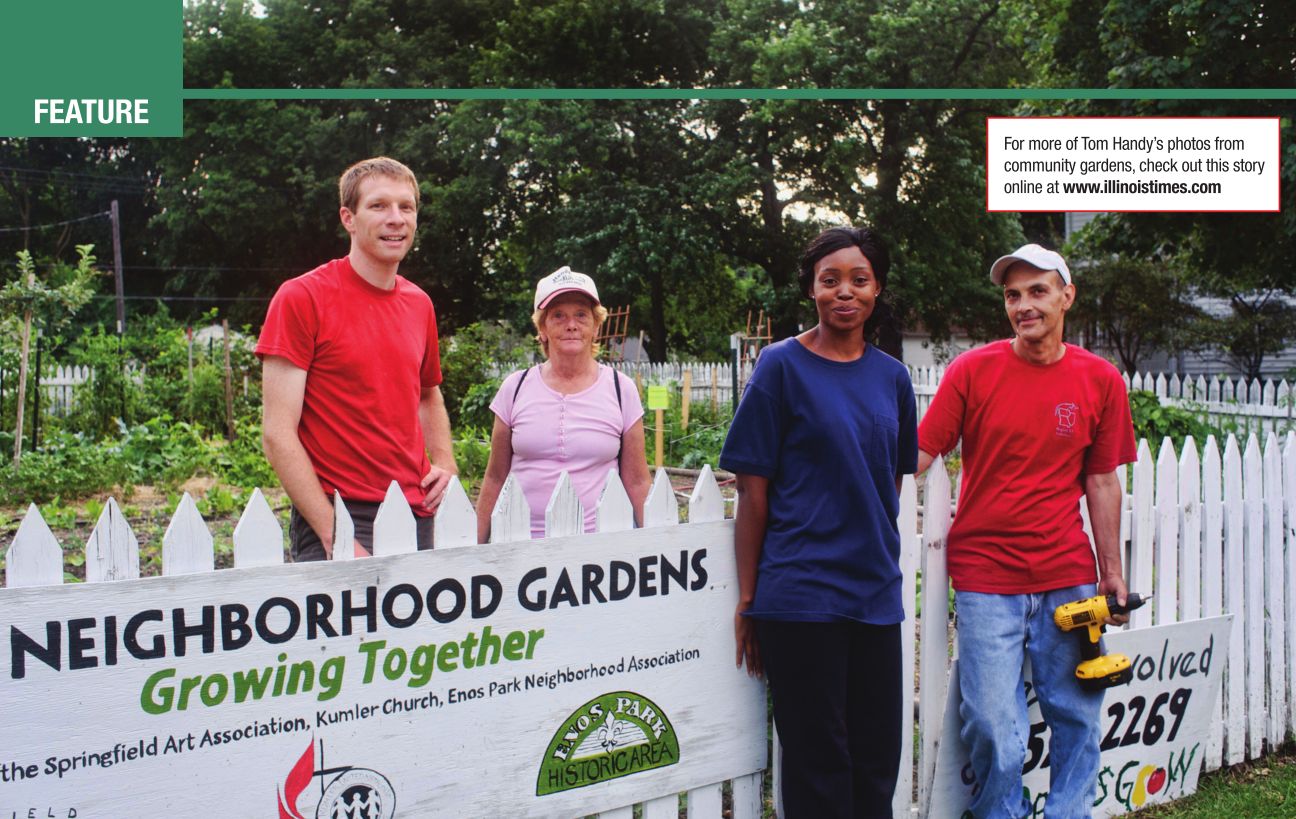
I get my first introduction to the third space concept at The Neighborhood Gardens on the city’s near north side in a neighborhood that is working its way back to its former historic glory. Within the confines of a white picket fence that surrounds 29 personal plots as well as a central community plot, the garden’s coordinator, Cory Blackwell of Kumler Outreach Ministries, elaborates on the third space idea: “Our hope is that we can create access to high-quality food, that we can teach and learn usable skills and that we can create a place in the neighborhood where people from all walks of life can get together – that we can create a third space – it’s not yours, it’s not mine, it’s ours.”
Although Blackwell’s mention of a third space is my first introduction to the term, the idea (also known as “third place”) is credited to Ray Oldenburg and his 1989 book, The Great Good Place. In
it he laments our country’s isolation – isolation within our homes and
within suburbs. He cites the lack of walking-distance communal spaces
within neighborhoods that were once offered by such establishments as
local small restaurants and the corner barber shops. For Oldenburg, the
third space represented a place for community building outside of our
homes (the first space) or workplace (the second space) that throughout
history has helped build civic engagement and encouraged creativity and
the free exchange of ideas – the anchors of community life.
At
The Neighborhood Gardens in the Enos Park neighborhood, the idea of a
third space has evolved into a gathering place with even greater
purpose. And, although only in its second year, the garden itself has
evolved. “We maintained this last year as a food pantry garden,” states
Blackwell. “This is the first year we made the transition to a community
garden. Last year when we did this, we grew food for people. And we
said that if we do that again, we’ve failed. We want to grow food with people.”
The
people who live in the neighborhood, especially residents who may not
know much about gardening and could benefit from the technical
assistance offered through partnerships, are the target audience of The
Neighborhood Gardens. Blackwell claims that 15 to 20 people can now be
expected on workdays – people who often did not know each other
previously. “By the end of the day,” he states, “these people know not only each other but they also have a working knowledge.”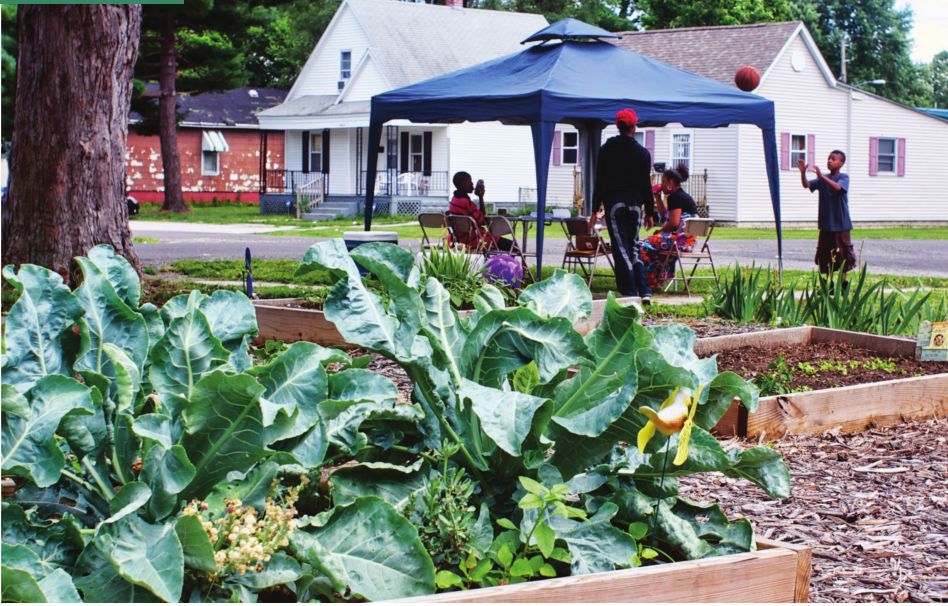
The
Kumler Outreach Ministries are assisted with organizational structure
by the Enos Park Neighborhood Improvement Association and additional
assistance is provided by the Springfield Art Association, which owns
the land. The University of Illinois Extension office is also lending a
hand by providing once-a-month cooking demonstrations, and it is
Blackwell’s hope that the plot holders will begin doing demonstrations
of their own.
It seems, so far, his hopes are being realized.
All
the plots are filled, and Blackwell now finds himself with a waiting
list. He adds, “We hope to have a potluck, which is somewhat
garden-related in that it’s about food, but it’s more about community.
It’s about creating relationships together.”
Victory
in gardens When community gardens are mentioned, invariably the legacy
of the Victory Gardens comes up. Although these gardens were grown
during the time of both world wars, the World War II efforts most often
come to mind. While the relief of pressure on public food supplies was
the stated goal, gardens once again offered up more than vegetables by
providing a boost for morale and a sense of empowerment and
contribution. People everywhere grew produce in any space available – a
front yard, a flower garden, a vacant lot or on public land, such as San
Francisco’s Golden Gate Park. In her book, City Bountiful: A Century of Community Gardening in America, Laura Lawson notes that 20 million gardens produced 8 million tons of food in 1943.
Although
this accomplishment is astonishing, it is even more astonishing to
consider that 70 years later many neighborhoods, even in the fertile
Midwest, find they exist in “food deserts” where the most readily
available food comes not from the ground but from fast food
establishments and gas stations. Now one of the victories sought from
community gardens is greater health, especially for the country’s
children.
Two of the
garden sites on the tour are tied directly to the younger generation.
The Douglas School garden and the Seeds of Possibility Community Garden,
located off of East Cook Street, are genHkids (generation Healthy)
gardens. The genHkids coalition was founded by Kemia Sarraf, M.D., in
collaboration with numerous organizations and institutions with the goal
of a “hands-on, grassroots approach to improving child health.”
At
the Seeds of Possibility Garden, the brightly painted toolshed exudes
optimism while the tallest of tomato stakes suggest room for growth.
Both of the genHkids gardens on the tour have been in existence for only
a few months, and the people behind the scenes (and in the dirt) are
still determining ways to engage children – a task that becomes more
difficult given the summer hiatus of schools, when the growing season is
at its best.
But
according to George Sinclair at the Seeds of Possibility Garden,
genHkids has already realized huge success in changing the food program
at the Chatham School District, which will now be serving
made-from-scratch meals for both breakfast and lunch in the upcoming
school year. In addition, their Destination Dinner Table program has
gone into schools with a professional chef to help train parents in
preparing these same types of meals for under $8 and in less than 30
minutes. “We would eventually like to be in every school in District
186,” states Sinclair.
Likewise,
the Springfield Community Garden on Springfield’s east side is focusing
on child and family health. The welcoming committee at this tour site
is set up beneath a small tent, with young and old alike ready to show
off their gardening prowess.
Katie
Page, one of the garden’s coordinators, tells me that they are in their
fourth year and now own three lots at the Miller Street location as
well as another, their latest, at Poplar Place (formerly Evergreen
Terrace). “We get families together and teach them about food,” she
says. What does it grow on – a plant, vine, on the ground, on a bush?
What part of the body is it good for? We also have taste testing and
cooking demonstrations. On Tuesdays, we have yoga classes. We got a big
cart we put pads on, and the families do yoga.”
As
we stroll to an area that boasts benches provided by the park district
and raised beds for disabled gardeners, we are joined by Vera Garrett,
the spearhead of this venture and a force to be reckoned with. It is as
if the words cannot come fast enough as she whirls into a discussion
about how their project has reached far beyond growing vegetables, as
their extended name, Springfield Community Garden and Family Fit Center,
suggests.
“We did a double-dutch [jump rope] clinic. We had 48 children and 7 parents trying to learn to do the double
dutch. We try to have a speaker once a month. Last month we had a
medical doctor and a chef come out to engage the families. The medical
doctor talked about heart disease and diabetes. Next month we hope to
have a dietician, and we have a mental health specialist coming out next
year. So we have a holistic family approach,” she concludes while
barely taking a breath.
We
complete our tour with a visit to the third and latest plot at the
Miller Street location. This lot, which was once filled with beer
bottles, is now a place of neighborhood pride. But for these women, the
idea of neighborhood goes far beyond their immediate surroundings. As
Katie Page states, “We don’t have it tailored for only the north side or
east side. We just pass out our flyers wherever we can because a
community garden to us, it can be the city of Springfield – whoever
wants to be involved.”
Back
to the land The 1970s would provide a new chapter in the history of
community gardening and urban agriculture. The desire for
self-sufficiency and a new environmental consciousness led to thoughts
of sustainable agriculture and the “back-to-the-land” movement. Deborah
Cavanaugh-Grant says she played her own role in the movement as manager
of a community garden plot in East Lansing, Mich., in 1977. “Thirty
years later, people are thinking about that kind of stuff again – for
probably a lot of the same reasons.”
It
was during the 1970s that the Jefferson Park Community Gardens came
into existence on Springfield’s west side. Although the original gardens
of the 70s are still in existence, these early plots have dwindled. But
in their wake has followed a newer, larger, more visible area of
individual plots where water is now provided by the park district.
Community
garden member Gary King leads our tour and points out his personal
contribution to the community of this newer garden, which has been in
existence now for three years. “I built the compost bin there last year
out of not only recycled wood, but it was wood I actually pulled out of
Spring Creek that had floated down there,” he says. Next to the compost
bin is a plot planted with native prairie plants – an addition courtesy
of his son, Wes.
As if
on cue, Wes King, who happens to be the interim executive director of
the Illinois Stewardship Alliance, appears on the scene. He has just
finished gathering vegetables from his plot in the old 1970s section of
the garden. After spilling out his bounty on the ground for all to
admire, he begins telling me of the new hopes the Illinois Stewardship
Alliance has for the future of urban agriculture in Springfield.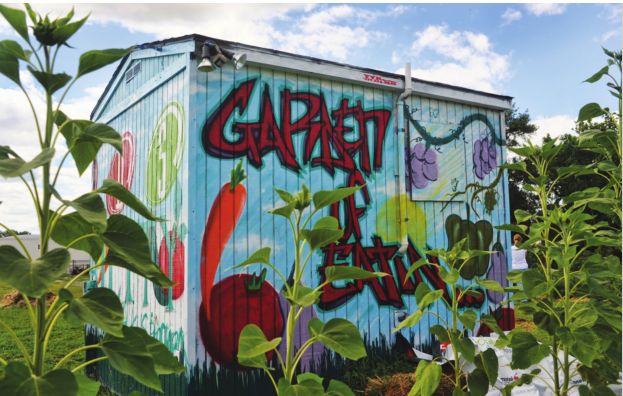
The
Alliance will be working to bring together community members and
stakeholders to create a plan for developing urban agriculture on the
east side and in the core of Springfield. Their partners in the project
are many – the Illinois Public Health Institute, genHkids, the
Springfield Federation, Springfield Urban League, Sangamon County,
University of Illinois Extension, Sangamon County Community Resources
and Lincoln Land Community College, among others. The plan will likely
include not only profitable ventures but school gardens and community
gardens as well.
In a 2009 publication titled Restorative Commons: Creating Health and Well-being through Urban Landscape, Lindsay
Campbell of the U.S. Forest Service asks, “Can we imagine the city as a
mosaic of gardens – products of both nature and culture that serve
both?” If the plans of the Illinois Stewardship Alliance move forward,
it seems to suggest we can.
An
old idea The line of antique tractors engulfed by plant growth speaks
of longevity at Suttill’s Gardens, my last stop of the day. A young
woman leads our tour, but when I start asking questions about specific
dates and acreage, she directs me elsewhere. “My grandpa would know
more,” she says. “He’s in the shed.”
I
do indeed find Grandpa, Ron Suttill, manning the corner of an
outbuilding where produce for sale is spread around him. Dressed in a
cap and overalls, Suttill has the look of an old-timer, and indeed he
is. Yet he is but one in a long line of family members to work this six-acre urban farm.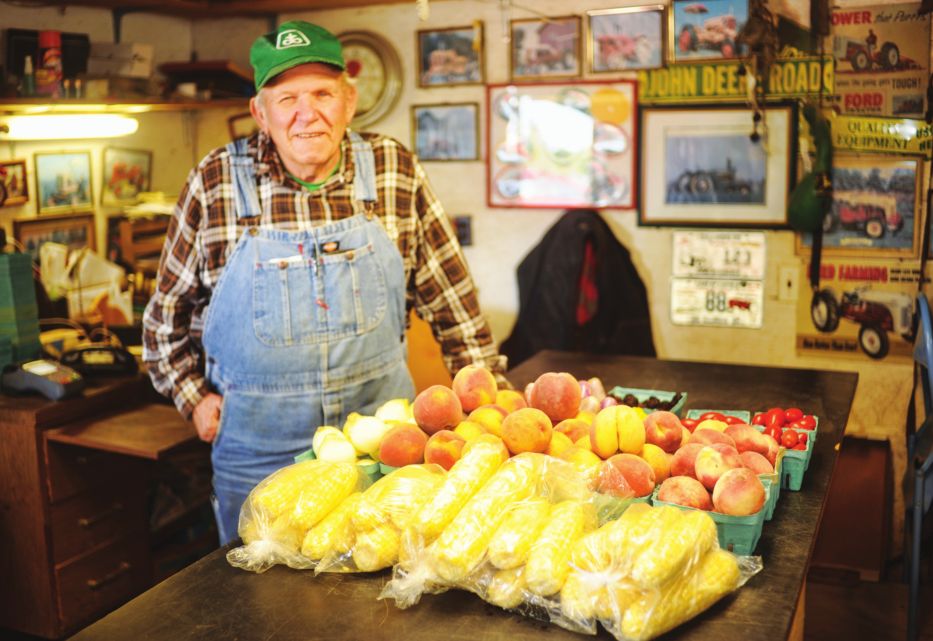
“My
grandmother started it in 1902,” he states. “And then Dad did it all
his life. After he passed away, I took it over – it was probably ’68 or
’69.” Suttill’s Gardens remains a fixture of Springfield and a symbol of
the possibility for the future of urban farming.
A
good idea The successes achieved at the sites featured on the “Roots to
Rooftop” tour are impressive. But as Deborah Cavanaugh-Grant reminds,
it is no easy thing. “It’s complicated to manage all this stuff, and
when last summer it was 110 degrees for five weeks and no water,
people’s enthusiasm for gardening wanes.”
Yet
with all the history behind us, with shoulders to stand upon, with the
coming together of so many diverse groups, it appears that community
gardens and urban agriculture – the old but good idea – may once again
help us tackle society’s challenges.
Writer
Jeanne Townsend Handy and photographer Tom Handy reside in Springfield
and enjoy collaborating on articles about nature and the environment.


