Building bigger, better hospitals
Three separate expansion projects bring improved health care to Springfield
HEALTH | Patrick Yeagle
What’s the official bird of St. John’s Hospital? The crane.
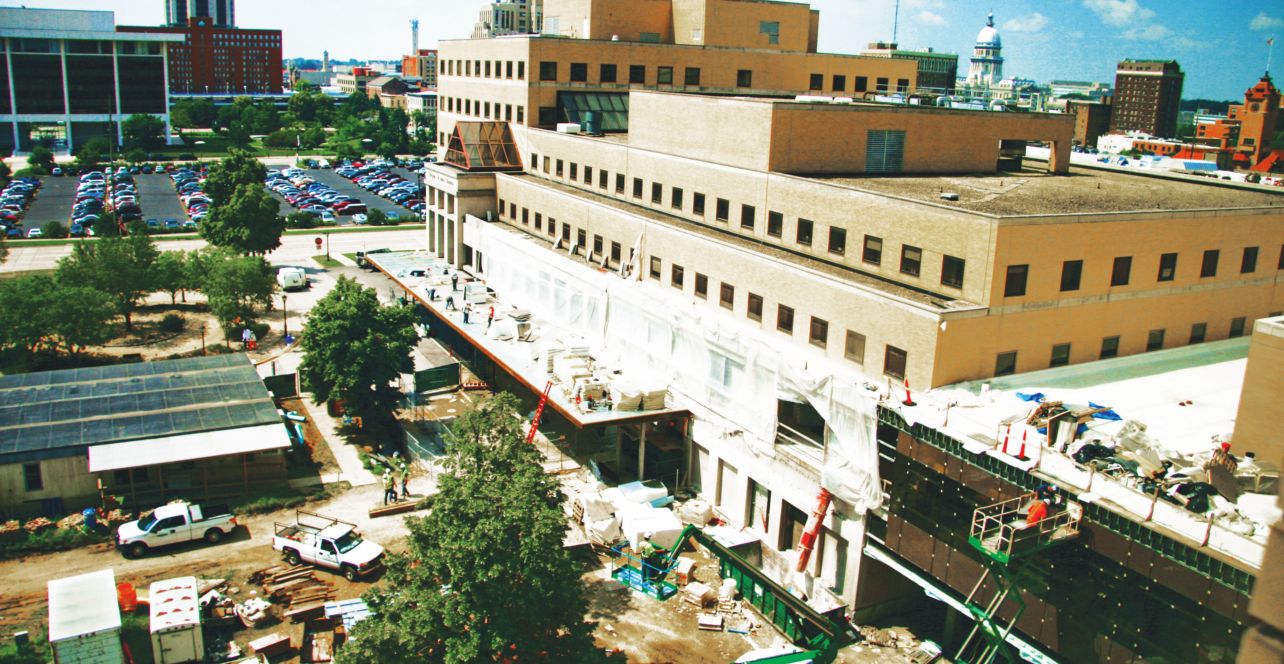
That silly joke popped up shortly after the towering construction crane began hoisting materials around the hospital in June 2012. The construction is part of the hospital’s ongoing expansion project, and two other major health care providers in Springfield – Memorial Medical Center and Springfield Clinic – have since begun their own expansion projects.
Each provider is pouring millions of dollars into improving their facilities with new technology and clever innovations that make visiting the hospital easier, more comfortable and more likely to produce a good outcome. They’re doing it with an eye for the environment, too – cutting waste by reusing or recycling building materials, while getting more bang for their energy buck with green designs. And most of the manpower and materials are coming from nearby companies, giving a welcome bump to the Springfield economy.
St. John’s Hospital Using the elevator at St. John’s Hospital is like stepping into a time machine. Once you get past the attractive main lobby, tastefully appointed with wood and stone in Franciscan minimalist style, you’ll see a typical 1970s-era hospital corridor: sterile and dimly lit, with bland colors and few distinctive features.
Take the elevator to the recently renovated eighth floor, however, and you’re transported to a different era. There are warm colors, pleasing textures and distinctive design cues like doorways set at an angle so that less of each patient room is visible from the hallway. The eighth floor just reopened at the beginning of this month after being totally gutted and rebuilt, but it’s already full of patients.
On the elevator once more, use a secret code to be taken to the seventh floor, which is temporarily between the old and new designs. The floor has been completely gutted, and it will soon be transformed into a modern space that will hardly be recognizable.
This extreme makeover is part of the St.
John’s Hospital renovation, which is aimed at not only modernizing the building, but also preparing it for the future. Along with the updates to the patient tower, St. John’s is relocating and upgrading its surgery units to make such invasive procedures less invasive for the patient and the family.
All told, St. John’s is spending $51 million on the patient tower renovation project and $121 million on the surgery modernization project, for a total of $172 million. The project is funded with about $69.4 million in cash and about $103 million in bonds. The eighth and ninth floors have already been renovated and reopened, and the sixth and seventh floors are under construction. Meanwhile, the old administrative wing was demolished to make way for a new building that will consolidate the hospital’s surgery services.
The rooms of the redesigned patient tower are designed to maximize comfort for the patient and visitors. Every patient room will be private, with only one patient per room. The rooms on the already completed eighth and ninth floors feature couches that convert into queen-sized sleeper sofas, multiple TVs, wireless Internet and supply closets that can be restocked from the hallway so nurses don’t have to interrupt family moments. All of the doors are wide enough to be wheelchair-accessible, and the bathrooms feature automatic lights, walk-in showers with no lip and toilets with foldable handrails. On the wall of every patient room is a dry erase board listing the patient’s goal for the day, expected discharge date, numbers to call for help and a space where the patient or family can leave comments for the staff.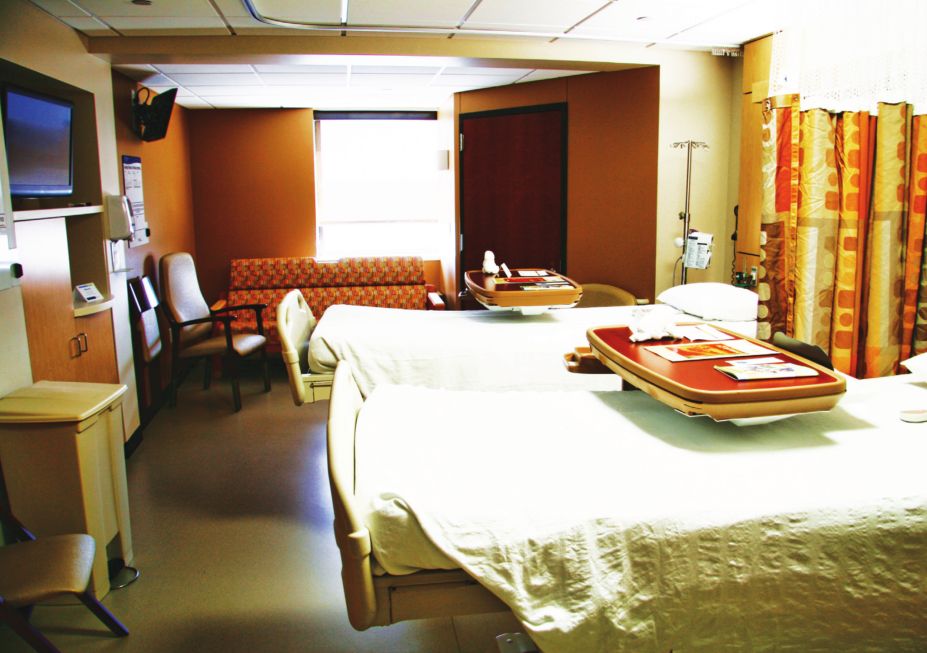
Each floor is arranged with patient rooms along the outside wall and nursing stations in the center. That puts supplies and equipment in a central location and ensures nurses are never far from the rooms they oversee. In fact, each nursing station is arranged to have a clear view of every room under its care. Additionally, certain floors will be devoted to patients with certain types of ailments. The eighth floor, for example, is dedicated to neurology and features special rooms with simultaneous EEG and video recording capabilities so that doctors can determine what is happening in a patient’s brain during a seizure.
Because
all surgical operations at St. John’s will soon take place in the same
wing, a patient’s visiting family will never be stuck waiting halfway
across the building. Instead, a series of new and elegant private
waiting rooms close to the operating rooms will keep families nearby.
The
new surgery wing will feature 16 operating rooms with a sterilization
unit, a pharmacy, office space and space for a future emergency
department within the same building. The new operating rooms will
feature the latest “smart” surgical technology, with monitors built into
ceilings and walls so that specialists can “patch in” and consult with
surgeons remotely during procedures.
“We
needed to ensure that we had contemporary care,” said Dave Olejniczak,
chief operating officer of St. John’s Hospital. Built beginning in 1878
and renovated in the 1970s, St. John’s is run by Hospital Sisters Health
System, a Franciscan Catholic organization with 13 hospitals in
Illinois and Wisconsin. Olejniczak notes that the renovated patient
tower will actually have 77 fewer beds than the current setup, for a
total of 204, because medical technology has advanced to the point that
many procedures don’t require a hospital stay.
The
hospital’s main entrance, which is currently on the north side facing
the parking garage, will eventually be moved back to its original spot
on the south side, facing
Madison Street. When a patient enters St. John’s in the future, she will
either go right for inpatient procedures – meaning ones that require
her to stay at the hospital to recoup – or go left for outpatient
procedures, which don’t require a hospital stay.
The construction is scheduled to be complete in February 2014.
 Memorial
Medical Center Though it may be mostly hidden, the front door to
Memorial Medical Center is still open, and it will remain open even when
a tall construction crane begins stacking three additional patient
floors atop Memorial’s existing E Building in the coming weeks. The
entrance will be protected when the crane begins its work, and even now,
a construction crew is preparing the thick concrete pad that will
support the crane. Just a few yards away, another crew is preparing to
build a new surgical center in a large hole that used to contain the
recently-demolished Wedeberg Conference Center, and across Miller Street
sits another construction site that will become a teaching center.
Memorial
Medical Center Though it may be mostly hidden, the front door to
Memorial Medical Center is still open, and it will remain open even when
a tall construction crane begins stacking three additional patient
floors atop Memorial’s existing E Building in the coming weeks. The
entrance will be protected when the crane begins its work, and even now,
a construction crew is preparing the thick concrete pad that will
support the crane. Just a few yards away, another crew is preparing to
build a new surgical center in a large hole that used to contain the
recently-demolished Wedeberg Conference Center, and across Miller Street
sits another construction site that will become a teaching center.
Memorial
started its construction this spring, and it’s scheduled to last until
winter 2016. Once it’s completed, the hospital will boast an additional
114 private patient rooms, six new operating rooms, and about 100 new
jobs. Despite adding about 200,000 square feet of new facility space,
the hospital is projected not to use any additional energy because of a
major efficiency retrofit to its infrastructure and mechanical systems.
Harry
Schmidt, Memorial’s vice president of facilities management, says the E
Building, which currently holds the main lobby and one floor of patient
rooms, was built with an addition in mind from the start. The building
is capable of supporting three additional floors, each of which will
have 38 private rooms. Schmidt says private rooms are a safety feature
because they limit the spread of germs between visitors and patients.
Private rooms are also more efficient, he says, because the hospital
currently has to take factors like gender and personality into account
when placing patients together in a room.
The
new patient rooms are designed to be comfortable for patients, with
wide doors, wood surfaces, warm colors, patient-controlled lighting and
window shades, large TVs and dedicated sitting areas for visitors.
Memorial even built a mock patient room to experiment with different
designs. Each room will have a mobile computer station for nurses and
space for supplies, medications and the patient’s belongings.
The
hospital’s new surgical center, set to open in late 2015, will feature
six new “smart” surgical suites with technology like robotic surgery
equipment. The new operating rooms will be larger, Schmidt says, to
accommodate current and future technology, bringing the hospital’s total
number of operating rooms to 23. And while the current operating rooms
are about 450 steps from the main entrance, the new ones will be just a
stone’s throw from the lobby, with comfortable and spacious waiting
areas for patients’ families.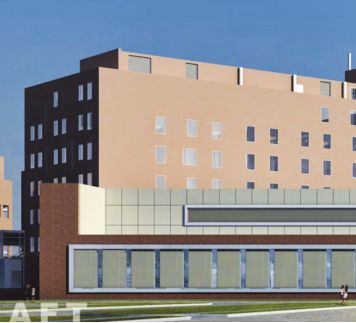
The
demolished Wedeberg Conference Center, which used to sit next to the
main lobby, must be replaced, but Memorial isn’t stopping with just a
simple meeting room. Instead, the hospital plans to open its new
Memorial Center for Learning and Innovation this summer. The center will
be located where there was once an employee parking lot at the
southeast corner of Miller and Rutledge Streets, and it will be
connected to the hospital’s parking garage on Miller Street by an
enclosed bridge spanning the road.
The
new three-story building will hold a 350-seat conference center, which
Memorial plans to use for professional development and community
education. There will be several classrooms and meeting rooms, with a
lecture hall and a cafe. The most noteworthy feature, however, will be
an advanced Surgical Skills Lab that will be used to train medical
students from Southern Illinois University School of Medicine and
elsewhere. The lab will have computerized mannequins which can be
programmed to give birth or exhibit specific symptoms like vomiting, so
that students can practice procedures without using a live patient. The
mannequins contain sensors that record every action, so instructors can
debrief students after a procedure on what went right and what went
wrong.
While
construction continues at Memorial, part of Miller Street is closed in
front of the main entrance. Once construction is complete, however, the
main entrance will have three driveway lanes for patient pick-up and
dropoff. The lobby will also have a coffee shop and more sitting space
for visitors.
In
addition to the hospital’s feat of expanding without increasing energy
consumption, Memorial has already taken steps to cut waste.
Debris from the demolished
conference center was sorted and recycled, while torn-up asphalt from
the old employee parking lot was recycled for a new parking lot
elsewhere.
Schmidt
says the hospital is using local contractors for most of its
construction work, which is scheduled to be completed in early 2016.
Springfield
Clinic In October 2012, several hundred people gathered at a
construction site on North First Street to scribble on one of the large
steel beams painted bright pink. The people were breast cancer
survivors, their families and friends and the families and friends of
breast cancer victims. Their scribbles were notes of triumph,
encouragement and remembrance for those who have struggled with breast
cancer. And the pink steel beam was a symbol of the strength of the
resolve to fight that disease.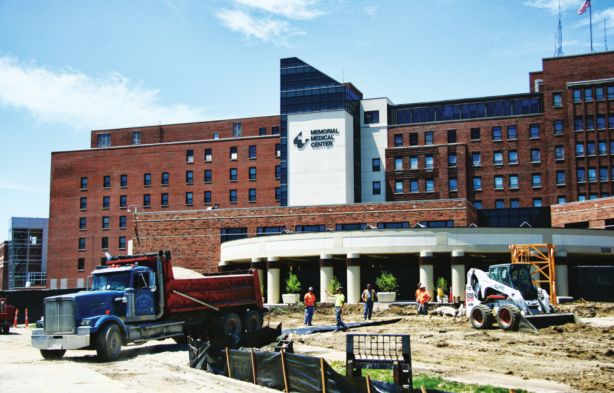
When
construction is complete in May 2014, those pink steel beams will form
the hidden structural skeleton of Springfield Clinic’s new medical
specialty building, named Springfield Clinic 1st North. Between 60 and
70 medical specialty providers will have offices there, providing a
variety of women’s health services, cancer treatments and surgical
services. At four floors and an estimated 132,000 square feet, the
building will be a substantial expansion for Springfield Clinic, which
already has several satellite offices in addition to the main campus
straddling Sixth Street. The new Springfield Clinic 1st North will be
connected to the existing Springfield Clinic 1st building via an
enclosed walkway spanning Dodge Street, and it will also be connected to
its own 600-space parking garage. The new building and the land it sits
on is owned by Memorial Medical Center and leased to the Clinic.
The
first two floors of the new building will be devoted to women’s health
while consolidating the Clinic’s OB/GYN services in one place. The third
floor will be for surgery, especially colon and rectal surgery, while
the fourth floor will hold specialists dealing with blood- and
cancer-related diagnoses and treatments.
The
construction was prompted by Springfield Clinic’s rapid expansion over
the past few years. They’ve recently experienced a 67 percent increase
in the number of physicians practicing at their Springfield Clinic 1st
building, and that space holds more than 100 physicians currently. It
was completed in 2006 and is already too full. The expansion will
alleviate that crowding and allow Springfield Clinic space to
consolidate and reorganize services at other locations.
 Health care growing Taken
together, the three expansion projects represent a local response to the
trend of growth in the health care industry nationwide. Georgetown
University’s Center on Education and Workforce released a study in June
2012 saying that health care makes up 18 percent of the U.S. economy,
and that number is expected to grow to 20 percent by 2020. The growth is
fueled by an aging population, increased insurance coverage due to
federal reforms and a decline in the productivity level of health care
workers, the study said.
Health care growing Taken
together, the three expansion projects represent a local response to the
trend of growth in the health care industry nationwide. Georgetown
University’s Center on Education and Workforce released a study in June
2012 saying that health care makes up 18 percent of the U.S. economy,
and that number is expected to grow to 20 percent by 2020. The growth is
fueled by an aging population, increased insurance coverage due to
federal reforms and a decline in the productivity level of health care
workers, the study said.
Locally,
the medical industry is second only to state government in terms of
employment, according to the Greater Springfield Chamber of Commerce. In
total, St. John’s Hospital, Memorial Health System and Springfield
Clinic together employ nearly 9,500 people, the Chamber noted in its
2012 community profile. As demand for health care grows, so will the
medical facilities.
Dave
Olejniczak, COO of St. John’s Hospital, summed it up this way: “We’re
not building for 2014; we’re building for 20 years from now.”
Contact Patrick Yeagle at [email protected].


