Supreme Court decisions bolster same-sex marriage fight in Illinois
Illinois couples don’t directly benefit from new precedent, however
LAW | Patrick Yeagle
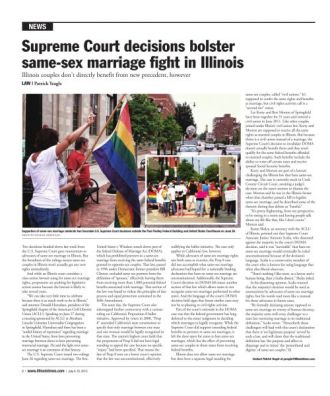
Two decisions handed down last week from the U.S. Supreme Court gave momentum to advocates of same-sex marriage in Illinois. But the broadness of the rulings means same-sex couples in Illinois won’t actually get any new rights immediately.
And while an Illinois court considers a class-action lawsuit suing for same-sex marriage rights, proponents are pushing for legislative action sooner because the lawsuit is likely to take several years.
“We can take very little time to celebrate because there is so much work to do in Illinois,” said attorney Donald Hanrahan, president of the Springfield chapter of the American Civil Liberties Union (ACLU). Speaking on June 27 during a meeting sponsored by ACLU at Abraham Lincoln Unitarian Universalist Congregation in Springfield, Hanrahan said there has been a “sordid history of repression” regarding marriage in the United States, from laws preventing marriage between slaves to laws preventing interracial marriage. He said the fight over samesex marriage is an extension of that history. The U.S. Supreme Court issued two rulings June 26 regarding same-sex marriage. The first, United States v. Windsor, struck down part of the federal Defense of Marriage Act (DOMA), which has prohibited partners in a same-sex marriage from receiving the same federal benefits granted to opposite-sex couples. That law, passed in 1996 under Democratic former president Bill Clinton, excluded same-sex partners from the definition of “spouses,” effectively barring them from receiving more than 1,000 potential federal benefits associated with marriage. That section of the law was found to violate the principles of due process and equal protection contained in the Fifth Amendment.
The same day, the Supreme Court also sidestepped further controversy with a curious ruling on California’s Proposition 8 ballot initiative. Approved by voters in 2008, “Prop 8” amended California’s state constitution to specify that only marriage between one man and one woman would be legally recognized in that state. The nation’s highest court held that the proponents of Prop 8 did not have legal standing to appeal the case because no specific “injury” had been specified. That means the fate of Prop 8 rests on a lower court’s opinion that the law was unconstitutional, effectively nullifying the ballot initiative. The case only applies to California’s law, however.
While advocates of same-sex marriage rights saw both cases as victories, the Prop 8 case did not accomplish what same-sex marriage advocates had hoped for: a nationally binding declaration that bans on same-sex marriage are unconstitutional. Additionally, the Supreme Court’s decision on DOMA left intact another section of that law which allows states to not recognize same-sex marriages performed in other states. And the language of the court’s DOMA decision held signs that future similar cases may not be as pleasing to civil rights activists.
Part of the court’s rationale in the DOMA case was that the federal government has long deferred to the states’ judgment in deciding which marriages to legally recognize. While the Supreme Court did support extending federal benefits to partners in same-sex marriages, it left the door open for states to ban same-sex marriages, which has the effect of preventing same-sex couples in those states from receiving federal benefits.
Illinois does not allow same-sex marriage, but does have a separate legal standing for same-sex couples, called
“civil unions.” It’s supposed to confer the same rights and benefits as
marriage, but civil rights activists call it a “second-tier” status.
Lee
Korty and Bert Morton of Springfield have been together for 31 years
and entered a civil union in June 2011. Like other couples joined under
Illinois’ civil union law, Korty and Morton are supposed to receive all
the same rights as married couples in Illinois. But because theirs is a
civil union instead of a marriage, the Supreme Court’s decision to
invalidate DOMA doesn’t actually benefit them and they won’t qualify for
the same federal benefits afforded to married couples. Such benefits
include the ability to write off certain taxes and receive spousal
Social Security benefits.
Korty
and Morton are part of a lawsuit challenging the Illinois law that bans
same-sex marriage. The case is currently stuck in Cook County Circuit
Court, awaiting a judge’s decision on the state’s motion to dismiss the
case. Morton said he was in the Illinois Senate when that chamber passed
a bill to legalize same-sex marriage, and he described some of the
rhetoric during that debate as “hateful.”
“It’s
pretty frightening, from my perspective, to be sitting in a room and
having people talk about my life like that, like I don’t count,” Morton
said.
Karen Sheley, an
attorney with the ACLU of Illinois, pointed out that Supreme Court
Associate Justice Antonin Scalia, who dissented against the majority in
the court’s DOMA decision, said it was “inevitable” that bans on
same-sex marriage would eventually be ruled unconstitutional because of
the decision’s language. Scalia is a conservative member of the court
who is known for using language that often riles liberal observers.
“There’s nothing I like more, as a lawyer and a human being, than a Scalia dissent,” Sheley joked.
In
his dissenting opinion, Scalia warned that the majority’s decision
would be used as ammunition by advocates of same-sex marriage rights,
but his words read more like a manual for those advocates in future
cases.
“By formally
declaring anyone opposed to same-sex marriage an enemy of human decency,
the majority arms well every challenger to a state law restricting
marriage to its traditional definition,” Scalia wrote. “Henceforth those
challengers will lead with this court’s declaration that there is ‘no
legitimate purpose’ served by such a law, and will claim that the
traditional definition has ‘the purpose and effect to disparage and to
injure’ the ‘personhood and dignity’ of same-sex couples.”
Contact Patrick Yeagle at [email protected].