Phasing into the future at the PCCC
Changes on the horizon for the convention center
ECONOMY | Scott Faingold
Things had gotten pretty bad for the Prairie Capital Convention Center.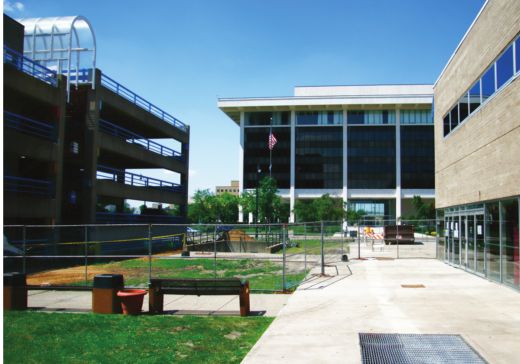
“The building had 30-year-old galvanized plumbing,” recounts PCCC general manager Brian Oaks. “It was to the point where we would come into a room – or get a security report – and there would just be water dumping out of the ceiling, because a pipe had literally rusted all the way through.”
Add an ancient, failing electrical system to this soaking-wet infrastructural nightmare, and it was not difficult to argue that the cavernous, 64,000-square-foot downtown Springfield institution was in need of a serious overhaul. “We weren’t able to provide the things high-end conferences needed,” says Oaks, with perhaps a touch of understatement.
A proposed $60 million plan for expanding the facility to more than twice its current size proved impractical to fund, leading to a more modest $15.8 million renovation which began in summer 2011, combining $4 million from the state’s capital plan with $5 million in city TIF funds and the remaining nearly $7 million from a bond issued by the center’s governing board. As of now, the PCCC is about halfway through its budget, with the biggest part of the work to be done between now and October.
The Prairie Capital Convention Center, originally built in 1978, is one of Springfield’s most significant structures, but it has long fallen short of its potential, both economically and culturally. The renovations currently being undertaken are a direct response to this state of affairs, and will hopefully bring the facility up to the state-of-the-art standards needed to compete for high-profile, high-profit business conventions as well as high-grade marquee performers. To capitalize on the physical improvements, a new public image and business philosophy will help put the PCCC on the map as a destination. This will not be your father’s convention center.
Oaks, who took over as general manager in 2007, works out of a colorful office lavishly festooned with memorabilia from past center events, including a pink guitar signed by Carrie Underwood as well as the remains of a smashed one signed by “Weird” Al Yankovic. He is quick to point out that the improvements to the center are not strictly repairs to the decaying physical plant. “We knew the building needed to be modernized so that we could stay competitive,” he says, with special focus on ways to better serve the needs of conventions, trade shows and other business events that can positively impact the local economy.
Specific efforts aimed at making the center a more attractive destination for such events include updated features to the conference rooms themselves, providing event organizers with such amenities as new audio-visual systems, with dropdown screens and ceiling mounted projectors. The building has also recently become Wi-Fi-enabled for the first time. “We now offer free Wi-Fi, which is a really big thing for events that want to utilize the building,” Oaks points out. “These days, whether you go into a McDonald’s or a Panera or a motel, people expect those services, and if you don’t have them then you’re behind the curve.” In addition to stepping up to circa 2007 technological requirements, the building is now equipped with up-to-date cat6 wiring, which Oaks and his board hope will allow for easier upgrades in the future.
When funding was first procured in early 2011 it was decided that the improvements to the center would be implemented gradually, in clearly defined phases. “One option was to just close the building down for an entire year and do everything all at one time,” says Oaks, “but the problem was that we were going to have to cancel a lot of events that had already been scheduled, some of them for
several years. It would have caused some pretty major conflicts and the
last thing we wanted to do was to have anybody leave Springfield and
potentially not come back.” While the phased approach elongated the time
frame of the project and required a great deal of logistical
problemsolving, it was deemed the best way to hang onto current
business.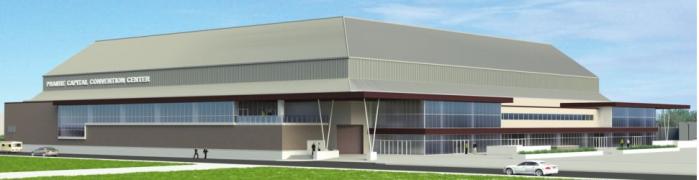
Phase
one, which took place over the summer of 2011, was a relatively modest
$350,000 renovation of the center’s administrative offices, along with
some concrete work on the building’s exterior. “We did that first
because it was the easiest thing to phase around,” says Oaks.
“Essentially we just packed up all our stuff, and for four months our
administrative offices operated out of a storage room on the lower
level. It was inconvenient for us, but it didn’t cause issues with any
events.”
The second
phase, in spring of 2012, was somewhat larger in scale and did result in
relocating some scheduled events to alternate facilities within the
center. “We tore up most of the lower level, including the main hall and
most of the meeting rooms, and then put it all back together,” recounts
Oaks.
Phase three,
which overlapped with the second phase and concluded in summer 2012.
involved a full renovation of the PCCC’s concession stands as well as
the mezzanine bathrooms. “That was a pretty big project – during that
time we had to redirect people to lower level bathrooms and we were also
forced to set up horrible temporary concession stands for a while,” he says ruefully. “But ultimately it didn’t have a major impact on events.”
Improvements
to the PCCC’s physical premises are just the first steps toward a
sweeping new business model, according to Oaks. He and newly hired
Director for Business Partnerships Shawn Mayernick are developing
strategies to create new revenue streams for the center, which will be
concentrated mainly in the procuring of sponsorships from local
businesses. “When I took over almost six years ago, we had literally
zero annual dollars coming in,” says Oaks, regarding sponsorship
opportunities. “We had a couple of businesses who were, like, our beer
provider and were giving us rolling beer carts
to sell their product or something, but we weren’t getting any actual
hard dollars” from sponsors, a serious shortfall compared to the kinds
of sponsorship deals regularly enjoyed by the center’s competitors in
other cities.
To this
end, major efforts have been made to increase the profile of the
building and change public perception regarding what the Prairie Capital
Convention Center is and what it provides. “We spend as much time as we
can speaking to Rotary clubs and civic organizations, kids groups,
educational organizations, wherever we can find somebody who will listen
to what we have to say,” according to Oaks. “It’s important to make
sure that people really understand how many people the convention center
brings into town and what that means in terms of dollars and cents in
tax revenues generated for the city and also jobs created through the
money that flows into Springfield.” Pre-renovation numbers provided by
Oaks show annual attendance at approximately 350,000, with convention
attendance accounting for between 125,000 and 150,000 and concerts
bringing in between 25,000 and 50,000, with the remainder generated by
smaller scale meetings, trade shows and banquets. According to a 2009
study, the PCCC has a $77.1 million total economic impact per year,
providing 400 local jobs and tax revenue of $3.4 million.
“Unless people in Springfield see something on
the marquee that they can buy a ticket for they don’t realize how busy
the convention center is,” says Oaks, pointing out that non-firefighters
are unlikely to realize that the Illinois Fire Protection Districts
were in town last week, bringing in about 1,000 firefighters from all
over the state for their conference. “And if you’re not a teacher you
don’t know about the 3,000 people who come in March for the Illinois
Reading Council – but what you do know is that KISS or Carrie
Underwood is coming, and that’s a big deal. What we’re trying to do is
make sure that we’ve got that right mix of top-notch artists coming
through town, along with the conventions and trade shows we have on an
annual basis.”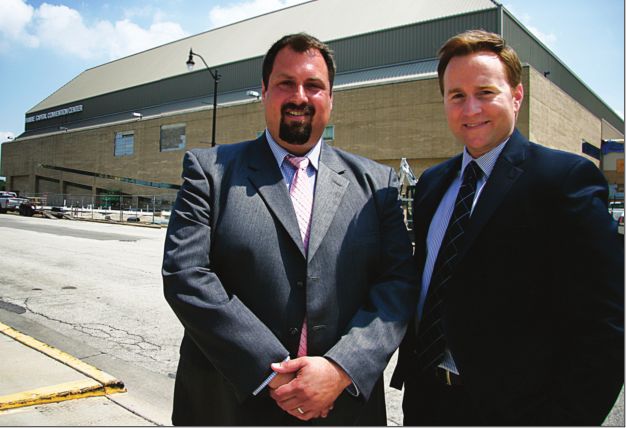
The
PCCC currently hosts between 220 and 230 event-days per year, and one
significant goal is to fill as many currently empty dates as possible
while diversifying the kinds of events that are being booked. “We have a
lot of teen conventions right now,” Oaks says. “Those are fantastic and
we hope to keep those. But when kids come to town, they’re typically
sleeping four to a hotel room and they’re eating at Subway.” Which is
all well and good, he points out, but has a very different economic
impact on Springfield when compared to a major client such as the
Illinois Health Care Association, whose annual convention and trade show
left Springfield for the Peoria Civic Center a few years ago. “Their
members come in and they’re renting out the hotel rooms at a higher room
rate, eating at our nicest restaurants, renting out private rooms for
receptions, shopping and spending money while they’re here.”
Once
the physical improvements are in place, the center will begin
aggressively seeking sponsorships, encompassing everything from naming
rights (“changing the name from ‘Prairie Capital Convention Center’ to
whatever business it might be that’s interested in something like that”)
to smaller deals with local businesses. “One of the things that we have
to offer, obviously, is exposure and so we’ll put up some signage in
the building for people to expose their business name to people who come
to the convention center,” Oaks explains.
Once
a solid roster of future ticketed events is on the books, the center
will also begin marketing season ticket packages to local businesses
interested in rewarding employees or entertaining clients, without
having to send them on often inconvenient road trips. “We know a lot of
businesses in town are buying season tickets to St. Louis Cardinals
games and we’ve heard those tickets can be hard to give away,” says
Oaks. “It’s a couple hours down there, food and beer is more expensive,
and on a Wednesday night people don’t always want to have to run down
and back that night so you have to add in a hotel room.” Instead, the
PCCC envisions opportunities for local businesses to offer tickets to
their employees to anything from the annual Home and Builders Show to
big-name concerts. “We think there will be great opportunities to bring
in a client, give ’em some wow factor and have an enjoyable evening
right here in Springfield.”
However,
these kinds of plans will have to wait until the completion of phase
four of the renovation, currently in progress, which will see new
bathrooms for the main hall, food courts added to the mezzanine, and an
expansion of the lobby on both the north and south sides. The most
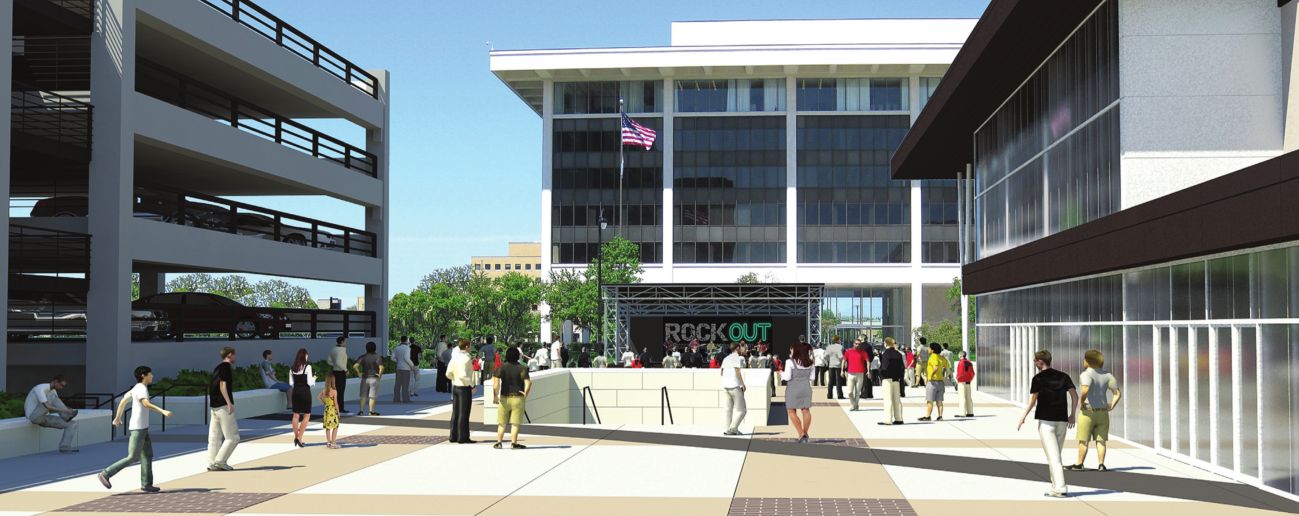
dramatic addition may well be a new outdoor plaza adjacent to the main
lobby, while the main hall will remain unchanged for the time being. The
project is currently on time and on budget. There were not enough funds
to cover improvements to the unsightly, rusted-out parking facilities,
so the center will be
self-funding that project, which is in the planning phase now. “It won’t
do to have a beautiful new building next to an ugly garage,” says Oaks.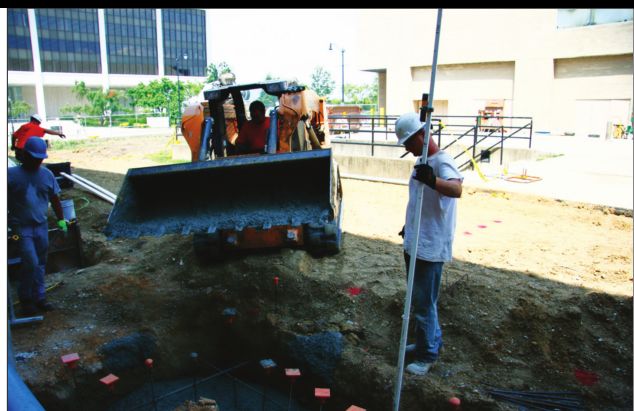
“We’re
tearing up everything that used to be there,” Oaks says, referring to
the old entranceway, “and putting in a new, clean, multifunctional
outdoor space where we can potentially do some special events for
conventions or trade shows. “The new plaza will also make smaller-scale
outdoor concerts possible in the summer, along with family movie nights
and casual bar and dining service. “It’s really cool,” Oaks enthuses.
“It definitely modernizes the space out there, which will give us an
edge with some of these conventions, something a little different than
other convention centers. But it’s also something that allows us to
generate new revenues in the summertime,” traditionally the center’s
slowest, least profitable season.
Beginning
in the middle of July, the PCCC will largely go dark, as the last batch
of changes will be far more difficult to phase around events.
“Unfortunately, we won’t have a great way to get people in and out of
the building so we can’t schedule any entertainment at all,” says Oaks.
The entire renovation project is scheduled to be completed by Oct. 25,
just in time for the Oct. 26 return of hugely popular Christian speaker
Beth Moore, who set the center’s alltime attendance record with her
appearance four years ago, bringing in 8,750 people from 30 states. “It
was really a huge deal,” says Oaks. “We were excited that they chose us
in the first place because we’re a little bit on the small end compared
to the facilities that they typically visit, but they enjoyed
Springfield so much and really felt it was a great event so they are
coming back, and that’s really gonna be the first big event in the new
space.”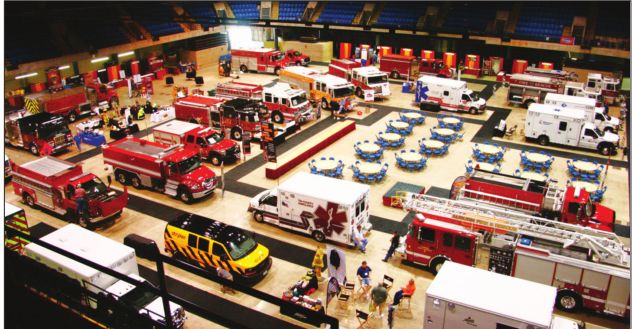
Aside from Moore’s October appearance and Disney’s Three Classic Fairy Tales on
Nov. 17, there is not a lot currently on the roster, a state of affairs
Oaks is planning to address in the coming months. “We’re in the process
of trying to plan some special events in those first couple of weeks of
November,” along with regular events such as the Ansar Shrine Circus
and a public open house “for people to come and see the space without an
event happening.” He will also actively seek out major touring artists
to present as part of a high-profile grand reopening.
“I
think we will be effectively changing the profile of the building, and
creating a product that will attract even more top-notch artists and
major conventions to the city of Springfield,” Oaks says with pride in
his voice. “I’m confident local businesses are going to want to attach
their name to us.”
Scott Faingold is a longtime contributor to IT and blogs about the arts as “Faingold at Large” at illinoistimes.com. He can be reached via [email protected].


