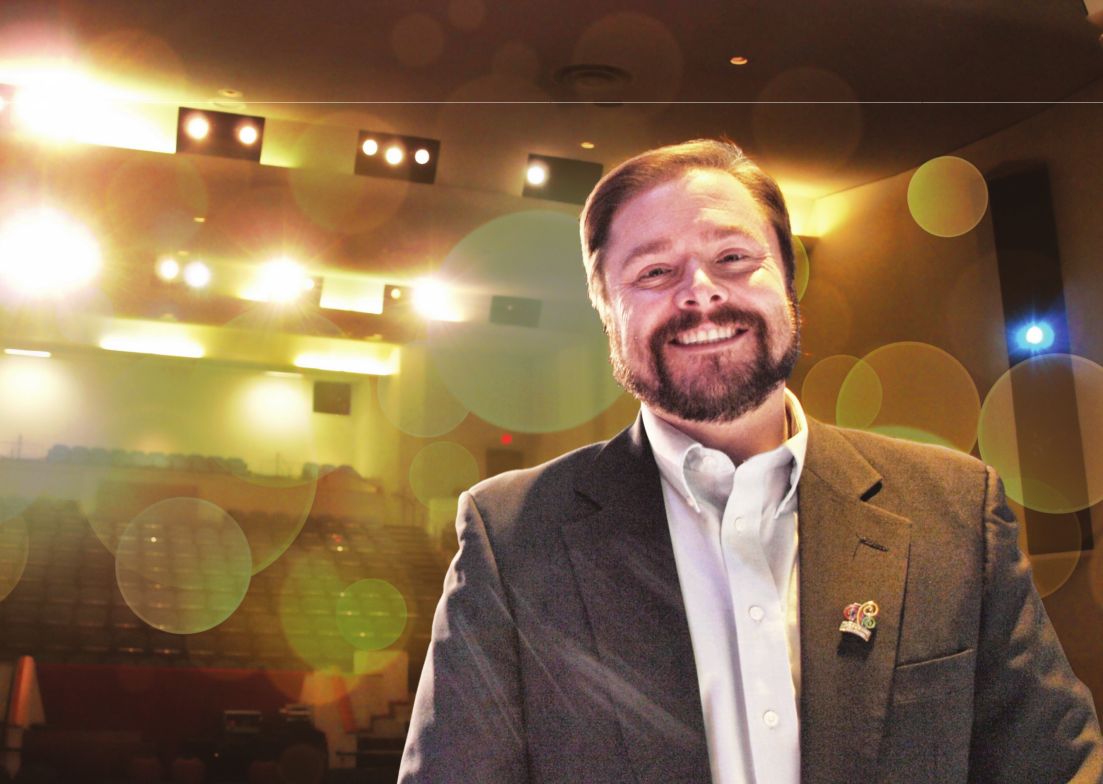
Gus’s new gig
Gus Gordon takes the helm of the Hoogland Center for the Arts
CULTURE | Scott Faingold
“At
a certain point I realized I was a clone,” says Gus Gordon of his
22-year tenure as chief meteorologist at WICS-TV Channel 20. His tone is
more amused than bemused, and entirely without rancor. “There was a
middleaged white guy like me at pretty much every local TV station in
America. There are really just a few archetypes that repeat over and
over across the country, and I was one of them. I wasn’t sure that was
what I wanted for my life.” Instead Gordon has managed to capitalize on
his unique position as a popular public figure in Springfield in
numerous ways, and was recently named executive director of the Hoogland
Center for the Arts, a job suited almost exactly to his personality and
interests. However, the position is not without new challenges, chiefly
those of balancing constant artistic and fundraising demands with those
of family life.
Gordon’s
two-decade journey to this moment was not straightforward, or even
planned. Gordon, now 47, originally landed in Springfield due to the
simple fact that he is not exactly a morning person. While doing
first-shift weather for the NTV network in
Cincinnati,
Ohio, “I quickly realized that was not my time of day,” he deadpans.
“Getting up at two in the morning to get to the TV station by 4 a.m.
was, let’s say, not an ideal circumstance.” A job search landed him a
position with more amenable hours, and he found himself relocating to
Springfield in 1990 for what he and his wife, Claire, now a professor of
communication at Lincoln Land Community College, had assumed was going
to be a two-to-four-year stay. “Somewhere along the way, after having
two kids (Amy, 16, and John, 13,) and getting a dog and buying a house
and then my parents moving into town, we kind of realized, this is home.
This is probably where we’re going to stay until retirement. So then we
started looking at the bigger picture. What now?” A lifelong passion
for the performing arts led the stalwart weatherman to the local
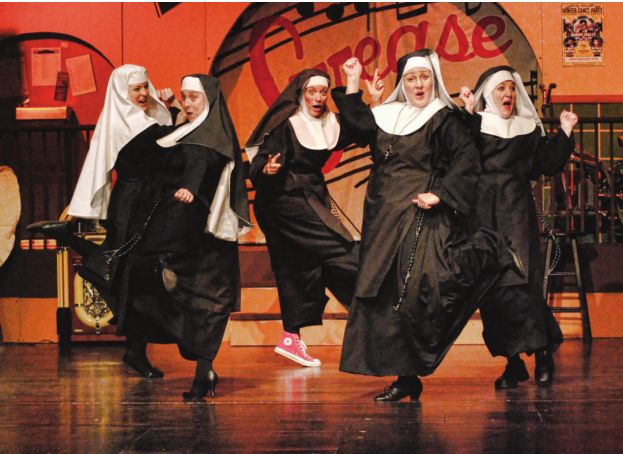
theatrical stage, beginning with the Muni’s 1991 production of Into the Woods, which featured both Gordons. “I was fortunate that Jack Connors (Channel 20’s then-general manager) and Les Vann (news director) realized that getting me out into the public had a payback to the station of humanizing me, making me more than just the guy who points at a screen. I thank them and owe them so much for allowing me the flexibility in my schedule to go out and be involved in things,” he says. In 1999, he and Claire started Gordon Productions in order to mount plays that were not being done by any of the established groups in town. Their first foray was Forever Plaid, a sendup of 50s and 60s “guy groups” like the Four Freshmen (the One Direction of their era). It proved so successful that they eventually revived it three additional times, including a 2004 production which was one of the very first shows to grace the main stage at the newly christened Hoogland Center for the Arts.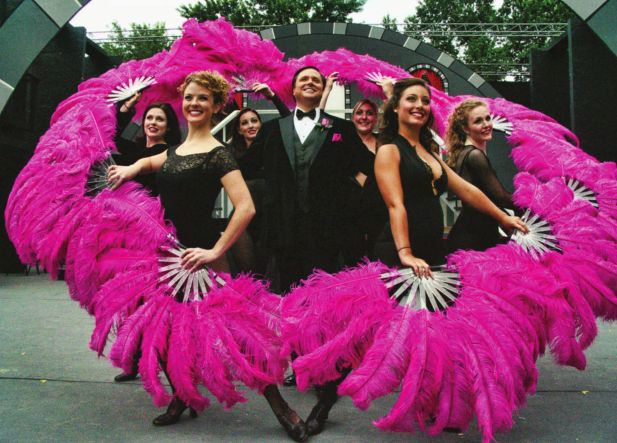
Gordon Productions continued to present various shows there until 2008, when Gus was approached by Grace Nanavati (vice president of the HCFTA board of trustees), Tom Appleton (board president) and Fred Jarosz (then-HCFTA executive director) with the offer of a parttime position as special events producer to handle fundraising events such as their yearly gala, at a time when it was becoming painfully clear that the Hoogland’s original business model of simply renting out space was not going to generate sufficient income to keep the facility running.
Gordon accepted the job while still maintaining his position at Channel 20, beginning a highly stressful period. “From 2008 until 2012, I juggled,” he says. “A lot. As special events producer, I was really doing the job of four or five different people. I also had a full-time job which included extra responsibilities whenever severe weather would occur, not to mention all the usual responsibilities of family life.”
It so happened that Gordon’s contract with WICS was set to expire just as a fulltime position as artistic director was offered to him in March 2012 by the HCFTA board. “A full-time job I was truly passionate about, while also getting a chance to give back to the community, was an opportunity I just couldn’t pass up,” he says. “I really enjoyed my career as a weathercaster but the thing with broadcasting was, as much as I liked it, seniority never kicked in. I’m there 22 years but I’m still the one they call at two o’clock in the morning when they need a fill-in,” he explains. “I’ve worked almost every Christmas Eve since I’ve been here, and every Thanksgiving almost, and wouldn’t it be nice to share that with my family every once in a while? My daughter is 16, she’ll be here another two years and then off to college. I’ve missed a lot of time over the years.”
He succeeded Jarosz as executive director when the latter stepped down last month. “I am perfectly cognizant of the fact that I would not have had this opportunity in any other town,” Gordon says vehemently. “Anywhere else I might apply for a position like this, the first thing they would do is look at my resume to see if I have a degree in arts management. And I don’t. But what I do have is real-life experience.”
While Gordon can occasionally be modest and reticent when discussing his personal life and achievements, he becomes downright expansive when discussing the various projects being undertaken at the Hoogland now that he is at the helm. Primary in Gordon’s mind are the twin objectives of expanding educational opportunities at the center and the ever-present issue of fundraising. “The thought that I really want to impart is that this building is important to the community. It’s an important place for kids to learn, to grow, to find out what it is they’re good at,” he says. “I also know in my heart that we are helping local businesses and restaurants down Sixth Street and in town. And I know it is a valuable resource for people who are recruiting top talent to come to Springfield, be they doctors, lawyers, CEOs, whatever, when they come here. If those people have a child that is a violinist or a ballerina, there is a place for them. It’s here at the Hoogland.”
 The first major effort toward branching out into education has been the Hoogland Kids and Hoogland Teens program, headed up by Matthew Vala [see p.14]. “This is a place where young people can go to experiment, and find their place to excel in the culture and in society,” according to Gordon. “I’ve often said, even if they don’t become the next Justin Bieber, what they learn through the arts can help them become successful adults. The skills they learn here, organization, teamwork, selfconfidence, can lead them to the next stage of their life, and they can become the next leaders of our community.”
Community and teamwork are the keys to Gordon’s leadership approach at the Hoogland, which he describes as a series of interlocking communities pulling together, none more or less essential than the others. In addition to what he describes as an inordinately supportive board of directors enabling the entire project, other essential components include the seven resident arts groups which rent office and rehearsal space at the Hoogland. “These groups have all come together and received probably more visibility than they had in their previous locations,” he enthuses. “Where these groups had been individual islands unto themselves in the past, now they have the added resources of other groups under the same roof that can help them.” For instance, resident artist David Cain has done otherwise unlikely collaborations with fellow residents in the Theatre Center, Arts Council and Ballet Company, facilitated by the proximity and community spirit of the resident groups. Gordon describes what sounds like a small village of groups “sharing ideas and sharing resources. Which all perhaps happened to some degree in the past – but now it’s just a matter of walking down the hallway.”
Also of huge importance, according to Gordon, is the Hoogland’s box office staff. “We have such a good team of people in Lara [Lebeck-Gephart],Vanessa [Ferguson] and Sarah [Mueth],” he says of the box office crew, who coordinate day-to-day concerns in the building, help with fundraising efforts and handle the booking of rental space along with providing the all-important interface with the community at large through customer service and ticket sales. According to deputy executive director Lara Lebeck-Gephart, the Hoogland has an operating budget of $800,000 a year and an average of 20 employees, with only five classified as full time.
Despite the success of 2011’s Fred Jaroszled $1.2 million campaign, finances are still a big obstacle at the Hoogland. “We’re still collecting money that was pledged toward that goal and will continue to do so through 2015,” Gordon says. However, even once the mortgage – which at one point reached a level of $27,000 per month – is eliminated entirely, parts of the building are 100 years old, there are major heating and cooling expenses, and much of the equipment put in during the initial refurbishment is now 10 years old and beginning to wear out. Accordingly, fundraising efforts have now shifted focus from keeping the lights from being turned off to accenting the reasons why it is important that they remain lit. To this end, the popular 600 Donors Club, which was instrumental in meeting the $1.2 million goal, now has transitioned into the more long-range Hoogland Forever Club.
Gordon is the first to admit that he is on a bit of a learning curve as he continues to make adjustments for his newly expanded fundraising responsibilities. “Unlike Peoria or Bloomington or Chicago or St Louis, we can’t go to, say, Anheuser-Busch and say, ‘Hey, would you support the arts?’ Springfield has some big companies but we don’t have some of the major companies that are into philanthropy.” The lack of corporate money makes community support even more important. “We have to just make this an appealing idea for people who live here and hope that they agree that this is worthwhile to support.”

Gordon’s new learning curve extends to the home front. What had been envisioned as a way to make more time for his family has not exactly worked out that way as of yet. “Since January I’ve been here every single weekend and every day of the week,” he confirms. “I’ve got to figure out, when does personal time come into this? Or my wife will be very upset with me. It’s not the kind of job where you clock in and clock out, it’s the kind where I’m not only in the office every day of the week, I’m on the computer at midnight and then I’m on the computer again at five o’clock in the morning. I’ve got to figure out how that’s all going to balance.”
Scott Faingold blogs about the arts as “Faingold at Large” at www.illinoistimes.com. He can be reached via [email protected].


