Winning winter salads
FOOD | Julianne Glatz
These days, people eat salads throughout the year with ingredients that used to be available only seasonally. But salads geared to cold weather are particularly satisfying when the temperature dips and chill winds blow. Here are three favorites.
Insalata di Caprese is a simple Italian salad that should only be eaten in warm weather when tomatoes and basil are at their peak and they are combined with fresh, delicate mozzarella and good-quality olive oil. This is a wintertime riff on that classic.
The seared and roasted tomatoes have many uses. I make them in large batches in the summer when tomatoes are at their peak, and freeze them in 1-cup portions. But the searing and roasting technique also is a great way to get maximum flavor from bland off-season tomatoes.
Seared and roasted tomatoes have many other uses. They make a great quick pasta sauce, a fantastic topping for bruschetta – by themselves or baked with goat cheese, or, mashed lightly and with a little added wine vinegar, as a dressing for other salads. Note: lettuce is not traditionally used for summer caprese.
Winter caprese
• 1 lb. log of fresh mozzarella
• Seared and roasted tomatoes, recipe follows
• Soft-leaved lettuce, such as mixed baby greens, bibb or other soft lettuce, washed and torn into bite-sized pieces if necessary, optional
• Extra-virgin olive oil
• Fresh thyme leaves for garnish, optional
• Freshly ground black pepper If the mozzarella has not been pre-sliced, use a serrated knife to slice it into half-inch rounds. If you are using the lettuce, spread it over the bottom of the plate on which you’ll serve the caprese, either individual salad plates or a platter. Place the mozzarella discs on top of the lettuce (if using) in an overlapping pattern – either circular or in a straight line, depending on the shape of the serving plate, tucking a small spoonful of the seared and roasted tomatoes in between each slice so that some of the tomato mixture is visible.
Drizzle with a little olive oil and sprinkle with fresh thyme leaves. Dust with the freshly ground pepper, or pass a pepper mill at the table for diners to grind their own. Seared and roasted tomatoes
• Approximately 8 firm medium tomatoes, regular or Italian
• 8 or more whole peeled garlic cloves
• 1/4 c. extra-virgin olive oil
• Salt
• 2 tsp. fresh thyme leaves, or 1 tsp. dried Preheat oven to 400 F.
Core and halve the tomatoes lengthwise, removing the seeds. In a large skillet, heat oil over moderately high heat. Fit as many tomatoes in skillet as possible. Sear without moving tomatoes until bottoms are dark and caramelized. This will take about 5-7 minutes. Remove from heat. Turn tomatoes over, sprinkle with salt and thyme. Tuck the garlic in between the tomatoes, turning them so they’re coated with the pan juices. Bake for 15-30 minutes (depending on the kind and size of tomatoes used) until the garlic is soft and the tomatoes are deep, dark red-brown in color.
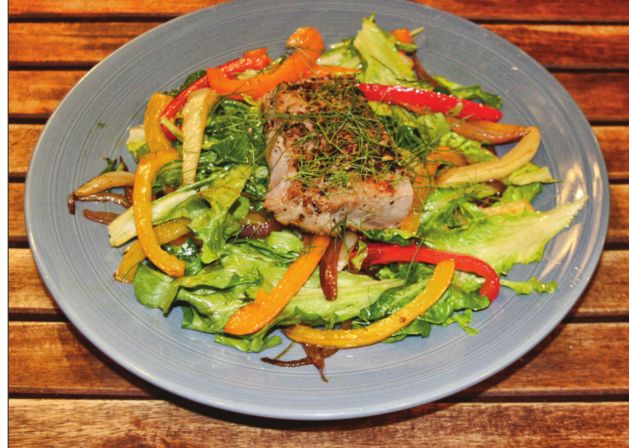
I devised the following recipe as a way to use some beautiful tuna steaks and leftover halves of red, yellow and orange peppers.
Seared tuna with sweet pepper and fennel salad
Per person:
• 1 tuna steak, at least 3/4-inch thick
• Salt
• 1 T. black peppercorns
• 1 T. fennel seeds, or use additional peppercorns
• Extra-virgin olive oil
•
Approximately 2 c. loosely packed red, yellow or orange pepper strips,
sliced about 1/4-inch thick, either singly or in combination
• Approximately 1 c. loosely packed, cored fennel bulb, sliced about 1/4-inch thick
• Approximately 1 c. loosely packed, peeled red onion slices, about 1/4-inch thick
• Approximately 1/2 T. good wine vinegar, any type
• Snipped fennel fronds for garnish
Wipe
any excess moisture from the tuna with paper towels. Place the
peppercorns and fennel seeds between 2 pieces of parchment paper or
paper towels and crush them lightly with a mallet or hammer. Sprinkle
the tuna on both sides with salt, and then with the peppercorn fennel
mixture, pressing it lightly into the tuna flesh.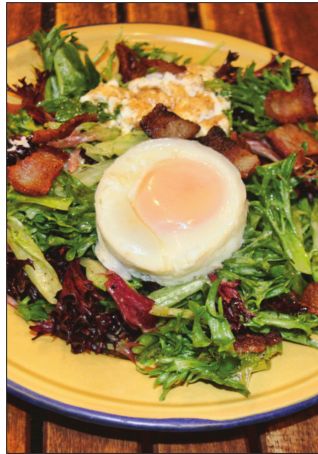
Pour
a thin film of olive oil in a large skillet and heat over high heat
until the oil just begins to smoke. Put the tuna in the skillet and let
sear, without turning for at least 1 minute for rare/ medium-rare,
longer for more well-done, then turn, sear an equal length of time.
Remove
the tuna and set aside. Add more olive oil to the skillet (about 1
tablespoon per person), still on high heat, and add the peppers, fennel
and onion. Sprinkle with salt, then stir-fry until they’re crisp-tender,
about 3-5 minutes. Scrape the skillet contents into a large bowl, toss
with the vinegar and let come to room temperature.
To
serve, toss the lettuce with the peppers, fennel and onion, arrange on a
plate(s), top with the tuna and sprinkle with the snipped fennel
fronds.
This is as
French as it gets. I’ve seen this described as a “breakfast salad,” but
the French eat it as a first course or light entrée.
Frisée,
the lettuce with fringe-like leaves traditionally used for this salad
has recently become available locally. I’ve seen both red and green
types as part of a 4-pack labeled “artisanal” in several groceries.
Frisee with chevre, bacon and egg (Salade frisee ou mesclun avec chevre chaud et bacon)
For the dressing:
• 2 cloves garlic, or to taste
• 1 tsp. Kosher salt
• 1/3 c. extra-virgin olive oil
• 1 tsp. Dijon mustard, or stone ground mustard
• 2 T. good quality red wine, balsamic or sherry vinegar Entrée:
• 1 slice thick-cut bacon
• 1/4-1/3 c. chèvre (fresh goat cheese)
• Bread crumbs or lightly toasted, finely chopped almonds or walnuts
• 1 large egg, preferably from a pastured chicken
• 2 generous handfuls frisée, preferred, or other soft-leaved lettuce, washed and torn into bitesized pieces
• Freshly ground pepper to taste Preheat the broiler.
Make
the dressing: Mash the garlic cloves with the salt into a paste. Put
the olive oil in a small mixing bowl and whisk in the remaining
ingredients. Set aside.
Cut
the bacon into squares and place in one layer in a cold medium skillet.
Turn the heat to medium-high. Once the bacon begins to turn translucent
and brown, stir frequently until the pieces are brown and crisped.
Remove the bacon with a slotted spoon to a paper towel to drain. Leaving
a thin coating of the fat on the bottom of the skillet, pour off the
excess fat and reserve for another use. Set the skillet aside to cool to
room temperature.
Form
the chèvre into a fat disc and then coat each side and the rim with the
breadcrumbs or finely chopped nuts. Place on a small baking sheet and
broil until lightly browned and just beginning to slump a bit.
While
the chèvre is broiling, “poach-fry” the egg: Place the skillet back on
the stove, and crack the egg into it, leaving the yolk unbroken. Turn
the heat to high. When the white begins to change color and solidify,
add about 1/4 cup of water to the skillet, and immediately cover it.
Cook for about 1 minute without peeking, then uncover the skillet. If
the white is still not cooked through, cover the skillet again and cook
until the white is firm, but the yolk is still liquid. If you desire a
hard-cooked yolk, cook longer.
While
the cheese is broiling and the egg cooking, whisk the dressing to
combine, then toss with the greens, add freshly ground pepper to taste
and arrange evenly on a plate.
Carefully
place the warm disc of chèvre (it may be difficult-to-impossible to
transfer it from the pan to the plate without it falling apart,
depending on the chèvre’s firmness; don’t worry, it’ll taste good either
way), the “fried” egg and the bacon. Serve immediately.
Contact Julianne Glatz at [email protected].


