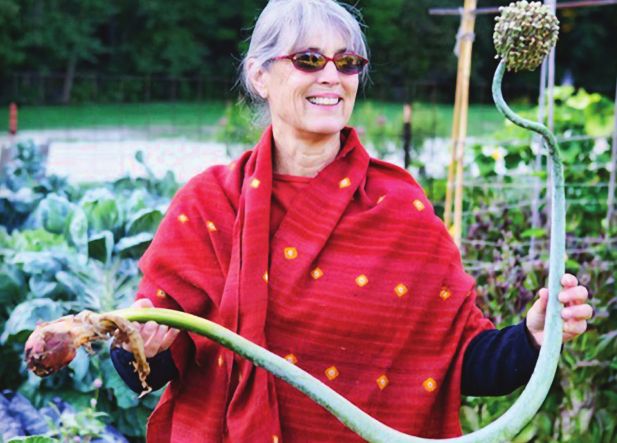
Deborah Madison’s recipe for what’s hot in vegetables
FOOD | Julianne Glatz
It’s a sure bet that every year around this time, I’ll be pulling Deborah Madison’s Vegetable Soups from my cookbook shelves. There’s just something so right about vegetable-based soups – even substantial concoctions – after the surfeit of the holidays. Madison’s treatments of vegetables are masterful, whether she’s showcasing a single ingredient or combining contrasting flavors, textures and even colors.
I don’t just reach for Vegetable Soups after the holidays. There are chapters on soups for spring, summer and autumn, as well as winter. There’s a chapter on light broths and restorative soups, and others with soup recipes based on bread and grains and legumes. There’s even an appendix on “Doctoring Up Canned Soups.”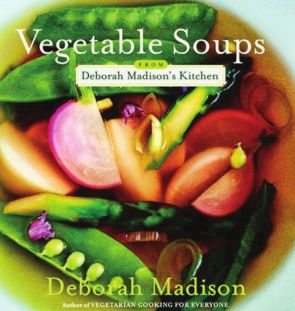
And I use Madison’s other cookbooks – 11 in all – throughout the year; many of her well-written and always reliable recipes have become standards in my kitchen, from a fantastic black bean chili (not Springfield chilli, to be sure, but equally good in its own way) in Madison’s first cookbook, The Greens Cookbook, to a delicate squash blossom omelet in The Savory Way, which is my first mustmake dish whenever squash blossoms are available. There are others, from Seasonal Fruit Desserts and This Can’t Be Tofu to Local Flavors: Cooking and Eating from America’s Farmers Markets, that’s also a compendium of beautiful farmers market photographs from coast to coast. There’s even a humorous tome, What We Eat When We Eat Alone, that she co-authored with her husband, artist Patrick McFarlin (and also includes recipes).
Madison’s professional cooking and teaching career, books and recipes have been primarily about vegetarian cookery. That’s how she earned her reputation, as well as just about every food-writing award in America – some several times. So it comes as a surprise to many that she’s not a total vegetarian, though she eats meat sparingly, and only from environmentally sustainable and local farms. Some of her cookbooks, such as Local Flavors, do have recipes that include meat.
“Connecting people to the food they eat, its source and its history has long been my work,” she writes. “… writing is one way to reveal the deeper culture of food, whether through recipes or through profiles of farmers and ranchers, producers and cooks. My interests lay with issues of biodiversity, seasonal and local eating, farmers markets, and small and mid-scale farming. I am on the board of the Seed Savers Exchange, have been involved with Slow Food for over a decade, and am presently co-director of the Monte del Sol Edible Kitchen Garden in Santa Fe, New Mexico [where she lives].”
I’ve been fortunate to have
met Madison on two occasions. The first, years ago (I forget exactly
how many), she was the speaker at a Slow Food Champaign/Urbana event. In
summer 2007, I attended a two-day Slow Food writing workshop she
conducted on an incredible sustainable farm outside Milwaukee. We were a
small group – about a dozen – in an intimate setting. And since the
workshop was primarily about integrating our own life experiences in our
food writing, we got to know each other rather well, rather quickly.
For such a small group, we were astonishingly diverse in age and
experience; our only common thread was that we’d all sat down to nightly
dinner with our families in our childhoods.
As
I had been in Champaign/Urbana years before, I was struck with
Madison’s beauty. It wasn’t just – or even primarily – physical. She had
a glow that clearly came from inner peace and serenity.
I
shouldn’t have been surprised. Madison’s food career began at the San
Francisco Zen Center where she studied for 18 years. “While there I held
a host of kitchen positions, from head cook, to guest cook, to private
cook for the abbot and his guests,” she writes. “What began as a mild
interest in cooking grew to a passion.”
That
passion led to a stint at the renowned (some might even say revered)
Berkley restaurant Chez Panisse and eventually to Madison becoming the
founding head chef at San Francisco’s Greens Restaurant. Greens was
America’s first “fine dining” vegetarian restaurant, and as one reviewer
noted, “The Greens Cookbook is a rarity; it is a book that created a revolution in cooking when it first appeared in 1987.”
Madison’s newest book, Vegetable Literacy is
due out on March 19. “It’s about the 12 plant families in our kitchen,”
Madison told me. “It was a lot of fun to delve more into the botany in
our kitchen.”
I’m sure
it was, just as I’m sure I’ll have a lot of fun reading it and using
some of the recipes. But for now, I’ll be content to savor some of
Madison’s wintertime soups – and maybe next month, a pot of that chili.
Green cabbage soup with potatoes and sour cream or yoghurt
This
“shimmering green” soup somehow manages to be both delicate and hearty –
not an easy feat. “I love this soup!” Madison told me, and I absolutely
agree, especially when it’s served with one of the blue cheese/toast
variations below.
The
recipe is simplicity defined, using just a small cabbage, a leek and a
potato in the soup base. And, as Madison says, “It’s a soup you can
count on having ready to eat in less than 30 minutes, and it’s subject
to a few excellent variations.”
Having
tried more traditional similar recipes in which the cabbage is
long-cooked and mashed into a purée, Madison achieves that delicacy and
gorgeous color cooking the ingredients just until tender, creating a
“fresher, brighter version.”
Savoy
is a crinkly-leafed variety of cabbage that’s especially flavorful.
It’s usually available at Meijer, but regular green cabbage is also
excellent. I prefer using tangy thick Greek-style yoghurt instead of
sour cream.
• 1 small green cabbage, preferably savoy, (about 1 pound)
• 2-3 T. butter
• 1 large leek, white part only, quartered lengthwise, chopped and rinsed
• 1 hefty Yukon Gold or russet potato, peeled and roughly cubed
• Sea salt and freshly ground pepper
• Sour cream or plain yoghurt
• Minced fresh parsley and/or dill
Quarter
the cabbage, remove the cores, and thinly slice the wedges crosswise.
You should have 5-6 cups. Bring 3 quarts water to a boil, add the
cabbage, cook for 1 minute, then drain.
Melt
the butter in a soup pot. Add the leek and potato, give them a stir,
and cook for a minute or 2; then lower the heat and simmer, covered for
20 minutes or until the potato is tender. Taste for salt and season with
pepper.
Ladle the
soup into bowls, then add to each a dollop of sour cream or yoghurt, a
sprinkling of the fresh herb(s) and a final grinding of pepper. Makes
7-8 cups.
Four variations:
•
Add 5 juniper berries and 2 tsp. finely chopped fresh rosemary to the
leek and potato. Serve with an extra pinch of rosemary (and the parsley,
if desired, but not the dill).
• Reduce the water by 1/2 cup and at the end replace the sour cream with crème fraîche or cream.
•
Serve with toasted whole wheat bread (preferably rustic) topped with
slices of any good blue cheese such as Maytag, Gorgonzola or Roquefort
or with …
• Blue cheese and walnut toasts
• 8 slices baguette or country bread, thinly sliced
• 1/4 pound blue cheese (as above)
• 3 T. butter, at room temperature
• 1/4 c. finely chopped walnuts
• freshly ground pepper Toast the bread under the broiler until nicely
browned on one side, then turn and brown a little less on the second
side. Mash the cheese and butter together, then add 3/4 of the walnuts.
Spread on the paler side of the toasts, then broil until the cheese is
bubbling. Remove, dust with the remaining nuts and a sprinkling of
pepper.
Note: In both
toast/blue cheese variations, the toasts can be served on the side, or
put in soup plates and the soup poured over them.
Contact Julianne Glatz at [email protected].


