Not so sweet Halloween treats
FOOD | Julianne Glatz
Halloween is traditionally all about the sweet stuff, at least from a culinary standpoint. But you can get into the Halloween “spirit” without the sugar. Here are a couple of recipes that do just that.
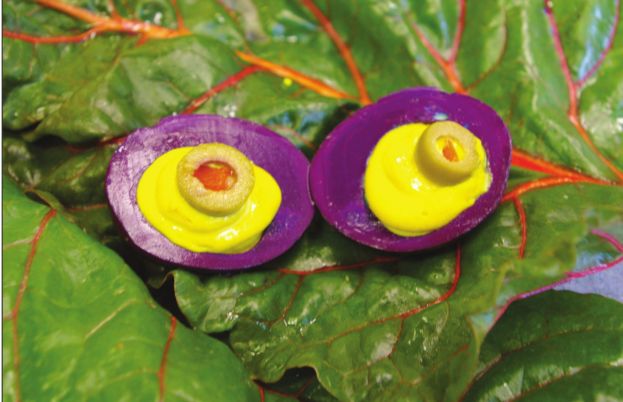
I have called this riff on deviled eggs by various names over the years: Devil’s Eyes, Evil Eyes, Devilish Eggs, Spooky Eyes. But whatever they’re called, these eyes always do a disappearing act as soon as they’re served.
Spooky eyes
• Hard-boiled eggs, shelled
• Black food coloring
• Mayonnaise
• Turmeric, optional
• Dijon mustard
• Cider vinegar
• Kosher or sea salt and freshly ground white pepper to taste
• Extra large pimento-stuffed green olives (or smaller ones if your eggs are small)
The day before you plan to serve the “eyes,” fill a large jar or deep bowl about 2/3 full of cold water. Add enough black food coloring to turn the water opaque, making sure the coloring is completely dissolved.
Halve the eggs lengthwise, gently remove the yolks, and set aside. Remove any yolk that clings to the edges or outside the egg whites with the corner of a damp paper towel. Discard any torn or broken egg whites, but add their yolks to the others. Add the whites to the jar with colored water. At this point you can go ahead and make the filling mixture below, or wait until the next day. Either way, refrigerate the jar of whites and the yolks (separately) overnight.
Purée the yolks in the food processor. Or press them through a food mill or sieve or mash them with a fork. Add mayonnaise, mustard, vinegar and a pinch or two of turmeric (this gives the yolks a brighter yellow color). Salt and pepper to taste. The term “deviled” implies a degree of spiciness, however the amounts depend on your personal taste. Start with just a tablespoon or so of mayonnaise, a teaspoon of mustard, a pinch or two of turmeric, and the same with the vinegar. You want to create a smooth creamy mixture, but one that’s not too loose. It’s much easier to add additional seasonings than it is to correct a mixture that’s too runny or spicy.
Gently remove the whites from the jars and tip out any liquid remaining in the cavities. Turn them upside down on paper towels for 15-30 minutes or until they are completely drained. They should drain until there’s no excess moisture and touching them doesn’t leave a stain on your finger.
Place the dyed egg white halves cut side up on a platter large enough to hold them comfortably in one layer. Fill the cavities with the yolk mixture using a portion scoop, two spoons, or a pastry bag fitted with a plain tip.
Slice enough olives crosswise so that there is one good slice, about 1/4-inch thick, for each egg half. Reserve the ends and other pieces for another use. Gently press an olive slice into the center of each “spooky eye.” For individual servings, place two “eyes” on a lettuce-lined plate with the more rounded ends of the eggs next to each other. Alternatively arrange all the “eyes” on a platter in a way that enhances their “spookiness.”
Bloody good gravy
to be served with roast beast Sure, you can serve spaghetti with tomato sauce and give it a creepy name, maybe Guts and Gore. But let’s face it: everybody will know it’s just, well, spaghetti and tomato sauce.
The dark red/purple beets
do a much better job of imitating actual blood. In fact, there’s a
variety named Bull’s Blood. Surprisingly, even though there is a
substantial proportion of beets in the gravy, their flavor is just a
background note; probably few would even guess what’s creating the
gravy’s bloody color. I also initially thought that the beets might make
the gravy too sweet, but it’s not.
I got the idea for roast beast from a line in Dr. Seuss’s How the Grinch Stole Christmas: “…
he [the Grinch] took the roast beast.” You can roast any kind of beast
you would like, although I think it works particularly well with pork,
not least because the gravy shows up particularly well on the lighter
(than beef) meat. The Beast can even be vegetarian, using seitan or mock
hamburger to make a beastloaf.
Happy Halloween!
• 3-4 red beets (more if they’re small)
• 1/3 c. pan drippings from roasting the Beast, or substitute butter, vegetable oil or bacon fat
• 1/2 c. chopped onion, NOT super sweet
• 1/2 c. all-purpose flour
• 4 c. chicken, beef, pork or vegetable stock, cold or at room temperature
• Salt and freshly ground pepper to taste
Preheat
the oven to 375 degrees. Beets vary greatly in size; you will need 1
and 1/2 cups of roasted, chopped beets to make the gravy.
If
the beets have stems and leaves, cut them off leaving about 2 inches of
stems attached. Scrub well. Wrap in a foil packet in one layer, sealing
the foil tightly. If the beets are in several sizes, make individual
packets, or group them by size. If the beets are different colors and
include red beets, wrap the colors separately so the red beets won’t
stain the others. Alternatively, the beets can be placed on a rimmed
baking sheet or a baking dish large enough to hold them in one layer
(separated, if necessary as above.) Cover the baking sheet or dish
tightly with foil.
Bake
until the beets can be pierced easily with a knife. Baking time will
depend on their size(s); small beets can take as little as 30 minutes,
larger beets take from 40-60 minutes or more.
When
the beets are completely tender, open the foil and let them stand until
they have cooled enough to handle, then rub the skins off; they will
slip off easily, as will the top stem area. Use plastic gloves to avoid
staining your hands.
Coarsely chop enough of the cooked beets to measure 1 1/2 cups. Place the beets in the container of a blender or food processor.
Using
the pan drippings from whatever kind of “beast” you have roasted will
make the most flavorful gravy, so use those drippings if at all
possible. For making gravy with pan drippings, remove the “beast” from
the pan, cover and keep warm. Scrape any fat and accumulated juices from
the pan into a measuring cup. If it doesn’t equal 1/3 cup, or if
there’s little fat and a lot of juice, spoon the fat off into another
measuring cup and add enough butter, oil, etc., to make up 1/3 cup. Put
the fat and juices back into the roasting pan and place it on the stove
over medium heat If you don’t have the pan drippings, put 1/3 cup of
whatever fat you’re using in a large skillet over medium heat.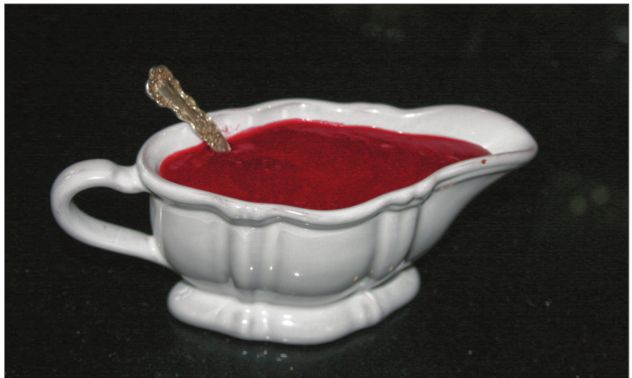
When
the fat is hot but not smoking, add the chopped onion and sauté,
stirring occasionally, until the onion is softened. Add the flour and
stir until any lumps of flour have dissolved. Cook, stirring frequently,
until the mixture is golden brown, about 5 minutes. If using pan
drippings, be sure to scrape the brown bits sticking to the bottom of
the pan into the mixture.
Scrape the mixture into the blender containing the beets. Add 2 cups of the stock and process until completely puréed.
Pour
the purée back into the pan. Put the remaining stock into the blender
and give it a couple pulses to incorporate the purée remaining in the
blender, then add it to the pan.
Over
medium-high heat, whisk the mixture together and bring to a simmer.
Cook, stirring frequently, until the gravy has thickened and reduced
enough that it’s somewhat darker. Season to taste with salt and pepper,
and the vinegar, if using. Makes about 4 cups.
Contact Julianne Glatz at [email protected].


