Old mother in a barrel: vinegar
FOOD | Julianne Glatz
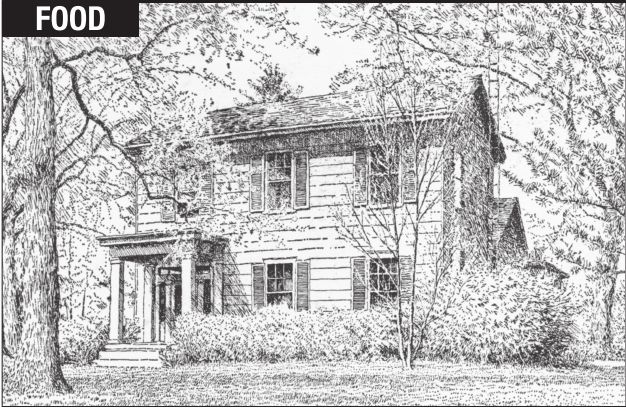
Every fall I remember what it was like to come as a child to this place that’s been my home for almost 30 years: the venerable Spaulding Orchard farmhouse. It’s the first home my husband and I bought, and probably our last.
It wasn’t our first choice, but after being entwined in this place for so long, it’s hard to think of living anywhere else. Since the early days of our engagement, my husband and I talked about building a log cabin, albeit one with modern conveniences. By the time Peter was in his junior year of dental school at the University of Illinois at Chicago, we were sketching floor plans and discussing the number of fireplaces it would have and other details.
Our dream log home was a carrot at the end of a very long stick: a reason for Peter to study hard, and for us to live frugally. But we knew it would be a while after Peter graduated until we could realize our dream. First we’d have to pay off student loans and a loan for the dental chairs, x-ray machines and other equipment needed to outfit his office. It seems almost unbelievable now, but back in the late 1970s and early ’80s the interest rate on that loan (which floated two points over prime) was as much as 23 percent.
So when the Spaulding family decided to rent a bungalow located near the main house, we grabbed the opportunity. We’d enjoyed Chicago, but living on Spaulding Orchard Road seemed like a bit of heaven. The house was a bit smaller than our old apartment, but had a huge tree-filled yard. There were beautiful woods and a creek across the road, everything so peaceful and quiet that often the only sounds were birdcalls and wind rustling through trees. Sitting on the porch that fall with our newborn son, watching the surrounding woods begin to flame with the brilliant changing leaves, we knew we’d come home.
One reason it felt like coming home for me was that it was so familiar in a special way. Since childhood I’d come there in spring for asparagus and summer for peaches. But fall trips to the Spaulding Orchard were the best: a yearly ritual as closely linked to autumn as cooler weather and starting school. As we drove past the farmhouse, heading to the barns behind, I could hardly contain my excitement. There were piles of pumpkins, and apples everywhere: in bushels and boxes, piled on wagons, and heaped in the huge cider press inside a shed. If no one was around, mom would tap the horn, and Geraldine Spaulding would walk over from the farmhouse. “Would you like some cider?” she’d ask. That was the moment I’d waited for. She’d pull a coneshaped paper cup from the nearby dispenser, filling it from a jug of cider just pressed in that giant contraption. I’m not sure why it was so wonderful. I only know I wasn’t alone in loving it: I have lost count of the people who, learning where I live, mention those cups of cider.
But by the time we moved into the bungalow, the cider and produce were long gone. Mercer, Geraldine’s husband, had passed on, and their children had moved away. The orchard was cut down, the land leased to a neighboring farmer, and eventually sold to become Panther Creek. Geraldine lived alone in the farmhouse. For three years we were neighbors, seeing each other almost daily. Then her children persuaded her to move to Florida; the farmhouse was put up for sale (the bungalow was owned by another family member).
A year later, it was still on the market when our accountant told us it was time to buy a house and what we should
spend. Peter and I looked at each other. The old farmhouse and its two
acres listed for almost that exact amount. A log cabin was still
appealing, but Spaulding Orchard was home. Two phone calls and 48 hours
later, the farmhouse was ours.
There
were reasons the farmhouse hadn’t sold. Our new home was old – very
old; the Spaulding family said it had been built in the 1830s. The
first-floor rooms were lovely except for the kitchen, which was so small
there wasn’t even enough room for a table, and it had four doorways.
The second story consisted of one huge bedroom (also lovely), one
average-sized bedroom, and one that measured six feet by eight feet.
None had closets. The upstairs bathroom doubled as the hallway. The
electric wiring throughout was a nightmare.
Then
there was the basement. Not really a basement, it was a cellar with
dirt floors and moldering brick walls. Four oak barrels lay sideways on
cement blocks. Three were empty; the fourth nearly so. When we first saw
them, we talked about what the barrels had contained and decided we
might use them as outdoor decoration sometime, but afterwards forgot
about them. It was better to avoid thinking too much about the cellar.
Shortly
after moving, our then 7-yearold daughter Anne and two of her friends
were exploring our new abode. Suddenly the terrified trio pounded up the
cellar stairs, screaming. It took a few minutes before they calmed down
enough to talk. “It ... it … there … there’s a card tacked to one of
those barrels,” gasped Anne. “It says ‘Old Mother in Barrel.’” We’d
joked that the cellar was only good as a backdrop for spooky Halloween
stories. Was it horrifyingly true?
The girls glared at me when I laughed. What was funny about a dead woman in that barrel?
I
explained there probably was a mother in the barrel, but it wasn’t a
person. It was a vinegar mother. True, a vinegar mother does look a bit
creepy: slimy and rubbery. But it’s the opposite of evil. In fact, the
folks who advocate natural health remedies treasure it.
Vinegar
mothers are composed of cellulose and acetic acid bacteria (which are
probiotics, a.k.a. beneficial bacteria). It develops on fermenting
liquids, combining with oxygen in the air to convert alcohol into those
acetic acid bacteria. They occur in apple cider as well as a host of
other liquids, including wine.
Utilizing vinegar for health isn’t new.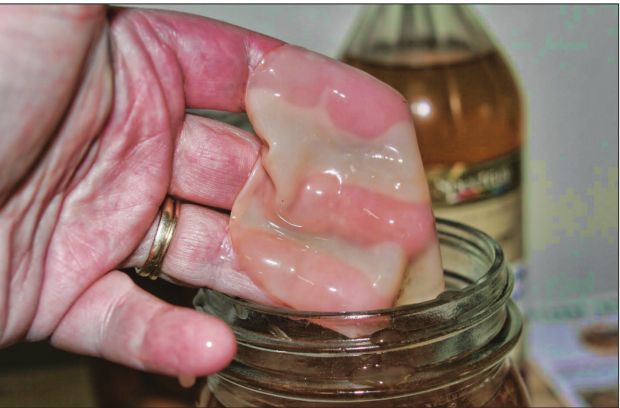
In
fact, Hippocrates wrote of using it in the fourth century B.C. When I
had a childhood cold, my grandmother would make me cider vinegar tea
sweetened with honey. Today advocates believe apple cider vinegar is the
most beneficial, using it both internally and externally for things
ranging from colds, weight loss and high cholesterol to sunburn and
dandruff. But to be effective, they say it must be made from unfiltered
and unpasteurized cider (the level of acidity destroys any bad
bacteria). Most cider vinegars in groceries have been pasteurized, but
commercial brands made from raw cider are widely available in health
food stores and some groceries. Locally, Food Fantasies carries it.
As
well as being good for you, apple cider vinegar is delicious, adding a
delightful piquancy to salad dressings and almost everything apple. I
like to toss apples I’ve sliced for pie, strudel or crisps with a
tablespoon or so, both to keep the apples from turning brown as well as
heightening their flavor. I also like to add those vinegar-tossed apples
to the pan when roasting a chicken or pork loin, and then deglazing the
pan with cider and a little more vinegar to make a sauce.
There
was a little more than three gallons of the vinegar in the “Old Mother”
barrel. It had been aging for at least a decade, darker, more intensely
flavorful and acidic than any commercial brand. I’ve used it sparingly
over the years to make fantastic deviled eggs and as mentioned above.
There’s still almost a gallon left.
And
history is repeating itself. Last week Anne called from Brooklyn about a
wonderful cold remedy she’d discovered: two tablespoons of cider
vinegar and a tablespoon of honey in a cup of hot water.
Contact Julianne Glatz at [email protected].


