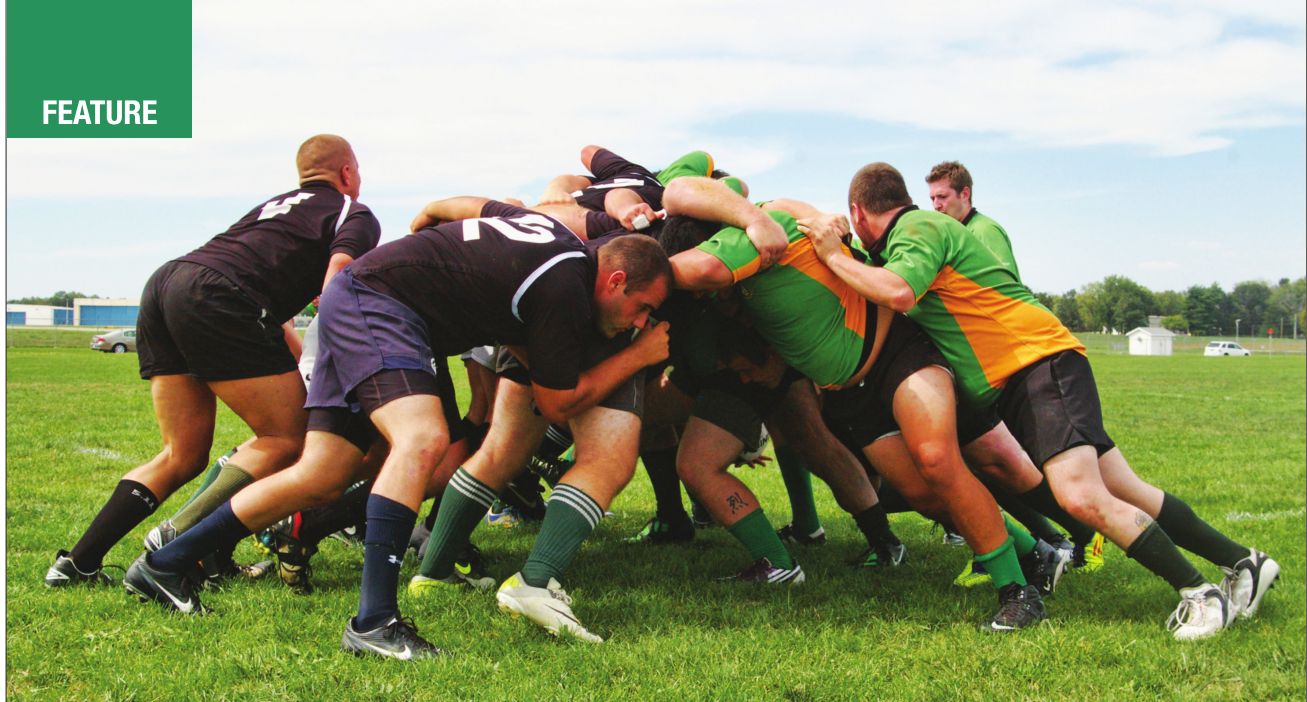
Scrumming in Springfield
The Celts are looking for a few good men
SPORTS | Bruce Rushton
It is easy to imagine the Springfield Celts as third-graders.
These are the guys who loved dodgeball, the ones who laughed and screamed “Whoa!” when balls found their mark in particularly violent fashion, the ones who pleaded for one more game before recess ended, the ones who didn’t notice when classmates cowered or developed sore throats necessitating trips to the school nurse, who never found anything wrong.
These guys were always up for smear-thequeer and at the bottom of the dogpile when the ball came loose. These guys didn’t bother with Band-Aids. These guys didn’t tuck in their shirts or get home on time.
These guys have not changed. It takes balls to play rugby – that is, perhaps, the sport’s oldest cliché, and it is true. There are women’s teams in big cities like Chicago and at a handful of universities across the land, but in Springfield, rugby is a case of boys being boys. Marriage, they say, is the leading cause of retirement from rugby, although debilitating injury and sheer age take their own tolls.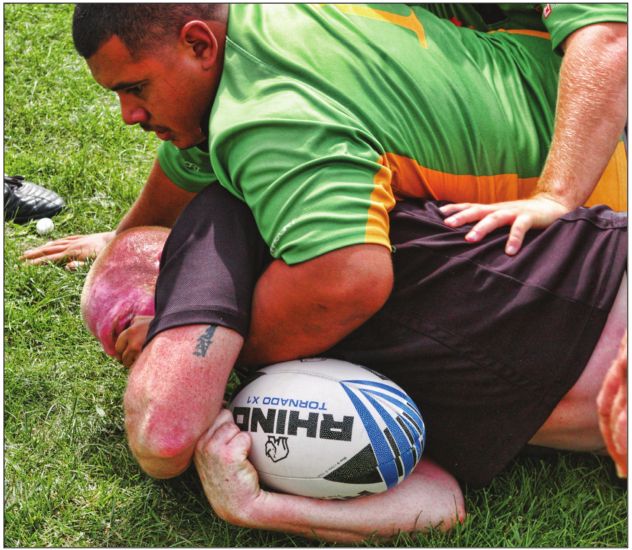
Rugby is played in the fall, spring and summer – only when the pitch freezes do ruggers hang their cleats. The cycle begins in February, when the Celts meet at Goals
Indoor Sports, an indoor soccer arena on North Peoria Road, for conditioning drills.
“They have a liquor license, so it’s good for us,” says Jim Carlberg, the team’s coordinator cum coach.
One of the biggest fraternities Tensions and expectations are high during this mid-September match against the Flatlanders, a team from Champaign. The Celts are looking for their first win in a long time, and the officials aren’t helping matters.
“That’s a bullshit call, sir!” Even in the heat of battle, Dave Schneller, a Celt whose playing career ended years ago, exercises proper etiquette as he shouts instructions to both players and officials from the sidelines. You can call a ref blind, you can say things about his sister. Just make sure you call him “sir.”
At the moment, Schneller believes a Flatlander is cheating by reaching into a huddled mass of players – it’s called a scrum – to grab the ball from the ground. You’re not supposed to use your hands until one side or the other pushes the opposition out of the way and the ball is clear of the scrum. Then, the scrum-half (yes, there are positions in rugby, just as in football) snatches the ball and either passes it to a teammate or runs with it himself.
If
there were a Springfield Rugby Hall of Fame, Schneller would be a
charter member. He started playing for the Celts in 1985 while attending
Lincoln Land Community College and became world class, playing for the
All Army Team after joining the military, then the All Services Team,
composed of the best players in all branches of the armed services.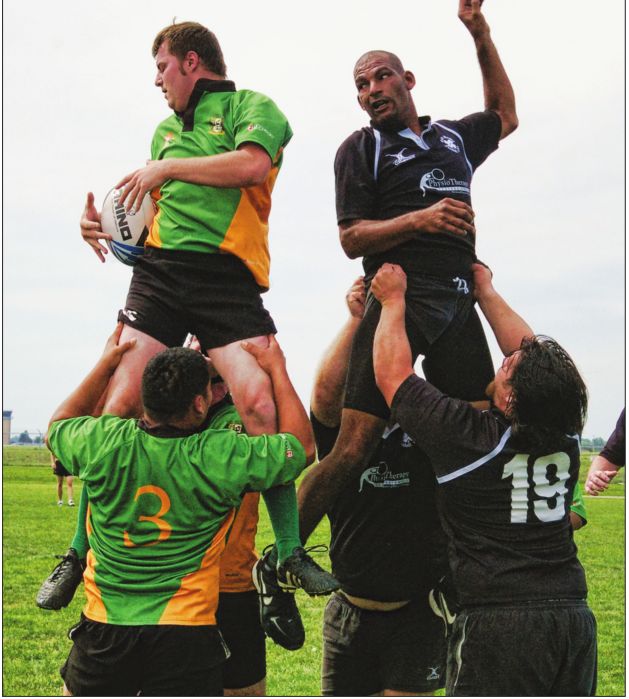
Schneller
was playing for the Celts when his career hit sunset during a match in
St. Louis. He was tackling an opponent when a cleat dug in and nothing
else did. His right leg twisted until it snapped.
Carlberg,
who was present when Schneller went down, recalls his teammate’s foot
facing backward. Bone protruded. Nonetheless, Schneller after several
surgeries eventually returned to the field and played a few games with a
medically fused ankle, Carlberg says.
“He’s an animal,” Carlberg said. “He just has heart.”
Schneller will always be a Celt. “It’s honestly one of the biggest fraternities you’ll ever find,” he says.
It’s camaraderie as much as competition, according to Mike Gillespie, who has been playing with the Celts since 1998.
“The
goal is to win – it’s important,” Gillespie said. “But is it the
epitome of being out there? Not at our level. No matter what happens, 14
other guys have my back.”
At
this level, speed, strength and conditioning go a long way. If you are a
naturally gifted athlete, Schneller says, you will do well. It is not
unlike hockey or basketball, only with more lucky bounces: There aren’t
many set plays, and so players tend to react. At the sport’s upper
levels, where everyone is fast and everyone is strong, tactics matter.
“When I was in England, they called it a tackling game of chess,” Schneller says. “You’re thinking four plays ahead.”
In
Springfield, it is more a ruffian’s version of biathlon: sprint,
wrestle, sprint, wrestle, sprint, wrestle, with a fair amount of cussing
interspersed throughout. The basics are fairly easy to grasp. The
object is to get the ball into what would be the end zone in football;
in rugby, it is called the try zone, with a try worth five points. Kick
the ball between the uprights and you also get points, albeit fewer.
No forward passes, no blocking and, of course, no pads. The ball
can be advanced by kicking. No tackling when the ball carrier is in the
air, no tackling around the neck. The referee has wide discretion when
it comes to issuing penalties for conduct deemed unsportsmanlike. Player
safety, after all, is important.
Rules, naturally, are made to be broken.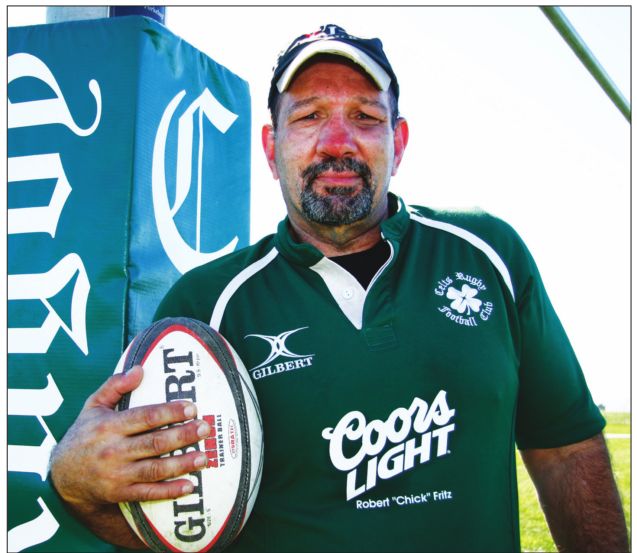
Injuries?
Big deal. Midway through the first 45-minute half against the
Flatlanders, Celts captain Evan Brunner, who makes a fireplug look like a
beanpole, is churning upfield with the ball when an opponent charges in
upright instead of diving for torso. Wrong move. If anything, Brunner
gains speed while throwing a forearm that makes direct contact with his
opponent’s face, putting the Flatlander flat on his butt, where he
remains, dazed, for several seconds before slowly picking himself up.
Should
have been a red card, Carlberg admits, which would have put Brunner on
the sidelines and forced the Celts to play a man short for the remainder
of the game. The ref seems to be the only one who didn’t see it, and so
the lads play on. Afterward, Brunner makes no apologies.
“Sometimes,
you’ll have that,” says Brunner, a guard at Logan Correctional Center
who once played offensive tackle for the MacMurray College football
team. “They knocked my guy in the face, I retaliated.”
After
the game, Mason Powell, who got it in the face, resembles Rocky after
Mick cut him in the late rounds. One eyelid is sliced open, his nose is
bleeding from the side and Powell keeps a bag of ice over half his face
in a losing fight against swelling. He is not entirely sure what
happened there at the bottom of a pile. From the shape of his wounds, he
deduces that a Flatlander stepped on his head.
“See,” Powell says as he points. “One cleat there and another over here.”
Powell
is smiling when he says this. Seven neophytes from Lincoln Land
Community College, where the Celts have been recruiting, watch together
from a sideline bench. After the main event is over, they’ll give it a
go themselves in a brief. They look eager.
“If
I get hurt, I get hurt – I’ll heal,” says Michael Price, a 17-year-old
freshman at Lincoln Land. “If I break my arm, I’ll have a bad-ass story
to tell.”
A tradition of excellence Back in the day, the Celts were bad asses.
It
took a few years after the club was formed in 1975, but by the
mid-1980s, the Celts were a force, good enough that they once beat a
team from Notre Dame and traveled to Chicago and other big cities in
search of games.
The
Celts, the old-timers say, were like the Oakland Raiders of yore, a
physical team that usually found a way to win and made opponents think
twice before granting rematches.
“We
were mobile and mean,” recalls Rick Hamilton after the match with the
Flatlanders, which ends in a tie after a kick by the Celts in the dying
minutes goes wide right by a yard – it would have been worth three
points had it gone through the uprights. “We would have killed these
guys.”
At 57, Hamilton
is old enough to be his youngest teammates’ grandfather. He started
with the Celts in 1976 and still plays. Hard.
He is prone to
inserting himself in games in a way unimaginable back in the early days,
when no substitutions were allowed. No one dares tell him “no.”
Hamilton
is neither the swiftest nor the strongest, but he does not embarrass
himself. Younger guys can run all over the field nonstop. Hamilton
compensates with knowledge of the game that allows him to figure out
where a play is headed and get into position with a minimal amount of
energy. He does not shy from contact.
That
Hamilton has played in five decades speaks to a cold truth: The Celts,
who haven’t had a winning season in more than a decade, have grown old.
So few players were left just a few years ago that the Celts could not
field a team and so skipped a season or two. Three regulars are now in
their 40s. For the team to survive, fresh ruggers are needed. And they
are starting to show up.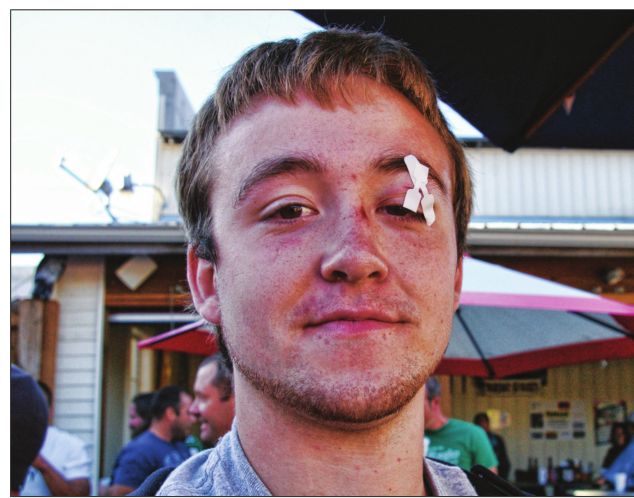
Last
year, the average age on the team was 30, Carlberg says. Now, it’s in
the low 20s, the youngest team in a decade, thanks to recruiting efforts
at Lincoln Land and high schools, where rugby is gaining a foothold.
Much like its parent club, the Junior Celts, a team of players from
several local high schools that plays in the spring, lost every match in
their inaugural 2010 season. But it didn’t take long to get
respectable. In 2011, they finished fifth in the state. Last year, the
Junior Celts went undefeated until the state championship game, which
they lost to a team from Chicago.
Fueled
by youth, the Celts, Carlberg says, are on the cusp, despite losing
their first game, then tying their second match to the Flatlanders in a
match they probably should have won. Not so long ago, the Celts would
have fallen apart when opponents scored and argued among themselves,
Carlberg says. Now, they just keep trying.
Still,
there is some frustration. After dominating the first half of their
home opener against the Shamrocks, a team from the Chicago area, the
Celts fall apart in the second half, allowing two quick scores and
prompting Dominique Stewart – Dom to his teammates – to complain,
loudly, about Celts who don’t show up for twice-a-week practices at
Kennedy Park, the team’s home field. Excuses about work and family
obligations don’t cut it with Stewart as the other team gets ready to
kick a conversion, not unlike an extra point in football but worth two
points, after scoring a try.
“The
only way to way to get better at rugby is to play rugby,” Stewart tells
his teammates. “I work, too, and I come to practices.”
A
numbers game In just his third year, Stewart is fast, fearless and
intense – exactly the sort of player the Celts need. A former Junior
Celt, Stewart wrestled and ran track at Lanphier High School but now is
devoted to rugby. He spent last summer playing rugby in Colorado, making
ends meet as a cook so that he could learn and play the sport he has
grown to love.
“If we had more numbers, the Celts would be a whole different team,” Stewart says.
Stan Korza, who got his start in 1977 and played for 25 years
until his body could stand no more, recalled the days when the Celts had
enough players to field three 15man teams. Numbers, he said, are key.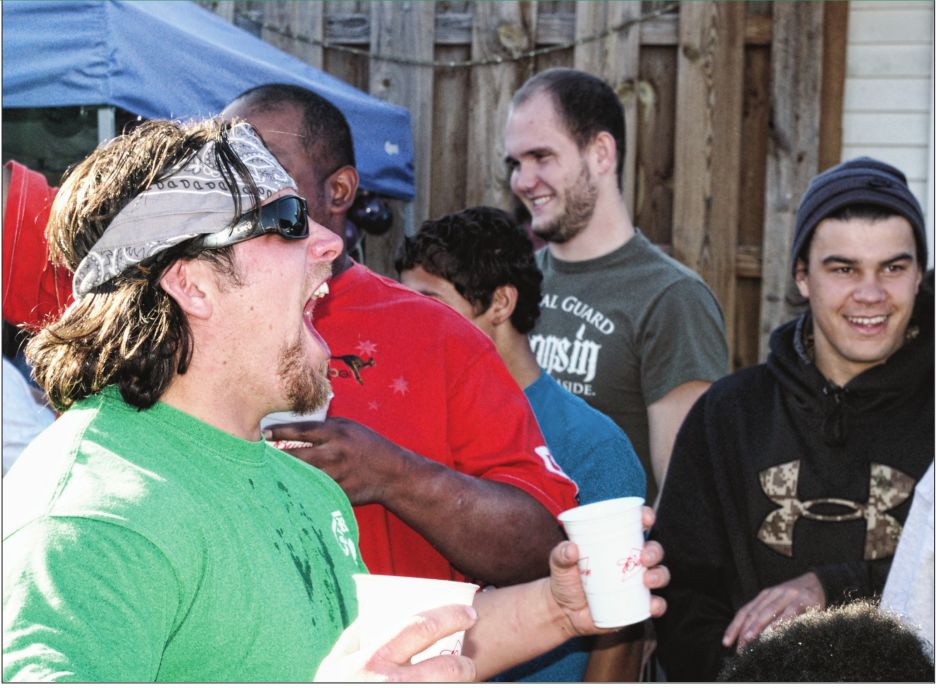
“If you get a lot of guys, you have more guys to choose from,” Korza said.
There
are signs of hope for a team that lost every game last year. The Celts
are competitive this season, and more guys are turning out, enough to
allow a 45-minute match between reserve players after the main game with
the Flatlanders. Half the players have never played before, and their
grasp of the rules is tenuous at best.
Veterans
say the attrition rate is 50 percent or more for new players, but they
are nonetheless welcomed, both at games and after-contest parties at
Weebles, a North Peoria Road tavern with a beer garden that is taken
over by players from both teams after on-field hostilities end.
Imbibing
with the opposition after matches is a time-honored tradition in rugby,
as are bawdy songs that involve detailed descriptions of unnatural acts
involving priests, pregnant women and puppies belted out at top volume.
As pitcher after pitcher of keg beer disappears, the singing begins.
“You get drunk with the guys you just fought,” Hamilton says. “It’s the most fun game I’ve ever played.”
Contact Bruce Rushton at [email protected].


