No jackpot
Video gambling gets off to a slow start
GOVERNMENT | Bruce Rushton
The best way to curb gambling might be for the state of Illinois to legalize it.
The going has been slow since lawmakers more than three years ago approved video gambling outside casinos. Only last spring did the state gaming board start accepting applications from businesses, fraternal organizations and veterans groups for licenses to have video gambling on their premises. Fewer than 350 of those applications have been approved. The application backlog stands at more than 3,000.
State Rep. Rich Brauer, R-Springfield, blames the gaming board for delays.
“To me, it’s very frustrating that the state is so unorganized that a fairly basic bill takes over three years to implement,” said Brauer, who voted in favor of legalization.
It’s not necessarily the gaming board’s fault, according to Gene O’Shea, board spokesman.
A lawsuit challenging the constitutionality of the statute that legalized video gambling delayed implementation, O’Shea said. The legal challenge ended more than a year ago when the state Supreme Court upheld the law. In 2010, the gaming board reopened bidding for a statewide computer system to track wagering and money after an unsuccessful bidder argued that the bidding process had been botched. Gaming officials have also complained that lawmakers did not provide sufficient money for the gaming board to promptly license applicants and otherwise create a regulatory system.
Regardless, the gaming board, which began allowing gambling at a handful of locations this month as a test, says it’s now ready for the games to begin.
“As you probably all know, we are set to go,” gaming board chairman Aaron Jaffe said last week at the board’s monthly meeting. “If you’re ready to go, we’re ready to go.”
But video gambling riches are far from a sure bet.
Brauer and other lawmakers who voted in favor of video gambling say they were swayed in part by tens of thousands of illegal machines that were already being played throughout the state without the government collecting a percentage. If it’s already happening, legislators figured, the state should cash in.
Thanks to a five-machine limit per location contained in state law, fewer than 20,000 machines could be installed now if every location that has applied for a license gets one.
That’s far fewer than the estimated number of machines that existed three years ago when lawmakers legalized video gambling.
Furthermore, the law allows local governments to ban video gambling, and hundreds of municipalities and counties have done exactly that. As a result, state forecasters have dramatically reeled back initial projections that showed the state might collect more than a half-billion dollars a year from video gamblers.
Illegal machines disappear
When state lawmakers approved video gam bling, legislators counted on video gamblers to help fund a $31 billion capital budget earmarked for road improvements, repairs to bridges, updates to crumbling buildings and, this being Illinois, a fair number of grants to such favored private organizations as the Irish American Heritage Center in Chicago and VFW posts throughout the state.
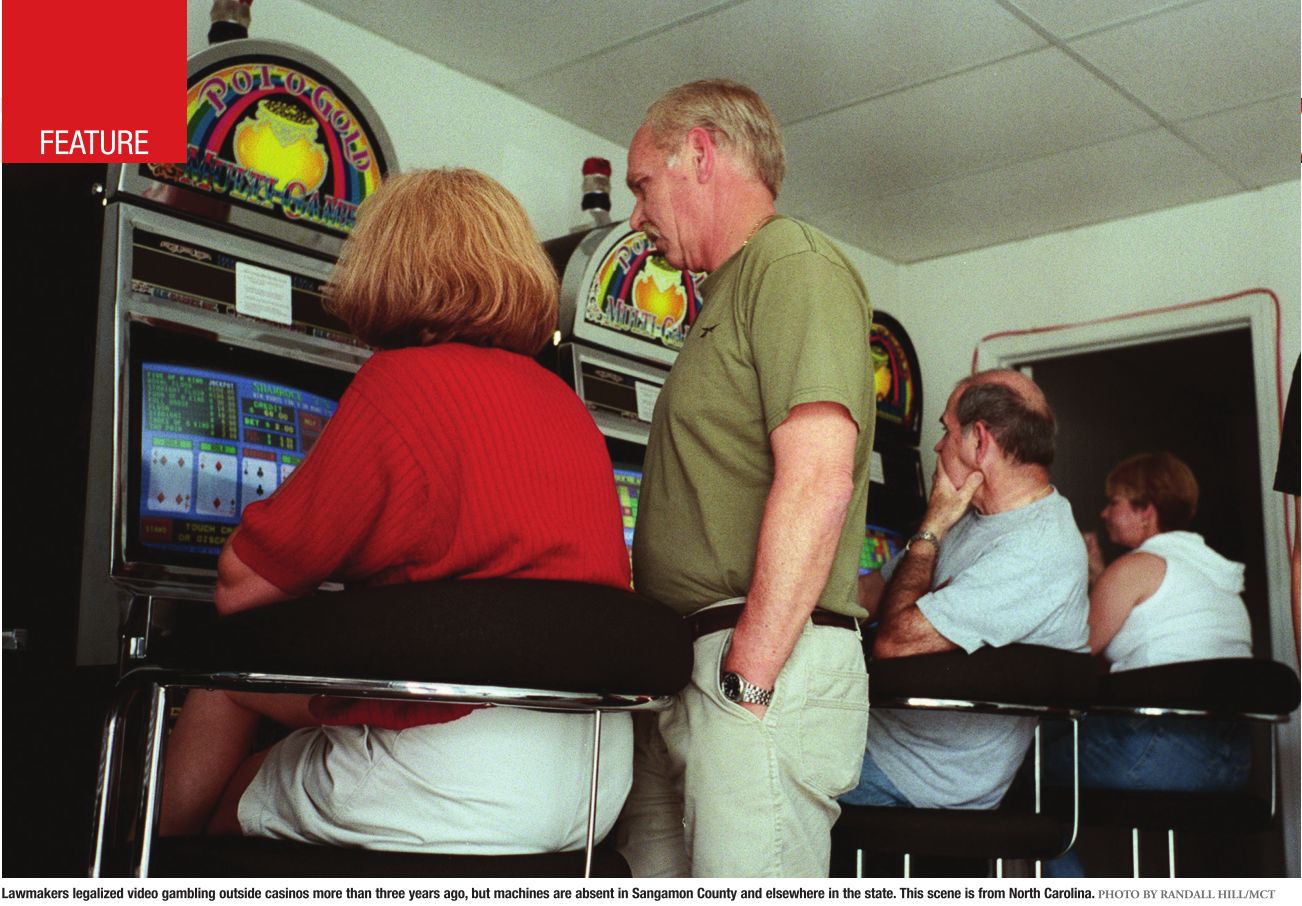
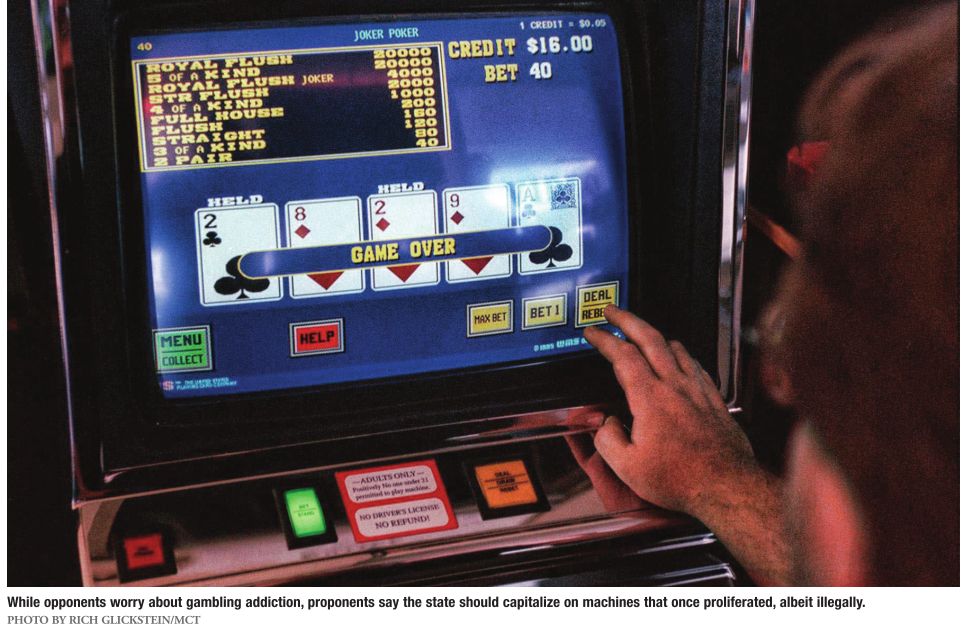
Pro-gambling politicians had reason to be confident. Even before lawmakers legalized video gambling in 2009, illegal so-called gray machines had proliferated for years, mostly in bars. The “for amusement only” disclaimers on the devices that gobbled untold riches were, well, amusing, and everyone knew it.
Aside from annual license fees of $30 per machine, the state collected nothing from the devices that looked like electronic slot machines, worked like electronic slot machines, sounded like electronic slot machines and paid off, albeit under the table, like electronic slot machines. By some estimates, more than 20,000 such games were
licensed in 2009 when the General Assembly voted to legalize the
business and take a cut of profits, with the state collecting 25 percent
and local governments getting an additional 5 percent. When unlicensed
devices were considered, estimates ranged as high as 60,000 machines.
No
longer. Check a dozen bars at random in Springfield and you’ll find
more ashtrays, smoking ban notwithstanding, than video poker machines or
any of the other so-called gray machines that once were as ubiquitous
as beer on St. Patrick’s Day.
“They’re
all gone,” says Mike Walton, a board member of American Legion Post 32
who acknowledges that the establishment on Sangamon Avenue was one of
scores in Springfield that once offered video gambling without oversight
from state gaming regulators.
Possession
of so-called gray machines became a felony in mid-August, but numbers
from the state Department of Revenue and the Springfield city clerk’s
office show the decline began three years ago.
The
number of amusement-device licenses issued in Springfield has dropped
from more than 1,000 in 2010 to 815 this year, with those figures also
including jukeboxes, video games such as Golden Tee and other gizmos
that aren’t used for gambling. The state Department of Revenue issued
more than 64,800 amusement-device licenses in 2010 and 62,200 in 2011.
Fewer than 46,000 licenses have been issued for the current licensing
year that began Aug. 1.
Sue
Hofer, spokesman for the state Department of Revenue, says the state is
still issuing licenses for “simulated gaming” devices that are
perfectly legal so long as no jackpots are paid.
“It
is up to the taxpayer to know whether their machines are in compliance
with the new gaming law,” Hofer wrote in an email. “A number of
taxpayers have indicated they have been getting rid of their simulated
gaming machines over the past three years in anticipation of video
gaming going online. This could be a potential cause of the decline in
the number of decals issued.”
Fear
of prosecution prompted bars to get rid of gray machines that paid
jackpots, Walton and others say. But even before possession of such
machines became a felony last month, the gaming board warned that it
would be tough on establishments that have allowed illegal gambling.
“It’s
my personal opinion that if you’re in the gambling racket today
illegally, you shouldn’t be able to operate legally,” chairman Jaffe
said in 2009. “It’s my feeling we should be as strict as we possibly
can.”
Applicants for
video gaming licenses must tell the board whether they have ever
“facilitated, participated or enabled” the use of amusement devices for
gambling. But after the board declared that it would ask applicants
whether they had ever been involved with illegal gambling, the
legislature passed a law in 2010 that defined “facilitated, participated
or enabled” as having been convicted of a felony gambling offense,
allowing applicants to answer “no” on licensing forms so long as they’d
never been prosecuted and found guilty.
Jaffe
has called the 2010 law a “disaster,” saying that lawmakers shouldn’t
take power away from the board. Lawyers familiar with the statute say
that the board can still consider past conduct, so the fate of
applicants who have had gray machines but not been convicted of gambling
offenses isn’t entirely clear.
The
board has revoked at least one license for jumping the gun on
legalization. The revocation came in April, after the board received a
tip that AAA City Vendors Gaming owned by Loyal T. Sprague III was
supplying gray machines to an American Legion post in Bartonville, near
Peoria, that was paying jackpots. It shouldn’t have been a surprise.
In 2004, the Peoria Journal Star reported
that Loyal T. Sprague, Jr., who had recently died from four gunshots to
his belly, had been a heavy gambler whose company, City Vendors
Amusement, supplied games to bars. Police reportedly found $80,000 in
cash in Sprague’s home, the newspaper reported, and those who knew him
said that he held gambling parties at his home and would bet as much as
$10,000 on the flip of a coin. The county sheriff called him “an
interesting dude” who always tried to help people.
The bar game business ran in the family:
Sprague had inherited it from his father, according to the Journal Star report,
and Loyal T. Sprague III, Sprague’s son, was also involved in the
enterprise. In 2010, one year after state lawmakers legalized video
gambling, the son incorporated AAA City Vendors Amusement and got a
license from the state.
When
the board unanimously voted to revoke the company’s license in April,
Jaffe said that regulators do their best when vetting applicants, but
success isn’t guaranteed.
“It’s
also clear to me that illegal activity in this industry does not exist
in a vacuum,” Jaffe said. “The bar owners know this is occurring, the
bartenders know that illegal payments are being handed out, the bar
patrons and gamblers know this is happening and, most distressing of
all, many local law enforcement officials have turned a blind eye to
this crime for decades.”
An
application from the Bartonville American Legion post where AAA City
Vendors Amusement had installed machines is pending at the gaming board.
Opinions vary on whether the state should grant it.
Christopher
Stone, a Springfield lobbyist who is seeking a license for a string of
planned businesses that will feature video gaming, says no. The gaming
board, he said, should be “fair and consistent:” If a supplier of gray
machines isn’t allowed to operate, then the bar where the machines were
paying out shouldn’t be allowed to get a license, either.
“You need two to tango, right?” Stone says.
“If they’re consistent with their policy, the American Legion doesn’t get one.”
A
manager at the Bartonville American Legion post said that the post
hasn’t heard from regulators since submitting a license application
about two months ago. Gaming board officials visited the post last
spring and demanded that gray machines be removed, the manager said.
“Yes,
we are concerned,” said the manager, who requested that his name not be
published for fear of running afoul of regulators. “We’ll just have to
see what happens.”
But
Walton, who works for the Sangamon County sheriff’s office and was once
Springfield’s police chief, said that he’s not worried about the gaming
board rejecting an application from his legion post because the
organization once had gray machines.
“If they did that, probably 90 percent of the applicants wouldn’t get one (a license),” Walton said.
Few licenses granted
So far, the American Legion post on Sangamon Avenue is losing when it comes to legalized video gambling.
Walton
says the post, which has not yet been awarded a license so gambling can
begin, has spent as much as $4,000 on lawyers, licensing fees,
fingerprinting and electricians to wire the building for new machines.
When gambling does start, Walton doesn’t expect to make as much money as
in the past. The gov ernment, he points out, is going to take a 30
percent cut.
The
state, meanwhile, is expecting a much smaller windfall than originally
envisioned. Since the General Assembly legalized video gambling,
forecasters have been reeling back revenue projections that are now a
fraction of what lawmakers were told when they voted to legalize.
In
2009, the state predicted that its cut from video gambling would total
between $288 million and $534 million. The state Commission on
Government Forecasting and Accountability last year slashed that
estimate, predicting that video gambling will raise between $184 million
and $341.2 million a year. The commission recently cut its prediction
even further in a yetunpublished report, saying that video gambling will
raise between $105.6 million and $196.2 million in annual revenues.
Municipalities
and counties can ban video gaming, and COGFA’s forecast has shrunk
because more than 300 communities, including Chicago, have done exactly
that, says Eric Noggle, senior analyst for the commission. More than 63
percent of the state’s population lives in jurisdictions that don’t
allow video gambling, he said.
The
commission’s forecast, based on the state receiving between $70 and $90
from each machine each day, is conservative, Noggle says. While COGFA
has said that predicting revenue from video gambling is “challenging,”
Noggle said he doubts that there will be as many legal machines as there
were illegal ones during unregulated days when bars weren’t bound by a
five-machine-per-location limit now contained in state law.
“We
all know a lot of this has been going on illegally for many years,”
Noggle said. “I’d be surprised if we actually reached the saturation
point of where it was before.”
In
Sangamon County, 84 bars, restaurants and other businesses have applied
for licenses to conduct on-premises video gambling, according to the
most recent figures available from the state gaming board, which has
granted just one license in the county, and not to a usual suspect.
With
hardwood floors, Perrier Jouet champagne and single-malt Scotches
costing more than $150 a bottle, It’s All About Wine on Wabash Avenue in
Jerome isn’t exactly a beerand-a-shot bar, but it is the first business
in the county to win the right to offer video gambling to patrons. Joe
Volenec, co-owner, calls it an experiment. He figures his customers
might enjoy electronic games of chance as they sip high-end chardonnays.
“I’m
not in the gambling business, I’m in the wine business,” Volenec said.
“I don’t see a downside to it. Let’s see what happens.”
The Abraham Lincoln Capital Airport is also hoping to cash in.
“We’ve
kind of had this on our radar screen as an additional revenue stream
for some time,” says airport executive director Mark Hanna. “Looking at
where this is going, it could be a very popular form of entertainment.”
More
than a half-dozen truck stops in Sangamon County have applied for video
gambling licenses. But fears of video poker on every street corner are
not coming true.
Bars and restaurants that pour alcohol are eligible to apply for video
gambling licenses, but fewer than 70 of more than 220 establishments
with licenses to pour alcohol in Springfield have applied. What the
future might hold is anybody’s guess.
Paul
Jenson, a Chicago attorney who represents businesses involved with
video gambling, predicts an uptick in license applications once video
gambling starts in earnest.
“I
think, eventually, these establishments will apply (for licenses),”
Jenson said. “I think, frankly, a lot of them don’t think it’s reality. …
Is the roll-out going to be a little slower than we thought a year or
two ago? Probably.”
Stone,
the Springfield lobbyist, estimated that between 10 and 20 percent of
bars won’t be able to get licenses for reasons ranging from inability to
pass background checks to delinquent taxes. State law also gives the
gaming board the authority to deny a license if it feels that permitting
machines would result in an “undue concentration” of gambling devices
in a geographic area.
But plenty of people, including Stone, see opportunity.
Stone
is the public face of Lucy’s Place, a partnership that plans on opening
video gambling parlors in Springfield and several other cities in
central and downstate Illinois. The company has yet to apply for
gambling licenses in Springfield, where it has liquor licenses for two
yet-unopened locations, but it has applied for 10 licenses in such towns
as Litchfield, Wood River and Columbia.
“I don’t think we’re going to rule out any communities if they decide they would like to do it,” Stone said.
Stone
is aiming for gamblers who appreciate the quietness afforded by
establishments that resemble coffeehouses more than bars or taverns.
Under state law, establishments must prohibit anyone younger than 21
from gambling, and Lucy’s Place will take care of that by barring minors
and checking driver’s licenses when people enter. While cocktails might
eventually be offered, beer and wine will come first. Lottery sales are
planned, as is food service. True couch potatoes can drop by and just
watch television.
It
is the sort of enterprise that worries Anita Bedell, executive director
of Illinois Church Action on Alcohol and Addiction Problems, which has
long opposed all forms of gambling in the state. The disappearance of
video gambling devices since possession of gray machines became a felony
is the proverbial calm before the storm, Bedell says.
“As
soon as it (legal video gambling) starts, it could mushroom,” Bedell
says. “I’ve read reports that said it could go up to 75,000 (machines).
It’s going to increase crime. It’s South Carolina had one machine for
every 100 residents, and the number of Gamblers Anonymous groups grew in
direct proportion.
Proponents
of video gambling say that the law in Illinois that limits the number
of machines per location and doesn’t allow machines in places other than
truck stops, fraternal organizations, veterans groups and businesses
that pour alcohol, was written with an eye toward problems in Iowa and
South Carolina that resulted in bans.
“We’re not throwing it in everywhere,” says going to increase addiction. … Does Springfield really want to become
another Las Vegas?” Bedell points to South Carolina and Iowa, which both
banned video gambling outside casinos after forays into legalization.
“I think it’s something that goes on today that
has gone on forever, and so I think it’s really silly for these
establishments to be operating illegally when they actually want to
operate legally, which increases revenue to the state.”
Just four years
after allowing video gambling, Iowa lawmakers in 2006 banned machines
that had been installed by the thousands in grocery stores, gas stations
and other businesses frequented by kids. After 14 years of legal video
gambling, South Carolina banned video poker in 2000. The machines had
become ubiquitous – by some estimates Rich Mitchell, director of the
Illinois Coin Machine Operators Association, which lobbied more than two
decades for legalization.
And
gambling in Illinois is hardly new. “People have been gaming in this
state for the last 80 years illegally,” Stone says. “You can’t regulate
and mandate choice. To legalize and to regulate it, that’s a good thing.
To actually have transparency on this is a great thing.”
State
needs revenue Mitchell says his group wants video gambling to start as
soon as possible, but he believes that the gaming board is doing the
best it can.
“They’ve
just absolutely got their hands full,” Mitchell said. “Member operators
have their hands full. I would say the roll-out is going to take three
years to complete.”
O’Shea,
the gaming board spokesman, said part of the delay is due to would-be
licensees not filling out paperwork properly. The board conducts
background checks on every applicant, and multiple ownership of entities
seeking licenses can complicate the process, he said.
“A
lot of the applications we’re getting are incomplete,” O’Shea said.
“Our licensing analysts have to go back to the locations and straighten
things out. It’s proven to be time consuming.”
Rep.
Brauer predicts that there will eventually be the same amount of video
gambling as there was in the days of gray machines. He said he would
prefer that video gambling not exist, but that’s not realistic.
“I
think it’s something that goes on today that has gone on forever, and
so I think it’s really silly for these establishments to be operating
illegally when they actually want to operate legally, which increases
revenue to the state,” Brauer said.
Sen.
Larry Bomke, R-Springfield, who also voted for legalization, said that a
progambling vote is a tough one in the Springfield area, which has a
conservative bent. Like Brauer, Bomke said that his support was
pragmatic.
“The state
needs the revenue,” Bomke said. “It just seemed to me that they’re
(machines are) already there. We ought to be taking advantage of them.”
Bomke
said he’s heard from fraternal organizations concerned that they will
not make as much money as in the past due to the five-machine limit. He
said he’s upset with municipalities that have enacted video gambling
bans even while standing to benefit from public-works projects funded in
part by gambling proceeds. And he expected the state to reap financial
rewards far sooner than it has.
“The anticipation was, it would be up and running within a year,” Bomke said. “Obviously, that has not occurred.”
Contact Bruce Rushton at [email protected].