FOOD | Julianne Glatz
“…I have always depended on the kindness of strangers.”
From Tennessee Williams’ play, A Streetcar Named Desire
My circumstances and those culminating in those final words of A Streetcar Named Desire couldn’t have been more different. But on Memorial Day, I kept hearing Williams’ words in my head. I still do.
In last week’s IT I talked about Esther’s, a restaurant in Fredericksburg, Pa. , that’s become a stopping point on my frequent trips to Brooklyn. But on my last trip I didn’t make it to Esther’s or Brooklyn.
This time I exited, drove a half-mile, and stopped before making a left turn towards Esther’s I looked left, saw a small black car in the distance, looked right, saw no cars, and pulled into the intersection.
Immediately I realized I’d seriously underestimated the black car’s speed. And it wasn’t slowing down: a crash was inevitable.
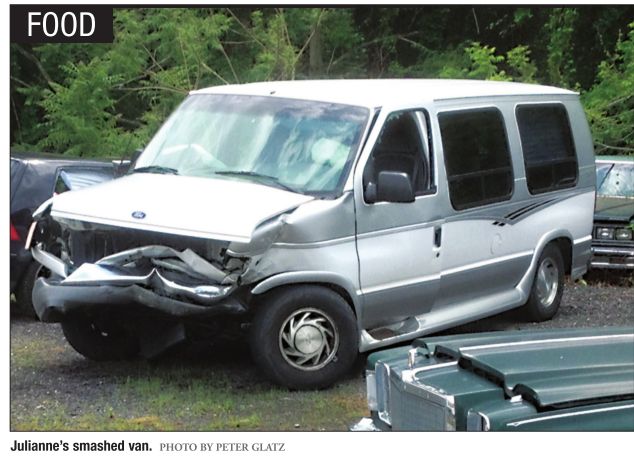
Minutes – which seemed like hours – after the van stopped, I unhitched my seatbelt, and got out. The van had spun 180 degrees around, and now faced the road I’d turned from. The front and its engine were totally smashed. The driver’s side window had crumbled, and I was covered with its bits. At the time I didn’t know for sure, but I knew it would be bad. I couldn’t pull the key from the lock and the airbags inflated – I never saw the entire front until I went to where it had been towed, but the front was completely smashed in. Even then it wasn’t “official” for a few days, but little as I know about cars, it was obvious even to me that it was totaled. And even if could have been repaired, it was certainly not going to be drivable anytime soon. The black car was several hundred yards further down. Though the intersection had been empty, soon there were flashing lights, EMTs, first responders and onlookers.
A few miles earlier, I’d stuck my wallet in a side door compartment after paying the PA turnpike exit fee. Now it and its scattered cards, cash and other contents were on the pavement. After collecting them, I walked to the road’s side. Blood was staining my shirt; someone quickly bandaged my hand.
Something glittered on the pavement: it was one of my glasses’ lenses. I hadn’t realized it had fallen out. Retrieving it, I saw a credit card I’d missed.
Someone walked by, shaking his head, “Young driver, not wearing a seat belt, going too fast. She [the other driver] probably has a broken nose.” An EMT at my side asked if I needed to go to a hospital. I shook my head, no.
As soon as I’d reached the pavement’s edge, I started calling my family. My first call was to my son Robb: he’d planned to travel from Boston to NYC for the holiday weekend. If he was still there, he’d be able to come more quickly than anyone. My Brooklyn kids don’t own a car; they rent one as needed in their apartment’s garage. But Robb had decided to stay in Boston, getting things done before joining us for our camping trip. Even so, when I told him what happened, he dropped everything and began the six-to-seven hour trip south.
The state trooper joked about his horrible handwriting while giving me a torn-off notebook sheet (with hanging chads) of contact information. The EMT repeatedly asked if I needed to go to the hospital; eventually I realized he was telling me I should. I wasn’t badly hurt, but was shaking from head to toe. And so I had my first-ever ambulance ride.
It was a 30-minute trip to the hospital. My blood pressure and heart rate were slightly elevated, but not alarmingly so; the EMT cheerfully said he’d seen far worse.
The ER staff diagnosed that the bleeding came from a scraped elbow and hand cuts too small to require stitches, or even band-aids. X- rays ruled out concussion; I was directed to the exit/waiting room.
Still
shaking, I faced my situation’s complexities. Being involved in a car
crash is inherently awful. Being involved in a crash hundreds of miles
from home is worse. Being involved while traveling in a van crammed with
camping supplies made a solution seem impossible.
The
worst complicating factor was the holiday. Having taken my computer bag
in the ambulance. I started to-do lists, trying to decipher the
trooper’s handwriting. Excepting my computer and my blood-stained
clothes, everything else was in the van. I had to get to it.
But
my cell-phone calls universally met with answering machines. Car rental
agencies were closed. Everything relating to the accident was strung
along a succession of small towns: the accident in Fredricksburg was 20
miles west from the troopers’ Jonestown station. I was at Lebanon’s Good
Samaritan Hospital, another 20 miles away, the van was in Grantsvillle,
some 30 miles west. Eventually someone from the towing company called
back: “Yeah, you let me know when you’ll be here, and somebody’ll go
open the gates.” Swell.
“I’d planned from the beginning to pay her for her help. But as we
talked, I became certain she wouldn’t accept anything, and I was right.
I’d also become convinced that she didn’t really live nearby, and just wanted to help me.”
When
my cell phone and computer batteries needed charging, I moved to the
empty security desk. Moments later, a hefty security guy, badge
proclaiming his name as Jason, stopped by. I asked if the hospital had
an information desk, he chuckled, “Yeah, but it’s a holiday. Nobody’s
there.” But later he asked if I drank diet soda (Not usually, but I was
horribly thirsty), and brought me a can from his private stash.
While
I’d been phoning, the young woman at the emergency reception desk
deftly dealt with an incoming stream: A severely sunburnt young child, a
man’s dislocated shoulder, someone’s sister had collapsed, and so on.
Around 5 p.m., she turned to me: “I couldn’t help overhearing. Where’d
they tow your van?” I told her, and she said, “I live near there. If you
don’t mind waiting until I get off at 7, I’d be happy to take you. And I
could take you to a nearby hotel afterwards.” I gratefully accepted.
Sometime
later she said, “I should introduce myself: I’m Stephanie.” As the
clock crawled towards 7, some folks who I’d seen coming in left,
offering me best wishes as they were wheeled out.
I learned a lot about
Stephanie during that drive. That she’d graduated from a nearby
university and lived with her parents. That she was leaving soon to move
to Delaware for a public relations (her major) position, and to be
closer to her long-time boyfriend. That her parents were schoolteachers.
By the time we reached the van, I felt as if I’d known her for years.
But
my respect and liking for Stephanie increased exponentially as we drove
through the opened gates. It was immediately clear this wasn’t a car
body shop. It was a car graveyard. Stephanie had to make a second
pass-through before I found the van: its front was mangled beyond
recognition. I’d spent the afternoon feeling lucky I hadn’t been
seriously injured; now I was grateful to be alive.
I
have bum knees, and couldn’t have retrieved my suitcase and garment bag
from the van’s rear. Stephanie clambered over tumbled plastic
containers to get them. Then she drove me to that nearby hotel, insisted
on loading my luggage onto a cart, accompanied me to my room, and
unloaded the luggage.
I’d planned from the beginning to pay her for her help. But as we
talked, I became certain she wouldn’t accept anything, and I was right.
I’d also become convinced that she didn’t really live nearby, and just
wanted to help me. I confirmed that with an atlas after I got home.
Robb reached me shortly before midnight.
The
next day, we rented a U-Haul. In 90-plus sweltering, humid degrees,
Robb did the yeoman’s work of transferring the van’s contents before
heading home. My husband spent frustrating hours at O’Hare as flights
were canceled because of violent thunderstorms sweeping the Eastern
Seaboard. It took more than 12 hours for him to reach me. The next day
we headed back to Springfield.
It’s
been hard to stop the endless loop of the accident running through my
head; sometimes I still shake when thinking about it. But I also
remember the kindness of those strangers: the folks who stopped to help
immediately after the accident, the ER staff, Jason the security guard,
and most especially of all, Stephanie.
Contact Julianne Glatz at [email protected].
For Julianne’s recipe of Pennsylvania Dutch Shoofly Pie, please go to www.Illinoistimes.com


