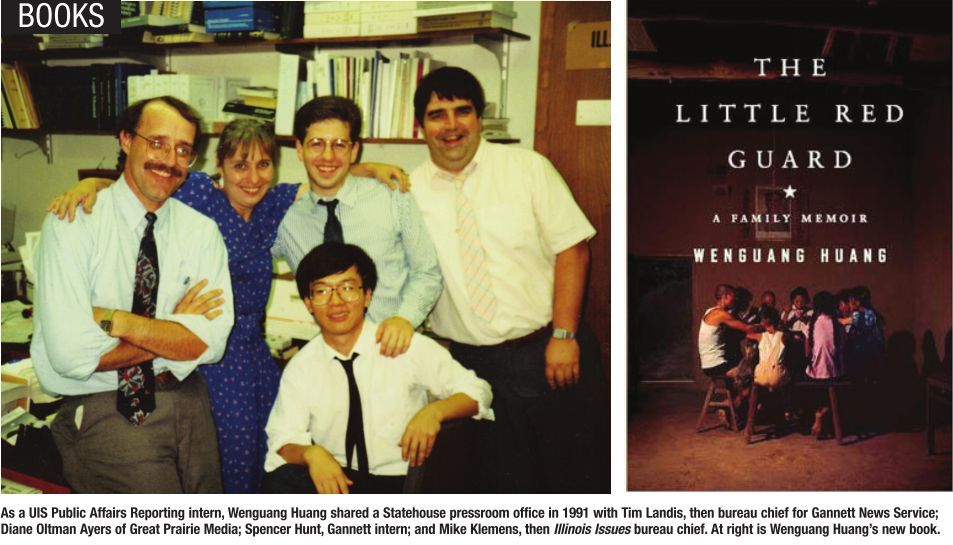
UIS commencement speaker and former student portrays life in The Little Red Guard
BOOK REVIEW | Mary Bohlen
 I thought I knew the story
of Wenguang Huang, who will be the commencement speaker at the
University of Illinois Springfield May 12. After all, I’ve known Wen for
21 years, first as my student at UIS and later as a dear family friend.
He met my extended family, picked apples in my husband’s orchard and
even flew from Chicago to Boston for my son’s wedding.
I thought I knew the story
of Wenguang Huang, who will be the commencement speaker at the
University of Illinois Springfield May 12. After all, I’ve known Wen for
21 years, first as my student at UIS and later as a dear family friend.
He met my extended family, picked apples in my husband’s orchard and
even flew from Chicago to Boston for my son’s wedding.
I
was wrong. Sure, I knew he had grown up in China during the Cultural
Revolution, was involved in student protests at the time of Tiananmen
and had embraced democracy after a short time in the United States. Not
until I read his just-published and captivating memoir did I realize the
extent of his journey.
Most of all, I did not know he had been the keeper of his grandmother’s coffin, a fact that stands at the center of The Little Red Guard.
In
the book, Wen details his life in Maoist China and his family’s
conflict over clinging to the old Confucian ways or embracing communism.
Nothing represents this divide more than his grandmother’s wish to be
buried in her home village and the government’s mandate for cremation,
her worst fear. Wen’s father risks his standing in the party, the
family’s finances and his wife’s anger to honor, as a filial son, his
mother’s demand he have a coffin ready for her eventual departure.
Caught in the middle is the
young Wen, who dutifully spouts the communist doctrine at school but
sleeps next to his grandmother’s secret coffin for years. Outwardly he
is on the path to party membership. At home he is the favored first
grandson and loyally laps up his grandmother’s love.
“As
a ‘Little Red Guard,’ I was supposed to defend and fight for Chairman
Mao’s revolution, not to guard Grandma’s coffin,” he writes. “Each time I
looked at the Little Red Guard scarf around my neck, I felt a pang of
guilt. I was even hit with a fleeting thought of reporting it to my
teacher. Then, the idea of seeing Father being paraded publicly deterred
me. Besides, Grandma would die of a broken heart and nobody would take
care of me.”
Increasingly
this contradiction, what he calls “a fusion of ideologies and faiths,”
causes him to question his beliefs. So do others as China experiences
the death of Mao, disenchantment with other party leaders, student
protests and eventually economic changes. Wen comes to view China in a
new light when his superior academic standing sends him to study in
Shanghai, in Great Britain and eventually in Springfield, Ill.
Despite
distancing himself from his homeland, Wen can’t shake free of his home.
After years of suppressing the tension among his father, mother and
grandmother, symbolized by the empty coffin in the room, Wen allows his
memories to break free in this coming-ofawareness memoir. It reads like a
novel as he journeys through the changes in his country and himself.
He
paints vivid portraits of his mother coping with three generations in a
two-room house, his father’s loyalty to hard work and communist ideals
and his grandmother’s tiny bound feet. His three siblings get little
attention until late in the book, but then this is Wenguang Huang’s
story. His story is one I am now, and others soon will be, happy to
know.
Mary Bohlen
taught thousands of students, including Wenguang Huang, at SSU/UIS
before retiring in August. She is now a freelance writer and editor.


